
Top Reasons Your Florida Home Needs Mold Testing (And What To Do Next)
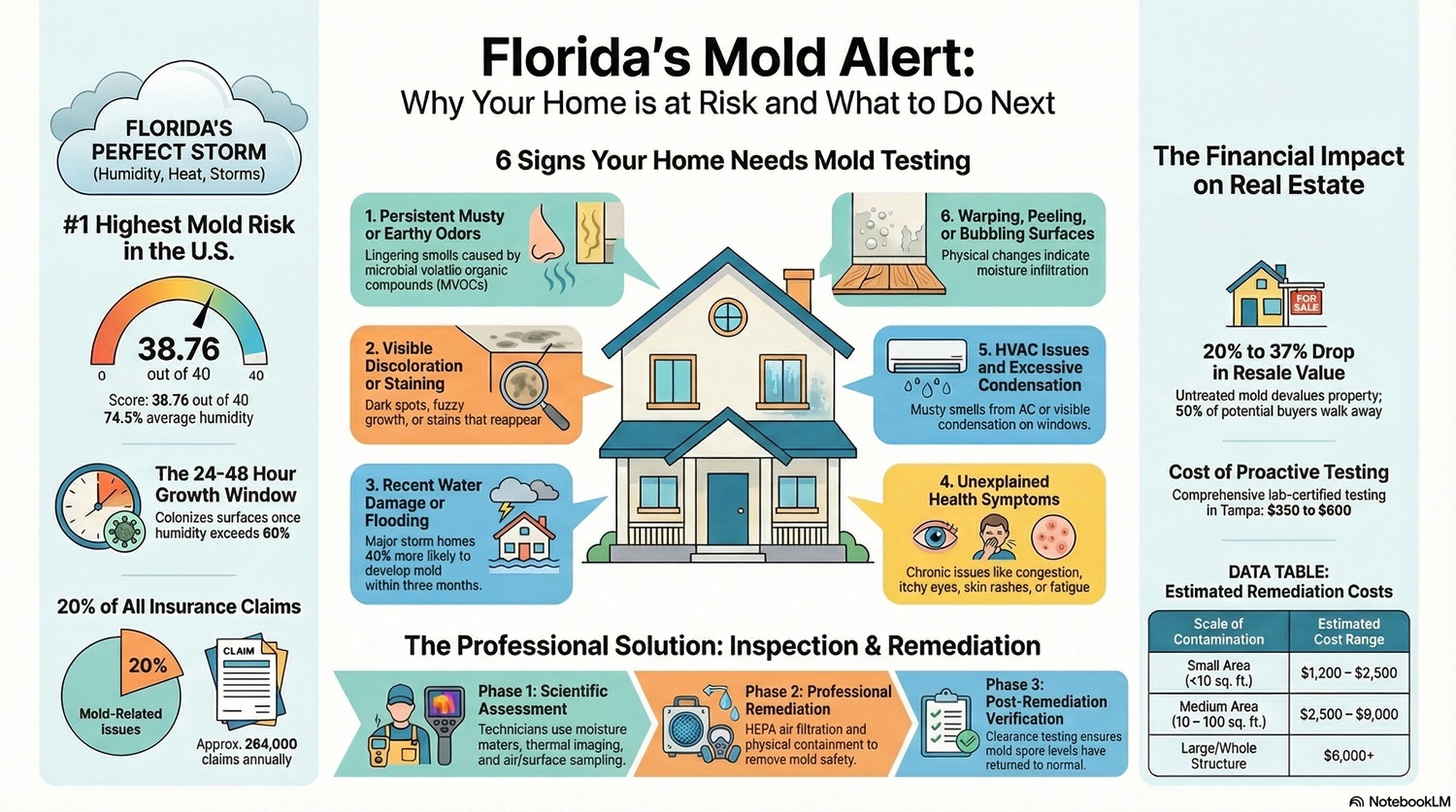
Recognizing the top signs your Florida home needs mold testing could protect both your family’s health and your property’s value. Florida ranks #1 in the nation for mold risk, scoring 38.76 out of 40 on the National Mold Index, driven by the state’s relentless heat, 74.5% average humidity, and aging housing stock — making mold testing not just a precaution, but a genuine necessity for homeowners throughout the region, including those seeking mold testing Tampa professionals.
Key Takeaways
| Question | Answer |
|---|---|
| What is the most common sign of mold in a Florida home? | A persistent musty or earthy odor, especially in closed rooms, is the most frequently reported early sign of hidden mold growth. |
| How quickly can mold grow after water damage in Florida? | Mold can begin colonizing surfaces in as little as 24 to 48 hours once indoor humidity exceeds 60%, which is common in Florida’s climate. |
| How much does a mold inspection in Tampa cost? | A visual mold inspection Tampa is often free. A comprehensive inspection with lab testing starts at approximately $350, with full mold testing lab analysis ranging from $350 to $600. |
| Is black mold dangerous? | Yes. Black mold (Stachybotrys chartarum) can cause serious respiratory issues and requires immediate professional attention and lab confirmation. |
| What should I do after mold is found in my Florida home? | Contact a licensed mold remediation Tampa professional immediately. Do not disturb visible mold before containment is established. |
| Can mold affect a Florida home’s resale value? | Yes. Undisclosed or untreated mold can reduce a home’s resale value by 20% to 37%, making proactive testing essential before listing. |
| Who provides mold testing and inspection services in Tampa? | Tampa Bay Mold & Remediation offers certified mold testing, inspection, and removal services throughout the Tampa Bay area. |
Why Florida’s Climate Makes Knowing the Top Signs Your Florida Home Needs Mold Testing So Critical

Florida’s combination of year-round warmth, persistent humidity, and seasonal flooding creates what experts call a “perfect storm” for mold proliferation. Unlike colder climates where mold growth slows in winter, Florida homes face continuous mold pressure throughout all twelve months of the year.
Understanding the specific indicators that trigger the need for mold testing Tampa professionals is the first step toward protecting your household. Many of these signs are subtle, and waiting until mold becomes visible often means the problem has already spread significantly behind walls, beneath flooring, or inside HVAC systems.
In 2026, the combination of recent storm activity and rising insurance scrutiny has made early mold detection more important than ever. Mold-related claims account for over 20% of all home insurance claims filed in the state of Florida, representing an estimated 264,000 claims annually, which underlines just how widespread and costly this issue has become for Florida homeowners.
This infographic highlights five key signs your Florida home may need mold testing. Use these indicators to decide when to call a professional.
Sign #1: Persistent Musty or Earthy Odors in Your Home
A musty, earthy, or stale odor that lingers even after cleaning is one of the most reliable top signs your Florida home needs mold testing. This odor is produced by microbial volatile organic compounds (MVOCs), which are released as mold colonies metabolize organic material behind walls, under floors, or inside ceilings.
Many homeowners assume the smell is simply “old house” odor or a product of Florida’s general humidity. That assumption can be costly.
Approximately 47% of residential buildings show visible signs of mold or a detectable moldy odor, making a persistent smell a statistically reliable indicator that a professional assessment is warranted. If the odor concentrates in specific rooms such as bathrooms, laundry areas, or rooms adjacent to exterior walls, this is a particularly urgent sign.
“Mold thrives in moist environments, making Florida’s humid climate an ideal breeding ground. A musty odor is rarely coincidental — it is often the first communication your home sends before the problem becomes visible.”
If you detect this odor consistently and cannot locate an obvious source, scheduling a mold inspection Tampa is the appropriate next step. Our technicians use moisture meters and air sampling to locate the source with precision.
Sign #2: Visible Discoloration, Dark Spots, or Surface Staining
Visible discoloration on walls, ceilings, grout lines, or around window frames is among the most direct top signs your Florida home needs mold testing. Mold presents in a variety of colors including black, green, gray, white, and even pink or orange, depending on the species and surface.
Do not assume that a small visible patch is the full extent of the growth. For every surface spot you can see, a much larger colony may exist behind the wall cavity or underneath flooring material.
Surface staining that reappears after cleaning is a particularly strong indicator. If you have repeatedly cleaned a spot and it returns within days or weeks, the underlying moisture source is still active, and mold growth is almost certainly ongoing. This is when a professional mold inspectionm in Tampa is not optional — it is necessary.
White or fuzzy growth on drywall, wood framing, or bathroom caulking should be sampled and confirmed by a laboratory. Our team collects surface swabs and sends them for certified lab analysis to identify the specific mold species and concentration levels present.
Sign #3: Your Home Has Experienced Water Damage or Flooding
Past or recent water damage is one of the most significant top signs your Florida home needs mold testing. Whether the source is a burst pipe, a roof leak, hurricane flooding, or a slow drip behind a dishwasher, any water intrusion that was not dried completely within 24 to 48 hours creates conditions favorable to mold growth.
In Florida, where tropical storms and hurricanes are a consistent reality, this sign applies to thousands of homes across the region every year.
Homes affected by hurricanes or major storms are 40% more likely to develop mold issues within three months of water exposure. Even if a home appeared dry after cleanup, hidden moisture within wall cavities, subflooring, and insulation can sustain mold colonies for months before visible symptoms appear.
If your home sustained any water intrusion event in the past 90 days and did not undergo professional drying and follow-up mold testing, scheduling a mold testing Tampa assessment in 2026 is strongly advised. Early detection at this stage prevents significantly more costly remediation later.
Did You Know?
Homes affected by hurricanes or major storms are 40% more likely to develop mold issues within three months of water exposure — even when no mold was initially visible after cleanup.
Source: CBS News
Sign #4: Unexplained or Recurring Health Symptoms Among Family Members
When household members experience persistent or recurring health symptoms without a clear medical explanation, hidden mold may be a contributing factor. This is one of the more frequently overlooked top signs your Florida home needs mold testing, because the connection between the indoor environment and health symptoms is not always immediately apparent.
Common mold-related health symptoms include the following:
-
Chronic nasal congestion or runny nose
-
Persistent coughing or throat irritation
-
Itchy or watery eyes
-
Skin rashes or hives without a known allergen source
-
Worsening asthma or respiratory conditions
-
Fatigue and headaches that improve when away from home
-
Neurological symptoms in cases involving black mold Tampa species such as Stachybotrys
Prolonged exposure to mold can lead to various health issues, including allergies, respiratory problems, and in severe cases, systemic illness. If symptoms consistently improve when family members are outside the home or traveling, the indoor environment should be assessed promptly.
A comprehensive mold inspection and testing service, including air quality sampling, can confirm whether airborne spore concentrations are elevated and identify the responsible mold species.
Sign #5: Excessive Condensation, High Indoor Humidity, or HVAC Issues
Visible condensation on windows, walls, or pipes is a clear signal that indoor humidity levels are elevated beyond safe thresholds. In Florida, the recommended indoor relative humidity level is between 40% and 60%. When humidity consistently exceeds this range, mold can begin colonizing surfaces within 24 to 48 hours.
HVAC-related signs are particularly important for Florida homeowners. A poorly maintained air conditioning system can accumulate moisture within the air handler, ductwork, and drain pan, creating a distribution network that spreads mold spores throughout the entire home.
Watch for the following specific indicators related to humidity and HVAC systems:
-
Condensation forming on interior window surfaces regularly
-
Wet or damp spots on walls near air vents
-
Musty odors emanating from vents when the AC runs
-
AC drain pan that is frequently full or overflowing
-
Allergy-like symptoms that worsen when the air conditioning is on
-
Visible discoloration around air supply vents or return grilles
If any of these signs are present, mold testing Tampa that includes air sampling from within your ductwork is recommended. Mold inside an HVAC system requires specialized remediation to prevent recontamination of the entire living space.
Sign #6: Warping, Peeling, or Bubbling Surfaces
Physical changes to building materials such as warped drywall, bubbling paint, peeling wallpaper, or buckled flooring are structural signals that moisture has infiltrated the material. Where moisture persists, mold follows.
These surface changes occur because moisture is being absorbed and released repeatedly, often indicating a slow or hidden leak that has been active for weeks or months. By the time these visual changes appear, mold growth behind the surface is highly probable.
Thermal imaging technology allows our technicians to detect temperature differentials caused by trapped moisture behind walls without any destructive investigation. This non-invasive approach is one of the most effective tools available during a professional mold inspection Tampa assessment.
If your home shows any of these structural changes, particularly after periods of heavy rain or humidity, do not delay scheduling a professional evaluation. The longer moisture-damaged materials remain in place, the greater the mold colony’s potential to expand.
Understanding Black Mold Tampa Homeowners Should Know About

Among all mold species, black mold Tampa homeowners most frequently ask about is Stachybotrys chartarum, commonly known as “toxic black mold.” This species is particularly dangerous because it produces mycotoxins that can cause serious respiratory and neurological health effects with prolonged exposure.
Black mold typically appears as a slimy, dark greenish-black growth on surfaces that have experienced chronic moisture exposure, such as drywall behind leaking pipes or ceiling tiles beneath a slow roof leak.
It is important to note that not all black-colored mold is Stachybotrys, and not all dangerous mold is black. Color alone is not a reliable diagnostic indicator. Laboratory testing is the only way to confirm the species present and the concentration levels in your air and on surfaces.
If you suspect black mold Tampa may be present in your home, do not attempt to clean or disturb it without professional guidance. Disturbing an active black mold colony without proper containment releases large volumes of spores into the air, dramatically worsening the contamination. Contact our Tampa Bay black mold removal specialists for a safe, thorough assessment.
How to Identify the Top Signs Your Florida Home Needs Mold Testing Before Buying or Selling
If you are preparing to purchase or list a Florida home, mold testing is not a luxury — it is a financial safeguard. A home’s resale value can drop by 20% to 37% if mold issues are discovered during a sale, and 50% of buyers will walk away entirely if a history of mold is revealed after the fact.
For buyers, understanding the top signs your Florida home needs mold testing before closing can prevent inheriting a costly problem. Request a professional mold inspection as part of your due diligence process, particularly for homes that have experienced any of the following:
-
Previous hurricane or flood damage disclosed in the property history
-
Visible staining or discoloration in bathrooms, kitchens, or laundry areas
-
Strong odors noticed during the property walkthrough
-
Homes that have been vacant for extended periods
-
Properties with aging HVAC systems or unverified duct cleaning history
-
Any building with a basement, crawl space, or enclosed slab moisture concerns
For sellers, proactive mold testing Tampa before listing gives you the opportunity to address issues before they become negotiation leverage for buyers. Transparent disclosure, backed by a clean mold testing report, builds buyer confidence and supports your asking price.
Did You Know?
A home’s resale value can drop by 20% to 37% if mold issues are discovered during a sale — and 50% of buyers will walk away entirely if a history of mold is revealed.
Source: Florida Department of Health
What to Expect During a Professional Mold Inspection Tampa Service
When you schedule a professional mold inspection Tampa service with our team, the process follows a structured, scientific methodology designed to give you the most complete picture of your home’s mold status. Here is what the process involves, step by step:
-
Initial Consultation: We discuss your concerns, review any known water damage history, and identify priority areas for assessment.
-
Visual Inspection: Our technician performs a thorough room-by-room visual survey, checking common mold-prone areas including bathrooms, kitchens, crawl spaces, attic spaces, and areas adjacent to exterior walls.
-
Moisture Detection: We use calibrated moisture meters to identify elevated moisture levels within walls, floors, and ceilings that are not visible to the eye.
-
Thermal Imaging: Where warranted, infrared thermal imaging is deployed to detect temperature differentials caused by trapped moisture behind building materials.
-
Air Sampling: We collect air samples from affected and control areas of your home. These are sent to a certified laboratory for analysis of mold species and spore concentration levels.
-
Surface Sampling: Swab or tape-lift samples are collected from any visible discoloration for lab identification and confirmation.
-
Detailed Report: You receive a comprehensive written report documenting findings, lab results, identified moisture sources, and recommended next steps.
A visual inspection is offered at no charge. A comprehensive inspection with lab testing starts at approximately $350, and full mold testing lab analysis ranges from $350 to $600 depending on property size and the number of samples required.
Mold Remediation Tampa: What Happens After Testing Confirms a Problem

If your mold testing results confirm contamination, mold remediation Tampa professionals will develop a customized remediation plan based on the extent and location of the growth. The scope of remediation is directly determined by the findings from your inspection and lab results.
Our mold remediation Tampa process follows industry-standard protocols and includes the following key phases:
-
Containment: Affected areas are sealed using physical barriers and negative air pressure to prevent spore migration to unaffected parts of the home.
-
HEPA Air Filtration: High-efficiency air scrubbers with HEPA filtration are deployed to capture airborne spores during the entire removal process.
-
Mold Removal Tampa: Contaminated materials are safely removed and disposed of according to regulatory guidelines. Non-porous surfaces are treated and cleaned using EPA-registered antimicrobial agents.
-
Structural Drying: The moisture source is addressed and affected structural elements are dried to safe levels before any restoration work begins.
-
Post-Remediation Verification Testing: After mold removal Tampa is complete, we conduct clearance testing to confirm that mold spore levels have returned to normal ambient levels.
Mold remediation Tampa costs vary based on the extent of contamination. Small area remediation (under 10 square feet) typically ranges from $1,200 to $2,500. Medium-scale remediation (10 to 100 square feet) ranges from $2,500 to $6,000. Large-scale or whole-structure remediation starts at $6,000 and above. For full details, visit our mold remediation resource center.
Preventing Future Mold Growth After Mold Removal Tampa Is Complete
Completing a mold removal Tampa project is only part of the solution. Without addressing the underlying moisture conditions that allowed mold to grow in the first place, recurrence is likely. Effective prevention requires a combination of environmental controls and regular maintenance.
We recommend the following preventive measures for all Florida homeowners following mold removal Tampa services:
-
Maintain indoor relative humidity between 40% and 60% using a calibrated hygrometer and, if necessary, supplemental dehumidification.
-
Service your HVAC system at least twice per year, including drain pan cleaning, coil cleaning, and duct inspection.
-
Ensure all bathroom exhaust fans vent to the exterior of the home, not into attic spaces.
-
Fix any plumbing leaks promptly. Even minor drips under sinks can sustain mold growth indefinitely.
-
Inspect your roof after every significant storm and address any breaches within 24 hours.
-
Ensure proper grading around your home’s foundation to direct rainwater away from the structure.
-
Schedule an annual mold prevention assessment to catch early warning signs before they develop into full contamination events.
Identifying and addressing moisture issues is crucial since mold thrives in moist environments. Prevention is always significantly less costly than remediation, and routine vigilance is the most effective long-term strategy for Florida homeowners.
Conclusion: Act on the Top Signs Your Florida Home Needs Mold Testing Without Delay
Florida’s climate means that recognizing the top signs your Florida home needs mold testing is one of the most important responsibilities homeowners in this state carry. From persistent musty odors and visible discoloration to past water damage, unexplained health symptoms, and high indoor humidity, each of these signs represents a genuine call to action.
Early detection through professional mold testing Tampa and mold inspection Tampa services is consistently less expensive, less disruptive, and less damaging to your health and property than waiting for a problem to become undeniable.
Whether you are concerned about black mold Tampa after a storm, need professional mold remediation Tampa following a confirmed contamination, or simply want the peace of mind that comes from a certified clean air report, our team is equipped and ready to help.
We understand the urgency of mold remediation and strive to provide prompt, professional service throughout the Tampa Bay area. Our approach is thorough, scientific, and transparent — because your family’s safety and your home’s integrity are what matter most.
Contact us today to schedule your inspection, or learn more about our complete mold inspection services and mold remediation services available to Florida homeowners in 2026.
Frequently Asked Questions
What are the top signs your Florida home needs mold testing right now?
The most reliable top signs your Florida home needs mold testing include persistent musty odors that do not clear after cleaning, visible dark spots or discoloration on walls and ceilings, unexplained health symptoms that improve when you leave the home, and any recent water damage or flooding. High indoor humidity and warped or peeling building surfaces are additional indicators that warrant immediate professional assessment.
How long does a professional mold inspection Tampa take?
A standard mold inspection Tampa service typically takes between one and three hours, depending on the size of the property and the number of areas being assessed. Lab results from air and surface samples generally take an additional three to five business days to return from the certified laboratory.
Is black mold in Tampa more dangerous than other mold types?
Black mold Tampa residents most commonly fear, Stachybotrys chartarum, does produce mycotoxins that can cause serious respiratory and neurological health effects. However, color alone cannot confirm the species — laboratory testing is required to identify whether black mold is present and at what concentration levels.
How much does mold testing Tampa cost in 2026?
Mold testing Tampa services in 2026 typically range from $350 to $600 for lab-certified air and surface sampling, depending on the size of the property and the number of samples required. A basic visual inspection is often provided at no charge, with comprehensive inspection and testing starting at approximately $350.
Can I stay in my home during mold remediation Tampa?
Whether you can remain in the home during mold remediation Tampa work depends on the extent and location of the contamination. For small, contained remediation projects, staying in unaffected areas may be possible. For larger or whole-home remediation projects, temporary relocation is typically recommended for health and safety reasons, particularly for children, elderly individuals, or those with respiratory conditions.
How do I know if mold removal Tampa was successful?
Successful mold removal Tampa projects are verified through post-remediation clearance testing, which involves collecting air and surface samples after the remediation work is complete and confirming through laboratory analysis that mold spore levels have returned to normal ambient concentrations. Our team recommends this verification testing as part of every remediation project.
Should I get a mold inspection Tampa before buying a Florida home in 2026?
Yes, a professional mold inspection Tampa is strongly recommended before purchasing any Florida property in 2026. Given Florida’s high mold risk ranking and the significant impact mold can have on property value — potentially reducing it by 20% to 37% — a pre-purchase inspection is one of the most financially sound steps a buyer can take during the due diligence process.