
Mold Inspection in Tampa: 5 Authoritative Articles On Mold Related Issues For Homeowners

Mold Inspection in Tampa: 5 Authoritative Articles On Mold Related Issues For Homeowners

May 4, 2026

Mold_Inspection_in_Tampa__5_Authoritative_Articles_On_Mold_Related Issues


Mold Inspection in Tampa – 5 Mold Inspection Articles | TampaBayMold.net

Content Collection · Mold Inspection Series

A collection of 5 blog articles targeting "mold inspection in Tampa" — each structured to answer important issues regarding mold

MOLD INSPECTION IN TAMPA, FL Why Florida's Humidity Makes It Essential

Why Mold Inspection in Tampa Is Non-Negotiable for Homeowners

Florida's subtropical climate creates near-perfect conditions for mold growth year-round. Here's what every Tampa homeowner needs to know before it's too late.

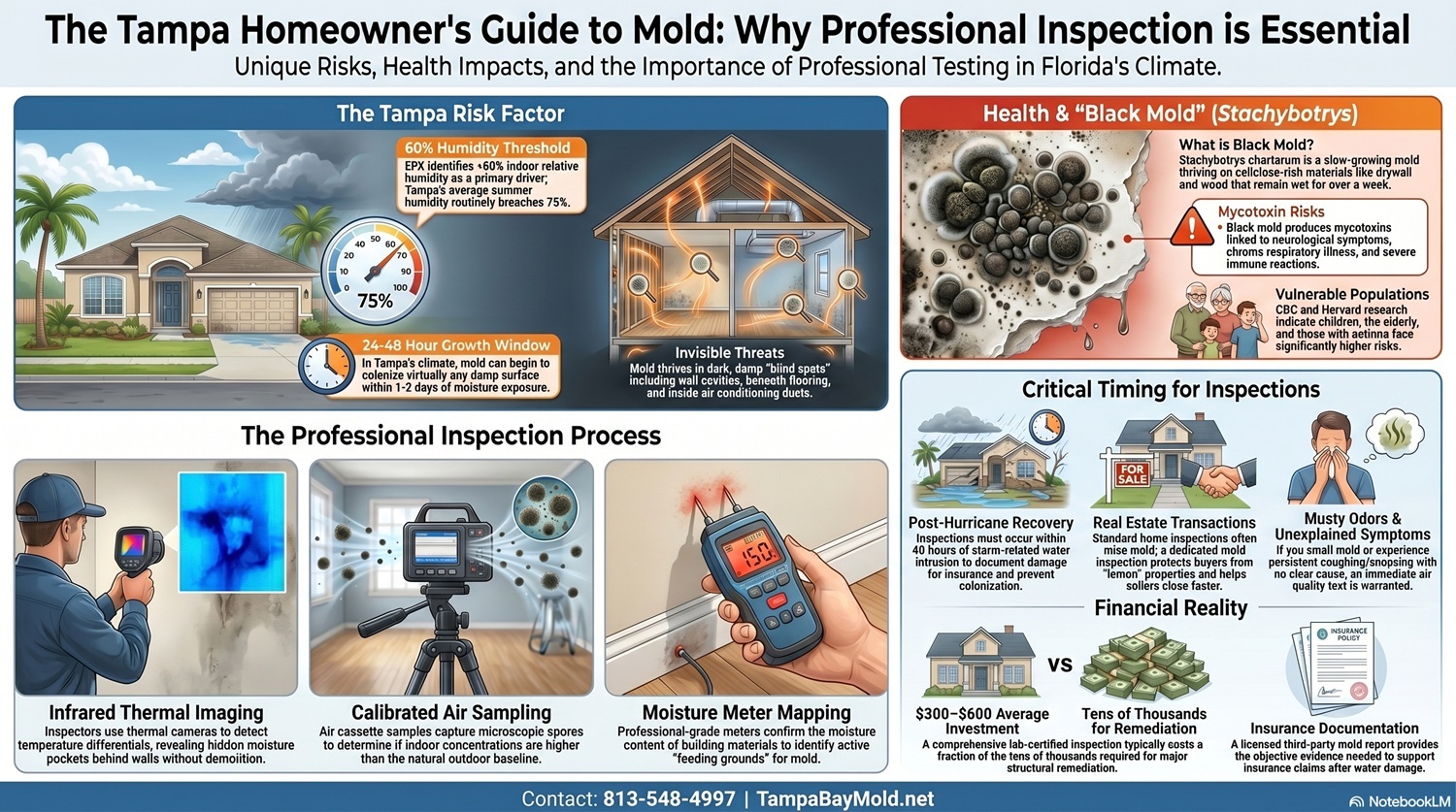
If you own a home or business in Tampa, mold is not a hypothetical threat — it is a year-round reality. Tampa Bay's subtropical climate, characterized by average summer humidity above 75% and frequent afternoon thunderstorms, creates ideal conditions for mold to colonize virtually any damp surface within 24 to 48 hours. For the region's estimated 1.3 million households, scheduling a professional mold inspection in Tampa is one of the smartest investments a property owner can make.

What Makes Tampa Uniquely Vulnerable

The U.S. Environmental Protection Agency (EPA) identifies indoor relative humidity above 60% as a primary driver of mold growth. In Tampa, that threshold is routinely breached — not just in summer, but during the rainy season that stretches from June through September. Add to that the city's aging housing stock, the prevalence of hurricane-related water intrusion, and the widespread use of air conditioning systems that can harbor condensation, and you have a city perpetually on the edge of a mold problem.

Mold does not simply look unpleasant. The Centers for Disease Control and Prevention (CDC) warns that mold exposure can trigger nasal stuffiness, throat irritation, coughing, wheezing, skin irritation, and eye irritation. For individuals with asthma, compromised immune systems, or pre-existing respiratory conditions, the health stakes are significantly higher. Children and the elderly face the greatest risk.

What a Professional Mold Inspection Includes

Many Tampa homeowners assume that if they cannot see mold, it is not there. This is one of the most dangerous misconceptions in property maintenance. Mold thrives behind drywall, beneath flooring, inside HVAC ducts, and within wall cavities — invisible until the colony is advanced enough to cause structural damage or serious health symptoms.

A certified mold inspection typically involves a thorough visual assessment, infrared thermal imaging to detect hidden moisture pockets, moisture meter readings, air sampling, and surface swab tests sent to an accredited laboratory. The inspector documents findings in a detailed report and, when warranted, provides a remediation protocol.

TampaBayMold.net — based at 550 N. Reo St., Suite #300, Tampa, FL — offers professional mold inspection services throughout the Tampa Bay region. Their certified inspectors use professional-grade moisture detection equipment and provide lab-certified air and surface sampling results. They offer free visual consultations, with comprehensive lab testing packages typically ranging from $300–$600 depending on property size. Visit TampaBayMold.net or call for a free visual inspection today.

When to Schedule a Mold Inspection in Tampa

There are clear trigger points that should prompt immediate action: a musty odor with no obvious source, visible discoloration on walls or ceilings, a history of water damage or flooding, unexplained respiratory symptoms among occupants, or the purchase or sale of a property. Post-hurricane inspections are especially critical — floodwaters carry a wide range of mold spores that can colonize interior surfaces within two days if materials are not thoroughly dried.

"By the time you see or smell mold, the problem is often much bigger than it appears." — TampaBayMold.net

For real estate transactions, a mold inspection in Tampa can mean the difference between a clean closing and a costly discovery after the fact. Buyers are increasingly requesting mold inspection contingencies, and sellers who proactively inspect and remediate are better positioned in a competitive market.

The Florida Department of Health requires mold assessors and remediators to be licensed under Chapter 468 of Florida Statutes, ensuring that qualified professionals handle what is ultimately a public health matter. When selecting an inspector, verify their state license and ask about their adherence to IICRC (Institute of Inspection, Cleaning and Restoration Certification) standards.

Tampa Bay homeowners who invest in annual mold inspections, particularly after storm season, are far less likely to face the exponential cost of extensive remediation, structural repair, or health-related expenses down the road. Prevention through inspection is always cheaper than remediation after the fact.

THERMAL IMAGING · MOISTURE DETECTION · BLACK MOLD TESTING TampaBayMold.net — Professional Mold Inspection in Tampa, FL

Black Mold in Tampa Homes: What Inspection Can Reveal Before It Harms Your Family

Stachybotrys — the mold species known as "black mold" — produces mycotoxins linked to serious health effects. A professional mold inspection in Tampa is the only reliable way to detect it early.

Few words alarm a Tampa homeowner more than "black mold." While the fear is sometimes overstated, the underlying health concern is real and scientifically documented. Stachybotrys chartarum — the species most commonly called black mold — produces mycotoxins that can cause neurological symptoms, chronic respiratory illness, and severe immune reactions in sensitive individuals. In Tampa's persistently humid environment, conditions that foster black mold growth are widespread and often hidden from view.

Understanding What Black Mold Actually Is

Stachybotrys is a slow-growing mold that thrives on cellulose-rich materials — drywall paper, wood framing, ceiling tiles, and cardboard — that have been continuously wet for more than a week. This is precisely why post-hurricane flooding and chronic roof leaks in Tampa homes are such significant risk factors. The mold may not be visible for weeks, establishing itself inside wall cavities and beneath flooring long before any discoloration or odor becomes apparent.

It is important to note that not every dark-colored mold is Stachybotrys. Aspergillus, Cladosporium, and Penicillium can all appear in shades of green, gray, or black, and all pose their own health risks. Only laboratory analysis of air or surface samples collected during a professional mold inspection can definitively identify the species present.

Health Effects of Black Mold Exposure

Research published by the National Institute for Occupational Safety and Health (NIOSH) estimates that nearly 47% of U.S. homes show signs of mold or dampness — with coastal, high-humidity environments like Tampa Bay consistently above the national average. The health effects of long-term mold exposure range from persistent coughing and sneezing to more serious conditions including chronic sinusitis, asthma exacerbation, and in rare cases of extreme exposure, pulmonary hemorrhage.

Children's developing immune systems make them especially vulnerable. A landmark study by Harvard T.H. Chan School of Public Health found that children living in damp, moldy homes had a significantly elevated risk of developing asthma compared to those in dry, well-ventilated homes. For Tampa families, this underscores the importance of early detection through professional inspection rather than waiting for visible signs of mold.

TampaBayMold.net specializes in black mold identification and remediation throughout Tampa Bay. Their inspectors use thermal imaging cameras and calibrated moisture meters to locate hidden Stachybotrys colonies behind walls, under floors, and inside HVAC systems — areas that visual-only inspections cannot reach. All samples are sent to certified third-party laboratories, ensuring objective, legally defensible results. Learn more at TampaBayMold.net.

How a Tampa Mold Inspector Tests for Black Mold

A comprehensive black mold inspection in Tampa begins with a detailed interview about the property's moisture history, followed by a room-by-room visual assessment. Inspectors then deploy infrared thermal imaging to identify temperature differentials that indicate hidden moisture accumulation — the single most reliable early indicator of Stachybotrys growth conditions. Moisture meter readings confirm the thermal findings, and air cassette samples or direct surface swabs are collected for laboratory analysis.

Results typically return within 3 to 5 business days and include a spore count, species identification, and comparison against outdoor baseline samples collected at the same property. This baseline comparison is critical — it allows the inspector to determine whether indoor spore levels are elevated relative to natural outdoor concentrations, which is the true indicator of an active indoor mold problem.

"All mold can cause health issues for sensitive individuals, but Stachybotrys does produce mycotoxins that can be harmful — and it is rarely visible until the colony is well-established." — TampaBayMold.net

If your Tampa home has experienced any water intrusion in the past two years — whether from a roof leak, plumbing failure, storm surge, or even condensation from a poorly maintained HVAC system — a professional mold inspection is a prudent and potentially life-protecting step. The cost of testing is a fraction of the medical and remediation expenses that undetected black mold can generate over time.

FOR SALE MOLD INSPECTION RECOMMENDED REAL ESTATE MOLD INSPECTION IN TAMPA, FL Protect Your Investment · TampaBayMold.net

Buying or Selling a Tampa Home? A Mold Inspection Can Save You Thousands

In one of the nation's most mold-prone real estate markets, a professional mold inspection in Tampa is increasingly standard practice — and skipping it can be a costly mistake for buyers and sellers alike.

Tampa's real estate market has been among the most active in the United States, attracting buyers from across the country who may be unfamiliar with the unique risks posed by Florida's humidity and weather patterns. What buyers from drier climates often don't anticipate is that mold — invisible, odorless in early stages, and capable of compromising both structural integrity and indoor air quality — may already be present in the home they're about to purchase. A professional mold inspection in Tampa is not just a precaution. In this market, it is a financial imperative.

Why Standard Home Inspections Miss Mold

General home inspectors in Florida are not required to be certified mold assessors, and most standard home inspection reports explicitly disclaim responsibility for mold detection. A licensed general inspector will note visible water stains or obvious discoloration, but they will not conduct air sampling, use thermal imaging for hidden moisture, or collect surface swab samples for laboratory analysis. These limitations mean that a property can pass a general inspection while harboring significant mold growth inside wall cavities, beneath flooring, or within the HVAC system.

The Florida Department of Business and Professional Regulation (DBPR) licenses mold assessors separately from general home inspectors for exactly this reason. When a Tampa home has any history of water damage, flooding, roof leaks, or plumbing failures — and a surprising number do, given the storm activity in the region — a dedicated mold inspection by a licensed assessor is the appropriate next step.

What Buyers Should Know

For buyers, the timing of a mold inspection matters. Ideally, it should be scheduled during the inspection contingency period, allowing sufficient time to receive laboratory results before the contingency deadline. Buyers should request a full inspection that includes air sampling from multiple rooms, outdoor baseline sampling for comparison, moisture meter readings throughout the property, and a written report with remediation recommendations if mold is found.

If mold is discovered, buyers have several options: negotiate a price reduction to cover remediation costs, require the seller to remediate before closing, or — in cases of extensive contamination — walk away from the purchase entirely. Having a detailed mold inspection report from a certified professional provides the documentation needed to support any of these outcomes.

For Tampa Bay real estate transactions, TampaBayMold.net provides pre-purchase and pre-listing mold inspections with expedited reporting to meet closing timelines. Their certified assessors cover residential and commercial properties throughout Hillsborough, Pinellas, and Pasco counties. They can document mold findings for insurance claims and provide the detailed remediation protocols that lenders and title companies increasingly require. Schedule at TampaBayMold.net.

What Sellers Should Know

Proactive sellers who order a mold inspection before listing their Tampa property are in a significantly stronger negotiating position. A clean mold inspection report is a marketable asset — particularly as out-of-state buyers become savvier about Florida's mold risk. If an inspection does reveal mold, addressing it before listing allows the seller to control the remediation process, use their preferred contractor, and present a certified post-remediation verification report to buyers.

Florida law requires sellers to disclose known material defects, and mold — if the seller has reason to know it exists — qualifies as a material defect under Florida Statutes § 689.261. A pre-listing inspection protects sellers legally, demonstrates good faith, and can accelerate the closing process by removing a common source of buyer uncertainty.

"Mold damage can impact home value and inspection results. Proactive inspection before listing is always the smarter strategy." — Industry Best Practice

Whether you are buying your first Tampa home or selling a property you've owned for decades, a professional mold inspection is a relatively modest investment — typically $300 to $600 — that protects against outcomes that can cost tens of thousands of dollars to remediate after a transaction closes.

POST-HURRICANE MOLD INSPECTION IN TAMPA, FL Storm Season Preparedness · TampaBayMold.net INSPECT WITHIN 48 HRS ✓ Thermal imaging ✓ Moisture metering ✓ Air sampling ✓ Lab analysis

Post-Hurricane Mold Inspection in Tampa: The 48-Hour Window That Matters Most

After a tropical storm or hurricane strikes Tampa Bay, mold can begin colonizing wet surfaces within 24 to 48 hours. Understanding the post-storm inspection process can mean the difference between a quick recovery and a prolonged health and financial crisis.

Tampa Bay sits squarely within Florida's hurricane zone. With an average of six named storms per Atlantic hurricane season and a direct-hit probability that increases every decade, Tampa homeowners are no strangers to the aftermath of tropical weather. But beyond roof damage, flooding, and power outages lies a threat that often receives less attention in the immediate recovery period: post-hurricane mold growth. A professional mold inspection in Tampa, conducted within the critical 48-hour window after water intrusion, is one of the most effective steps a property owner can take to limit long-term damage.

Why the 48-Hour Window Is Critical

Mold does not need much time to establish itself. Under the warm, humid conditions that characterize Tampa Bay following a storm — high ambient temperatures, saturated building materials, and often no functioning air conditioning — mold spores that are naturally present in the environment can germinate and begin growing on wet surfaces in as little as 24 hours. By 48 hours, visible colonies can begin to form on drywall, carpet padding, wood framing, and insulation. By 72 hours, if wet materials have not been dried or removed, remediation becomes significantly more complex and costly.

The EPA emphasizes that the most effective mold prevention strategy after any water intrusion event is aggressive drying within 24 to 48 hours. This means industrial dehumidifiers, commercial air movers, and in many cases, removal of wet drywall, insulation, and flooring that cannot be adequately dried in place. A post-storm mold inspection in Tampa helps property owners identify exactly which materials are wet, which are at risk, and what remediation steps are required before mold takes hold.

What a Post-Storm Mold Inspection Covers

Post-hurricane inspections differ from routine mold inspections in their scope and urgency. An experienced Tampa mold inspector will prioritize identifying water intrusion points — roof penetrations, window and door gaps, foundation seepage — before assessing the interior. Thermal imaging is particularly valuable in a post-storm context, as it can reveal moisture migration paths that are not yet visible at the surface, including water that has traveled horizontally through wall assemblies or vertically through multi-story structures.

The inspector will collect moisture readings throughout the property, document all water-affected areas with photographs, and provide a prioritized drying and remediation plan. When mold is already present — even if storm impacts occurred only days ago — air and surface sampling will identify the species and concentration, information that guides remediation protocol and is often required by homeowner's insurance carriers.

After a hurricane or tropical storm, TampaBayMold.net provides rapid-response post-storm mold inspections throughout Tampa Bay. Their certified inspectors prioritize emergency scheduling for storm-affected properties, helping homeowners document damage for insurance claims and receive actionable remediation guidance before mold establishes itself. Contact TampaBayMold.net immediately after any water intrusion event — every hour counts.

Navigating Insurance After Storm-Related Mold

Florida homeowner's insurance policies vary considerably in their mold coverage, and the relationship between hurricane damage and subsequent mold growth is an area where disputes between policyholders and insurers are common. A professionally documented mold inspection report — completed promptly after the storm and clearly linking mold presence to storm-related water intrusion — is the strongest evidence a homeowner can present to support an insurance claim.

FEMA guidance for post-disaster mold remediation recommends that all water-damaged materials be removed within 24 to 48 hours when possible, and that homeowners document every step of the cleanup process with photographs and written records. A third-party mold inspection conducted by a licensed assessor provides an independent, objective record that neither the homeowner nor the insurance company can dispute.

"Mold can begin developing within 24 to 48 hours of moisture exposure, whether from storm damage, flooding, or condensation." — TampaBayMold.net

As Tampa Bay residents learned from the impacts of recent storm seasons, the hidden costs of post-hurricane mold — medical expenses, extensive remediation, temporary housing, and lost property value — can dwarf the initial storm damage itself. Early inspection is not just prudent; it is protective of your family's health, your property's value, and your financial recovery.

HEPA FILTRATION Air Scrubbing AIR QUALITY Spore Count: LOW Post-Remediation ✓ INDOOR AIR QUALITY & MOLD INSPECTION IN TAMPA, FL Health Protection for Tampa Families · TampaBayMold.net

Indoor Air Quality and Mold Inspection in Tampa: What the Science Says About Your Home's Air

Airborne mold spores are invisible, odorless in early stages, and potentially dangerous — especially in Tampa's high-humidity environment. Here is what Tampa residents need to know about testing indoor air quality for mold.

The air inside your Tampa home may look clean, smell neutral, and feel comfortable — and still be significantly elevated with mold spores. Indoor air quality (IAQ) is one of the most underappreciated aspects of residential health in the United States, and in Florida's subtropical climate, mold is among the most significant contributors to poor IAQ. According to the EPA, the concentration of indoor air pollutants can be two to five times higher than outdoor levels — and in homes with active mold growth, that disparity can be far greater.

How Mold Spores Affect Indoor Air Quality

Mold reproduces by releasing microscopic spores into the surrounding air. In an undisturbed environment, a mold colony may release thousands of spores per minute — spores that are small enough to remain airborne for hours and be inhaled deeply into the respiratory tract. In homes where HVAC systems are running, those spores can be distributed throughout the entire property within minutes, meaning that mold located in one room effectively contaminates the air in every room.

The American Industrial Hygiene Association (AIHA) identifies mold as one of the primary biological contaminants affecting indoor air quality, along with bacteria, dust mites, and pet dander. For the estimated 25 million Americans with asthma — and the millions more with allergic rhinitis, chronic sinusitis, or compromised immune systems — elevated mold spore counts in indoor air represent a continuous, daily health burden.

Air Sampling vs. Surface Sampling: What's the Difference?

Not all mold inspections are equal. When the goal is to assess indoor air quality, air sampling is the most relevant test. Air cassette samples, collected using calibrated pumps at a standardized flow rate and duration, capture a representative sample of airborne spores that can be analyzed under a microscope at an accredited laboratory. The resulting report shows the concentration and species composition of mold spores in the air — and crucially, compares them to an outdoor baseline sample collected at the same property.

Surface sampling — tape lifts, swabs, or bulk samples from visible mold colonies — is complementary but answers a different question. It identifies what species are growing on a surface, not what is circulating in the air. For comprehensive indoor air quality assessment, both sample types are often warranted, particularly in homes where occupants report health symptoms but no visible mold has been found.

TampaBayMold.net provides comprehensive indoor air quality testing as part of their mold inspection services throughout Tampa Bay. Their certified inspectors conduct calibrated air sampling, outdoor baseline collection, surface and swab sampling when indicated, and HVAC system assessment. All samples are analyzed by an accredited third-party laboratory, with results typically available within 3 to 5 business days. For families experiencing unexplained symptoms, TampaBayMold.net offers free initial visual consultations.

HVAC Systems and Mold in Tampa Homes

Tampa homeowners run their air conditioning systems for the majority of the year — a necessity given the region's heat and humidity. But HVAC systems that are not properly maintained can become significant mold reservoirs. The combination of cold evaporator coils, humid return air, and cellulose-containing air filters creates an ideal environment for mold growth within the air handler itself. Once mold establishes in an HVAC system, every cycle of the air handler distributes spores throughout the home.

Annual HVAC inspections — including coil cleaning, drain pan inspection, and filter replacement — are the primary preventive measure. But when HVAC contamination is suspected, a mold inspector with indoor air quality training can assess the system directly and collect samples from the supply and return registers to determine whether the HVAC is contributing to elevated indoor spore counts.

"On average, Americans spend 90% of their time indoors — and indoor air pollutant concentrations are often five times higher than outdoor levels." — U.S. Environmental Protection Agency

The relationship between healthy indoor air and overall wellbeing is well-established in the scientific literature. For Tampa residents — who face among the highest ambient mold spore counts in the country due to the region's climate — investing in periodic indoor air quality testing through a professional mold inspection is one of the most direct steps available to protect household health. Whether you have never tested your home's air quality or suspect an emerging problem, the information provided by a professional Tampa mold inspection is the foundation of informed action.

All articles produced for TampaBayMold.net — Tampa Bay's Mold Inspection and Remediation Experts.

550 N. Reo St., Suite #300, Tampa, FL 33609 · tampabaymold.net

Leave a Reply

Your email address will not be published. Required fields are marked *