
How to Choose the Best Licensed Mold Inspection Professional: A Complete Guide for Tampa Bay Homeowners
Knowing how to choose the best licensed mold inspection professional is one of the most important decisions you can make for your home and your family’s health. People who spend time in damp buildings are more likely to report health problems including respiratory symptoms, infections, worsening asthma, hypersensitivity pneumonitis, and eczema. By the time you see or smell mold, the problem is often much bigger than it appears. In a region like Tampa Bay, where Florida’s humidity creates the perfect environment for mold growth, getting the right inspector from the start is non-negotiable.
Key Takeaways
| Question | Quick Answer |
|---|---|
| What credentials should a mold inspector have? | Look for a valid state mold assessment license from the Florida DBPR, and proof of insurance. |
| What does a certified mold inspection in Tampa include? | Visual examination, moisture readings, air sampling, surface sampling, thermal imaging, and lab-certified results from an accredited laboratory. |
| How much does mold inspection Tampa typically cost? | A standard mold inspection in Tampa Bay typically ranges from $300 to $600 depending on property size and sampling needs. |
| Should the same company do inspection and mold remediation Tampa? | In Florida, inspection and remediation are legally required to be separate if visible mold is more the 10 sq ft. Your inspector should not also be performing the remediation work unless it is less than this 10 sq ft threshold. |
| How do I know if I need mold testing Tampa for black mold? | You can’t identify mold type by color alone. Lab testing is needed. Any dark-colored growth warrants a professional assessment immediately. |
| What is clearance testing? | Clearance testing confirms that mold remediation was successful. It is conducted post-remediation by an independent inspector and includes lab analysis. |
| Is an owner-operated company better than a franchise for mold inspections? | Owner-operated companies offer direct accountability. You work with the same person from call to clearance, not a rotating call center staff. |
Why Choosing the Best Licensed Mold Inspection Professional Matters in Tampa Bay
Tampa Bay is not like the rest of the country. High humidity. Frequent rain. Older housing stock. These factors combine to create a mold environment that demands a specialist, not a generalist.
A standard home inspector is not the same as a licensed mold inspection professional. The tools are different. The protocols are different. The lab connections are different. If you hire the wrong person, you may get an incomplete report that misses hidden moisture behind walls, inside HVAC systems, or beneath flooring.
We serve Hillsborough, Pinellas, Pasco, Manatee, and Sarasota counties. In 2026, we are still seeing homes where a previous “inspection” missed the actual source of the problem. That costs homeowners thousands of dollars in repeated treatments that never fully resolve the issue. Know exactly what you’re dealing with. That starts with choosing the right inspector.
Step 1: Verify Credentials Before You Book a Mold Inspection
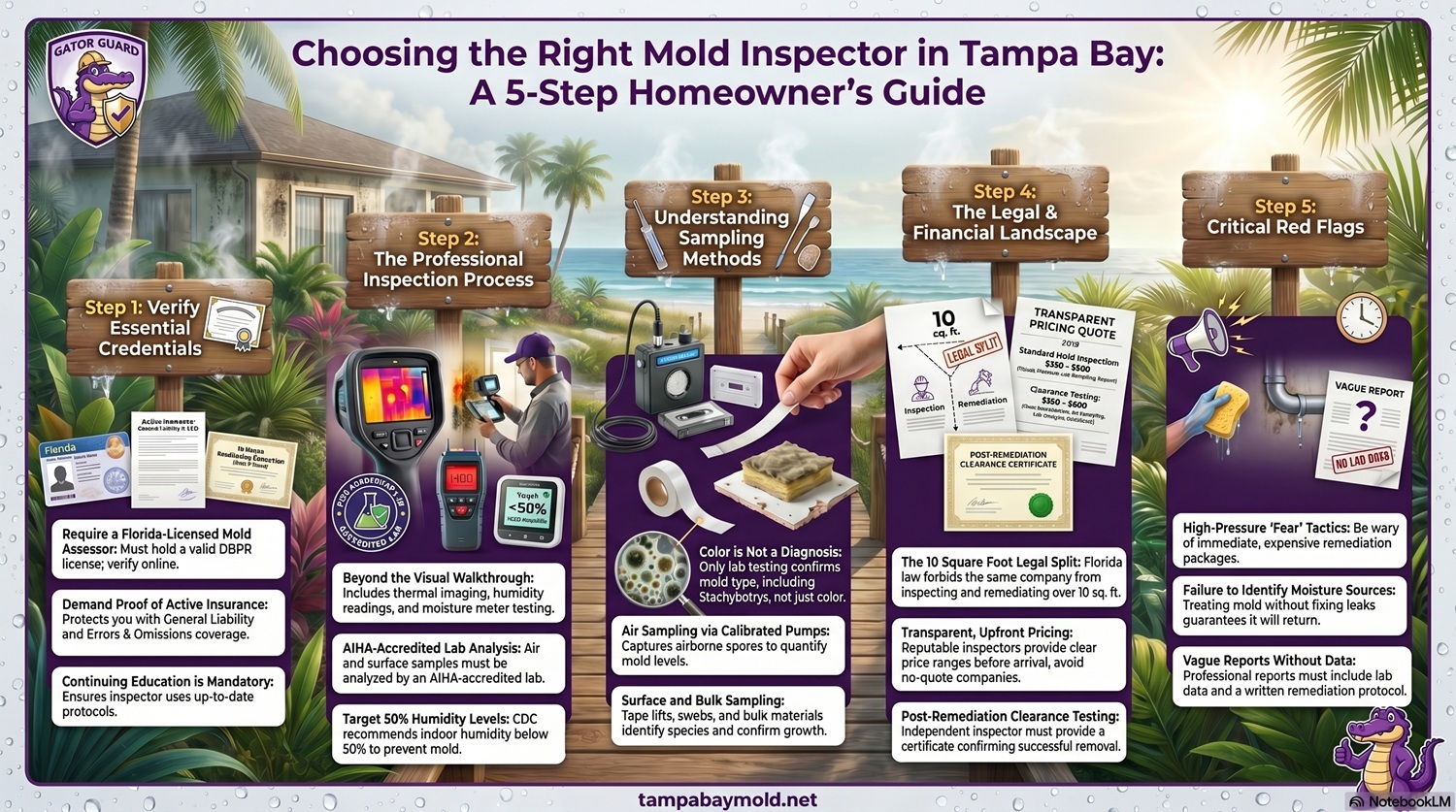
The first thing to check is licensure and certification. In Florida, mold assessors must hold a Florida-licensed mold assessor license issued by the Department of Business and Professional Regulation (DBPR). This is a legal requirement. Ask for the license number and verify it before anyone enters your home.
Also ask for proof of insurance. A licensed and insured professional protects you if something goes wrong on your property. This is a non-negotiable requirement.
Quick credential checklist:
- Valid Florida mold assessor license (verify on DBPR website)
- General liability insurance and E&O coverage
- Proof of recent continuing education (Active FL Mold Assessment license requires 14hrs of continuing education every 2 years to be renewed)
Step 2: Ask the Right Questions About the Mold Inspection Process
Before you commit, ask every inspector these specific questions. Their answers will tell you immediately whether they are the right fit.
1. What does your inspection include?
A proper mold inspection Tampa should cover: visual examination of the entire property, humidity and temperature readings, moisture meter readings at suspect areas, air sampling with lab analysis, surface sampling where visible growth is present, and thermal imaging to detect hidden moisture behind walls.
2. Which laboratory do you use?
Lab-certified results come from accredited laboratories only. Ask for the lab name. A reputable inspector works with an AIHA (American Industrial Hygiene Association) accredited lab. If they cannot name their lab, that is a problem.
3. Will you provide a written protocol?
A remediation protocol is written to remove the mold safely, and clearance testing is done to confirm success. Your inspector should be able to provide a written scope of work outlining every step of the recommended remediation process.
4. Do you also offer remediation?
In Florida, the same company cannot legally both assess and remediate on the same property unless visible mold is less than 10 sq ft. An inspector who also offers mold removal Tampa services on the same project is operating outside state law unless it fall under this threshold of 10 sq ft
Step 3: Evaluate Experience, Specifically in Florida’s Climate
General mold experience is good. Tampa Bay-specific experience is better. Florida’s humidity creates conditions that differ significantly from most other states. An inspector who learned their trade in a dry climate may not understand how quickly mold spreads in a subtropical environment with 90% summer humidity and year-round coastal moisture.
Ask how long they have been doing mold inspection Tampa work specifically. Ask if they regularly inspect properties in Hillsborough County, Pinellas County, Pasco County, Manatee County, and Sarasota County. Local knowledge matters. An inspector who knows the common construction methods of Florida homes, the typical HVAC configurations, and the seasonal moisture patterns will give you a more accurate assessment.
We have 17 years of mold experience, with 14 of those years right here in Tampa Bay. We live here, work here, and raise our families here. Tampa Bay is our home. That is the kind of inspector you want: someone with genuine, grounded expertise in the exact market where your property sits.
Experience questions to ask:
- How many mold inspections have you completed in Tampa Bay specifically?
- Have you worked on properties similar to mine (age, construction type, square footage)?
- How do you handle high-humidity environments differently than other regions?
- Can you provide references from past clients in our county?
How to Choose the Best Certified Mold Inspection Professional: Mold Testing Tampa vs. Basic Visual Inspections
Not all inspections are the same. A basic visual walkthrough is not adequate when mold is suspected in concealed spaces. Mold testing Tampa requires actual sample collection and lab analysis. Without it, you are guessing.
There are three main types of sampling a certified mold inspection professional should offer:
- Air Sampling: Captures airborne spores using calibrated pumps and cassettes. Samples are sent to an accredited lab. This is the most common method for quantifying mold levels in a space.
- Surface Sampling: Tape lifts or swabs from visible growth. Identifies the species present. However, you can’t identify mold type by color alone. Lab testing is needed.
- Bulk Sampling: Pieces of material (drywall, insulation, wood) are sent to the lab for analysis. Used in more complex cases.
The inspector should explain which sampling method is appropriate for your situation and why. If they recommend sampling everywhere without explanation, or skip sampling entirely on a large project, question their approach.
Step 4: Understand Pricing and Avoid Vague Quotes
Transparent pricing is not optional. It is a sign of a professional operation. A reputable inspector will give you a clear breakdown of costs before any work begins.
In Tampa Bay in 2026, expect to pay in this general range:
| Service | Typical Range | What’s Included |
|---|---|---|
| Standard Mold Inspection including sampling | $350 – $600 | Visual exam, moisture readings, written report |
| Post-Remediation Clearance Test | $350 – $600 | Air sampling post-remediation, lab analysis, clearance certificate |
We will never upsell you on services you don’t need. Know exactly what you’re paying for before anything starts. If an inspector cannot give you a clear price range on the phone, that is a warning sign.
Step 5: Red Flags to Watch for When Choosing a Mold Inspector
Just as important as knowing what to look for is knowing what to avoid. These are the patterns that consistently signal an inspector is not the right choice.
- No state license or expired license: Non-negotiable. Do not hire anyone who cannot produce a valid Florida mold assessor license number immediately.
- Vague reports without lab data: A written report without actual lab results is incomplete. Lab-certified results from an accredited facility should be standard.
- High-pressure upselling: If the inspector identifies “dangerous mold everywhere” within five minutes of arriving and immediately pushes remediation packages, get a second opinion.
- No moisture source analysis: A certified mold inspection professional must identify the moisture source driving the mold growth. Treating mold without fixing the moisture problem guarantees it comes back.
Inspection vs. Remediation: Understanding the Difference
These two services are often confused, but they are entirely distinct. Knowing the difference helps you choose the best certified mold inspection professional and structure the overall process correctly.
Mold Inspection is the diagnostic phase. The inspector finds the mold, measures its extent, identifies the moisture source, takes samples for lab analysis, and produces a written report with a recommended remediation protocol. This is assessment only. No mold is removed during this phase.
Mold Remediation is the treatment phase. A separate, licensed mold remediator follows the protocol written by the inspector. They contain the work area, use HEPA filtration, remove affected materials, clean surfaces, and restore the space. You can learn more about what a professional mold remediation in Tampa Bay process looks like before you commit to any contractor.
After remediation is complete, a clearance test is performed. The original inspector (or a separate assessor) returns and collects new air samples. The lab analyzes them. A clearance certificate is issued only when the results confirm the mold has been successfully removed.
This is our simple 4-step process:
- Call: We discuss your concerns, schedule the inspection, and give you transparent pricing upfront.
- Inspect: We conduct a full visual inspection, moisture assessment, and lab sampling.
- Protocol: A remediation protocol is written to remove the mold safely.
- Clearance: Clearance testing is done to confirm success.
How Mold Testing Tampa Protects Your Home and Your Real Estate Transactions
In 2026, mold testing Tampa is increasingly relevant not just for occupied homes but for real estate transactions. Buyers are requesting mold inspections as a standard contingency. Sellers are ordering pre-listing inspections to avoid last-minute surprises that kill deals.
A professional mold testing report gives both parties objective, lab-backed data. That data can be used in negotiation, in disclosure documents, and as evidence for lender requirements. Lenders in Florida are paying closer attention to mold disclosures than ever before.
For real estate scenarios specifically, you need an inspector who provides a report that holds up to scrutiny. Lab-certified results. Specific spore counts. A clear written protocol. Not a one-page summary with no data attached. You can review detailed guidance on Tampa Bay mold inspection for real estate buyers to understand exactly what a complete report should contain.
A concise 5-step guide to selecting the best certified mold inspection professional. Learn how to evaluate credentials, experience, and service options.
Black Mold Tampa: What You Need to Know Before Hiring an Inspector
Black mold Tampa concerns are among the most common reasons homeowners call us. The term “black mold” typically refers to Stachybotrys chartarum, a species associated with water-damaged materials and elevated mycotoxin production.
Here is the critical point: you can’t identify mold type by color alone. Lab testing is needed. Dark-colored mold could be Stachybotrys, or it could be Cladosporium, Aspergillus, or any number of other species. Every one of them warrants professional attention. None of them should be ignored.
If you suspect black mold Tampa in your home, do not disturb it. Do not spray it with bleach. Do not cover it. Call a certified mold inspection professional and let the lab results guide the response. The species, the concentration, and the extent of the growth all factor into the remediation protocol. Guessing gets expensive.
Our inspection process includes air sampling and surface sampling specifically to identify suspect mold species. You get a full lab report with species identification. Know exactly what you’re dealing with, and then make informed decisions from there.
How to Choose the Best Certified Mold Inspection Professional: Owner-Operated vs. Franchise
This distinction matters more than most people realize. When you call a national franchise for mold inspection Tampa, you may be routed through a call center in another state. The technician who arrives may be a recent hire following a standard checklist. There is no single accountable person overseeing your project from start to finish.
With an owner-operated company, the dynamic is entirely different. David personally oversees every project. No corporate runaround. When you call us, you talk to the person who is actually going to show up at your door. When you have a question about your lab results , you can get an answer from the person who conducted the inspection. That level of accountability does not exist at a franchise level.
We treat every home like it’s our own. That is not a marketing line. It is the operational standard that 17 years in this business has built. We live and work in the same five-county area where our clients live. That matters. A lot.
For a full breakdown of our approach and service area, visit our Tampa Bay mold remediation resource hub where we maintain detailed guides on every aspect of the inspection and remediation process.
The 5-Point Checklist: How to Choose the Best Certified Mold Inspection Professional
Before you book any mold inspection, run through this checklist. If you cannot confirm all five points, keep looking.
- Licensed and insured in Florida: Verify their DBPR mold assessor license number is active. Confirm they carry general liability insurance and errors and omissions coverage.
- Uses accredited lab for testing: Lab-certified results must come from an AIHA-accredited laboratory. Ask which lab they use and confirm its accreditation status.
- Transparent pricing before arrival: You should receive a clear price range for the inspection before anyone visits your property. No vague “we’ll let you know after we look.”
Conclusion: Choosing the Best Licensed Mold Inspection Professional Starts with the Right Questions
Knowing how to choose the best certified mold inspection professional is not complicated. It requires the right questions, a verified credential check, and a clear understanding of what a proper inspection actually includes.
Florida’s humidity creates the perfect environment for mold growth. That is not going to change. What changes is how you respond. A certified, experienced, owner-operated inspector gives you lab-certified results you can act on. A vague visual walkthrough from an unlicensed generalist gives you false confidence and an expensive problem that keeps coming back.
Whether you are dealing with suspected black mold in Tampa, scheduling mold testing in Tampa ahead of a real estate transaction, or following up on a completed mold remediation project with a clearance test, the standard is the same. Licensed. Certified. Lab-backed. Transparent pricing. Owner accountable.
We serve Hillsborough, Pinellas, Pasco, Manatee, and Sarasota counties. David personally oversees every project. No corporate runaround. If you are ready to know exactly what you’re dealing with, reach out to our team today.
“We live here, work here, and raise our families here. Tampa Bay is our home. Treat every home like it’s our own.”
Frequently Asked Questions
How do I know if a mold inspector is actually licensed in Florida?
Verify their license number directly on the Florida DBPR website at myfloridalicense.com. Any active mold assessor will have a valid license listed there.
What is the difference between a mold inspection and mold testing Tampa?
A mold inspection is the overall assessment process that includes visual examination, moisture readings, and identification of problem areas. Mold testing Tampa refers specifically to the sample collection and lab analysis phase. A thorough inspection should include both components when mold is suspected.
Is it worth getting a mold inspection in Tampa in 2026 even if I don’t see any mold?
Yes. Florida’s humidity creates the perfect environment for concealed mold growth inside walls, beneath flooring, and within HVAC systems. Many serious infestations have no visible surface signs. If there are musty or earthy odors, unexplained health symptoms, or a history of water intrusion, an inspection is warranted even without visible mold.
How long does a mold inspection Tampa take and when do I get results?
A typical mold inspection Tampa takes 1 to 3 hours depending on the property size and the number of areas being assessed. Lab results from air or surface samples typically return within 24 to 72 hours, after which your inspector should provide a full written report with findings and recommendations.
Can a mold inspector also do the mold remediation Tampa work?
Florida law requires that mold assessment and mold remediation Tampa be performed by separate licensed parties on the same project if visible mold is more than 10 sq ft. Small projects where visible mold is less than 10 sq ft is considered non-regulated and do not fall under this requirement.
What does black mold Tampa actually look like and do I need a lab test to confirm it?
Black mold Tampa typically appears as dark greenish-black or gray patches on surfaces, often in damp areas like bathrooms, under sinks, or behind walls. However, you can’t identify mold type by color alone. Lab testing is needed to confirm species. Never assume and never ignore it regardless of color.
How much does mold removal in Tampa cost after the inspection is done?
Mold removal Tampa costs vary considerably based on the size of the affected area and the materials involved. Small bathroom mold can be addressed in a day, while larger attic or crawl space projects may take longer and cost significantly more. After your inspection, a written remediation protocol should include a scope and cost estimate from the remediator before any work begins.