
5 Signs of Black Mold Every Tampa Homeowner Misses Until It’s Too Late
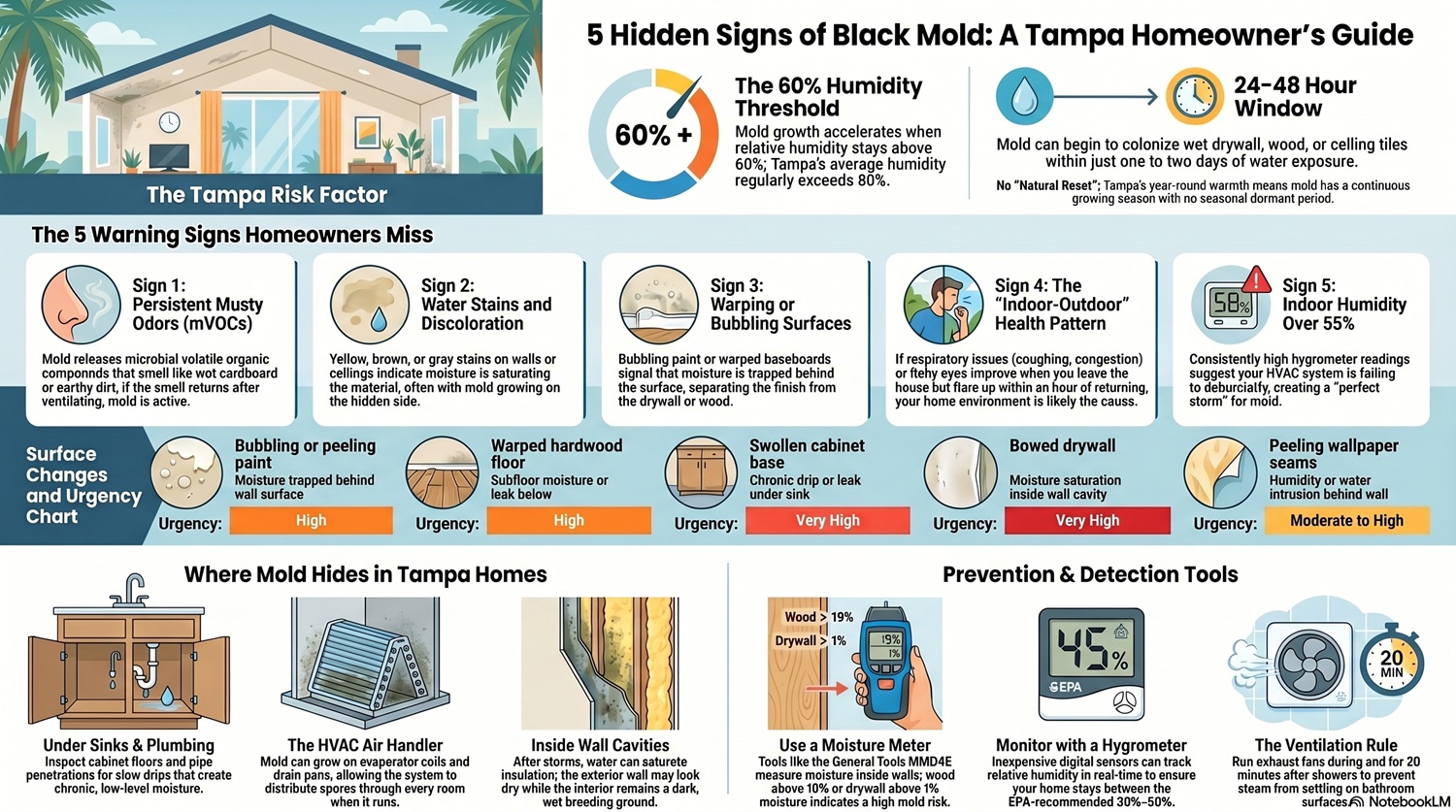
- Black mold thrives in Tampa’s heat and humidity — making Florida homes significantly more vulnerable than homes in drier climates year-round.
- The five warning signs most homeowners miss include musty odors, water stains, warping surfaces, unexplained health symptoms, and persistently high indoor humidity.
- Black mold produces spores and microbial volatile organic compounds (mVOCs) that circulate through your air and can trigger serious respiratory and allergy symptoms — even before you see any visible growth.
- Mold can take hold in as little as 24 hours after water exposure, making fast action after leaks or flooding absolutely critical.
- Keep reading to find out exactly where black mold hides in Tampa homes — some of these spots will surprise you.
Black mold doesn’t announce itself — it grows quietly in the corners of your home while you go about your day, and by the time most homeowners spot it, the problem is already out of hand.
Tampa Bay’s warm temperatures and notoriously high humidity create near-perfect conditions for mold growth year-round. Unlike drier climates where seasonal changes provide a natural reset, Tampa homes stay warm and moisture-rich for most of the year. That means black mold gets a longer growing season, more hiding spots, and more opportunities to go undetected. TampaBayMold.net sees this play out constantly — homeowners who thought a smell was just “normal Florida dampness” discover extensive mold growth months later.
Knowing what to look for — before it becomes a remediation emergency — is the most valuable thing you can do as a homeowner in this region. Here are the five signs that matter most.
Tampa’s Humidity Makes Black Mold a Bigger Threat Than You Think
Black mold, most commonly the species Stachybotrys chartarum, needs three things to grow: moisture, warmth, and an organic surface to feed on. Tampa delivers two of those three conditions automatically. The average relative humidity in Tampa hovers well above the 60% threshold that mold experts identify as the tipping point for mold growth. Add in Florida’s frequent rain events, aging housing stock, and the moisture that air conditioning systems pull indoors, and you have a recipe for chronic mold problems.
The CDC notes that mold grows naturally in the environment, but indoors it becomes a health concern — particularly in areas with consistently high humidity. For Tampa homeowners, this isn’t a seasonal warning. It’s a year-round reality that demands consistent attention.
Sign 1: A Musty Smell That Won’t Go Away
If your home smells like a wet basement even when everything looks clean and dry, that odor is your first and most reliable warning sign. A persistent musty or earthy smell is almost always tied to active mold growth somewhere in your home — and the fact that you can’t see it doesn’t mean it isn’t there.
That odor comes from microbial volatile organic compounds, or mVOCs, that mold releases as it metabolizes organic material. These compounds are chemically distinct, and many people describe them as smelling like dirt, wet cardboard, or stale air. Once you recognize the scent, it’s hard to mistake for anything else.
The problem is that many Tampa homeowners chalk this smell up to general humidity or an older home. They open a window, run a fan, and assume the problem is resolved. It isn’t. If the smell returns within hours or persists despite ventilation, mold is actively growing somewhere in that space.
Why Musty Odors Mean Mold Is Already Growing
Mold doesn’t produce mVOCs in its early dormant stages — it produces them during active growth. So if you’re smelling that musty odor, mold has already established a colony and is actively spreading. By the time a smell is strong enough to notice across a room, the growth behind it is typically significant.
Where to Sniff First in a Tampa Home
In Tampa homes specifically, start your investigation in the following order: under bathroom and kitchen sinks, inside cabinets on exterior walls, around your HVAC air handler, in closets on exterior-facing walls, and in any room that has experienced water intrusion — even minor flooding from a past storm. These are the zones where moisture lingers longest and where air circulation is typically the poorest.
Sign 2: Water Stains and Discoloration on Walls or Ceilings
Yellow, brown, or gray staining on your walls or ceiling is never purely cosmetic. Water stains form when moisture seeps through a surface and leaves mineral deposits behind as it evaporates. That moisture is exactly what mold needs to establish itself, and in many cases, staining and mold growth are happening simultaneously — just on opposite sides of the same surface.
How to Tell a Water Stain From Active Mold Growth
A water stain that has fully dried will typically feel slightly rough or chalky and may have a distinct ring or halo pattern. Active mold growth looks different — it tends to appear as fuzzy or powdery patches, often dark green, black, or gray, and the surrounding surface may feel slightly soft or damp to the touch. If you press gently on a stained area of drywall and it gives slightly, there is almost certainly moisture — and likely mold — behind it.
Why Tampa’s Rain Season Makes This Sign Worse
Tampa’s rainy season runs roughly from June through September, during which the city receives the majority of its annual rainfall in intense, concentrated storms. Roof flashing, window seals, and siding that hold up fine during dry months can fail quickly under that kind of repeated water pressure. Homeowners often notice a stain appearing after a heavy storm, assume the roof was temporarily overwhelmed, and move on without investigating further. For more information on identifying and dealing with mold issues, check out these identification tips and FAQs.
That’s the mistake. Even a small, slow roof leak can saturate insulation and drywall over weeks, creating a large, hidden mold colony long before the stain on your ceiling grows large enough to demand attention. Any new stain that appears after rain — no matter how small — warrants immediate investigation into the moisture source.
Sign 3: Warping, Swelling, or Bubbling Surfaces
When building materials absorb moisture over time, they change shape. Wood swells and warps. Drywall softens and bows. Paint and wallpaper lose adhesion and begin to bubble or peel. None of these are aging quirks — they are physical evidence that moisture has been present long enough to alter the material itself, which almost always means mold is present or imminent.
This sign is particularly important because it indicates chronic moisture, not just a one-time event. A pipe that burst and was cleaned up immediately may not lead to mold. But a slow drip under a sink that has been warping the cabinet floor for three months? That is a textbook mold scenario.
Quick Reference: Surface Changes and What They Signal
Surface Change What It Likely Means Urgency Level Bubbling or peeling paint Moisture trapped behind wall surface High Warped hardwood floor Subfloor moisture or leak below High Swollen cabinet base Chronic drip or leak under sink Very High Bowed drywall Moisture saturation inside wall cavity Very High Peeling wallpaper at seams Humidity or water intrusion behind wall Moderate to High
Any one of these changes in a Tampa home should prompt an immediate check for moisture — and a serious consideration that mold may already be present behind the affected surface.
What Warped Drywall or Wood Actually Means
Drywall is particularly vulnerable because its paper facing is an ideal food source for black mold. Once drywall absorbs moisture to the point of warping or softening, the paper layer is almost certainly compromised — and mold growth on or inside drywall typically cannot be cleaned. It must be removed and replaced entirely. The same applies to wood framing that has been wet long enough to show visible warping or staining.
In Tampa homes, pay special attention to drywall at the base of exterior walls, particularly in rooms with sliding glass doors or older single-pane windows. These are common moisture entry points during heavy rain events.
The Hidden Mold Behind Bubbling Paint or Wallpaper
Bubbling paint is one of the most underestimated signs of mold. Most homeowners see it and think it’s a painting problem — bad primer, cheap paint, or surface prep issues. Sometimes that’s true. But in a humid climate like Tampa’s, bubbling paint on an interior wall frequently indicates that moisture vapor is pushing through from behind, separating the paint from the drywall surface.
When that happens repeatedly, the damp surface behind the paint becomes a prime mold growing environment — dark, moist, and with limited airflow. By the time the bubbling is noticeable, there is often an established mold colony directly behind the wall surface that you cannot see from the front.
- Check for bubbling paint along the base of exterior walls after heavy rain events
- Look for wallpaper seams lifting in bathrooms, laundry rooms, or any below-grade space
- Press gently on bubbled areas — a soft or spongy feeling confirms moisture in the wall
- Never simply repaint over bubbling paint without identifying and resolving the moisture source first
- If bubbling reappears within weeks of repainting, treat it as a confirmed moisture and potential mold issue
Sign 4: Unexplained Health Symptoms at Home
One of the clearest indicators that your home has a mold problem is when your body reacts differently depending on where you are. Mold-related health symptoms are frequently mistaken for seasonal allergies, a lingering cold, or general fatigue — and because they come on gradually, most people don’t immediately connect them to their home environment.
Black mold produces spores that become airborne and circulate through your HVAC system, spreading through every room. It also produces mVOCs that irritate the respiratory tract even in people without traditional mold allergies. The result is a home that makes you feel unwell in ways that are frustratingly hard to trace back to a specific cause.
Respiratory and Allergy Symptoms Linked to Black Mold
Black mold exposure triggers a recognizable cluster of symptoms that the CDC and EPA have both documented extensively. These include nasal and sinus congestion, chronic coughing, wheezing, throat irritation, skin rashes, and watery or irritated eyes. In more sensitive individuals, exposure can trigger asthma attacks or cause shortness of breath severe enough to require medical attention. If you or anyone in your household has developed a persistent cough or unexplained congestion that no medication seems to resolve, your home environment deserves a hard look.
Why Symptoms Get Worse Indoors But Improve Outside
This is the pattern that should immediately raise a red flag. If you wake up congested, spend the day outdoors feeling relatively normal, and return home to find your symptoms flaring again within an hour — that cycle is a strong indicator of indoor air quality problems, with mold being one of the most common culprits. Mold spores circulate continuously through your HVAC system, meaning simply being inside the home keeps you in constant contact with the allergen. Leaving the home removes you from exposure, and your body begins to recover. Returning puts you right back in it.
Who Is Most at Risk in the Household
- Infants and young children — developing lungs are far more sensitive to airborne mold spores and mVOCs
- Elderly residents — immune response weakens with age, making it harder to fight off mold-related respiratory issues
- People with asthma — black mold is a well-documented asthma trigger that can escalate attacks quickly
- Those with existing allergies — mold allergies are extremely common and can amplify reactions to other allergens already present in the home
- Immunocompromised individuals — anyone undergoing chemotherapy, living with HIV, or on immunosuppressant medications faces significantly higher risk from mold exposure
The tricky part about mold-related health symptoms is that they mimic so many other common conditions. A doctor treating you for recurrent sinus infections may never think to ask about your home’s moisture levels. That’s why connecting the dots yourself — noticing the indoor-outdoor pattern, checking for other signs in your home, and getting a proper mold inspection — is so critical.
Don’t dismiss symptoms just because they seem mild. Chronic low-level mold exposure can accumulate over months and years, gradually wearing down respiratory health in ways that only become fully apparent much later. Tampa homeowners with older homes, or those who’ve experienced any flooding or storm damage, should be especially alert to this pattern.
Sign 5: Consistently High Indoor Humidity Levels
You might not see mold and you might not smell it — but your hygrometer will tell you the truth. Consistently high indoor humidity is both a sign that mold conditions exist and a primary driver of mold growth itself. In Tampa, where outdoor humidity regularly exceeds 80%, keeping indoor levels in check requires active effort. When that effort lapses — even temporarily — mold finds its window.
What Humidity Levels Actually Trigger Mold Growth
The EPA recommends keeping indoor relative humidity between 30% and 50% to prevent mold growth. At 60% and above, common molds can begin establishing colonies on organic surfaces within days. At 70% or higher, the timeline accelerates dramatically, and black mold in particular can take hold in as little as 24 to 48 hours on wet drywall, wood framing, or ceiling tiles.
In Tampa, it’s entirely possible for indoor humidity to spike above 60% after a storm, during an AC failure, or even just during the hours when doors and windows are left open on a humid summer evening. A single high-humidity event isn’t necessarily a crisis — but repeated spikes, or sustained elevation above 60%, create exactly the conditions black mold needs to thrive.
Tools That Measure Indoor Humidity Accurately
Indoor Humidity Monitoring: Tool Comparison for Tampa Homeowners
Tool Accuracy Level Best For Approx. Cost ThermoPro TP50 Hygrometer ±2–3% RH Single-room monitoring $10–$15 Govee WiFi Hygrometer H5179 ±3% RH Whole-home monitoring with app alerts $30–$40 Inkbird IBS-TH2 Plus ±3% RH Remote monitoring in hard-to-access spaces $20–$25 Professional Moisture Meter (e.g., General Tools MMD4E) Varies Pinpointing moisture in walls and floors $15–$50
Place at least one hygrometer in your most vulnerable rooms — typically the bathroom, laundry room, and any below-grade or interior room with limited airflow. Check readings at different times of day, particularly in the morning after overnight humidity buildup.
If your readings consistently exceed 55% indoors, your HVAC system may be undersized, malfunctioning, or simply overwhelmed by Tampa’s climate demands. A correctly functioning central air system in Florida should be pulling significant moisture out of the air as part of its normal cooling cycle. If it isn’t, that’s a mechanical problem worth addressing immediately — both for comfort and for mold prevention.
Where Black Mold Hides in Tampa Homes
Black mold doesn’t grow in the middle of a sunny wall — it gravitates toward darkness, moisture, and limited airflow. Knowing its preferred hiding spots lets you build a targeted inspection routine rather than guessing where to look.
Under Sinks and Around Plumbing Fixtures
The cabinet space under a bathroom or kitchen sink is one of the most mold-prone areas in any home. Slow supply line drips, drain condensation, and the occasional pipe fitting failure all create exactly the kind of chronic, low-level moisture that black mold feeds on. Because these spaces are dark, enclosed, and rarely opened, a mold colony can grow for months completely undetected. Pull everything out from under your sinks at least twice a year and inspect the cabinet floor, back wall, and the areas around pipe penetrations with a flashlight.
Bathrooms, Basements, and AC Units
Bathrooms are ground zero for mold in most homes — shower grout, caulk lines around the tub, the underside of bath mats, and the ceiling directly above the shower are all high-risk zones. In Tampa, many homes lack true basements, but slab-level utility rooms, enclosed laundry spaces, and crawl spaces under older homes function similarly as low-ventilation, high-moisture environments. Perhaps most overlooked is the HVAC air handler itself — the evaporator coil and the drain pan beneath it can accumulate mold that then gets distributed through every room in the house every time the system runs. If you’ve never had your air handler inspected for mold growth, that inspection is overdue.
Behind Walls After Storm or Flood Damage
This is where Tampa homeowners are most vulnerable and least prepared. When storm water intrudes through a wall, window frame, or roof penetration, it saturates the insulation and drywall inside the wall cavity — areas that may never fully dry on their own. The exterior surface of the wall dries quickly, giving the appearance that everything is fine. Behind it, mold establishes and spreads along the wall framing, often covering large areas before any exterior sign appears. If your home has ever experienced storm-related water intrusion — even what seemed like a minor amount — those walls should be professionally assessed for moisture content before you assume all is well.
How to Confirm Black Mold Before Calling Anyone
You don’t need to guess. There are practical steps you can take to gather real information about your home’s mold situation before deciding whether a professional inspection is necessary — though in many cases, that inspection will still be the right call.
Using a Moisture Meter to Find Problem Areas
A moisture meter is an inexpensive tool — the General Tools MMD4E, for example, runs about $15 to $20 — that measures the moisture content inside building materials like drywall and wood without requiring you to cut into the wall. You press the two pins against the surface and get an immediate reading. Wood with a moisture content above 19% is considered at high risk for mold growth. Drywall above 1% moisture content warrants investigation. These numbers give you something concrete to work with rather than guessing based on appearance alone.
Walk your home systematically, testing areas around windows, at the base of exterior walls, under sink cabinets, around the toilet base, and anywhere you’ve noticed staining or odors. Keep a simple log of your readings and locations. If you identify multiple areas with elevated moisture, that pattern tells you there’s likely a larger moisture management problem in the home — not just an isolated spot — and professional remediation assessment is the appropriate next step.
When a Professional Mold Test Is Worth It
A professional mold test makes sense when you have strong indicators — persistent odor, health symptoms, visible staining, or elevated moisture readings — but no visible mold growth to confirm. A licensed inspector will use tools like infrared thermal imaging cameras and air quality sampling to detect mold colonies hidden inside wall cavities, above ceiling tiles, or under flooring. Air sampling in particular measures the concentration of mold spores in your indoor air compared to outdoor baseline levels, giving you concrete data rather than guesswork. If your moisture meter readings are consistently elevated in multiple areas, or if health symptoms are affecting multiple household members, skip the DIY investigation phase and go straight to professional testing.
Delaying Mold Removal Costs More Than You Expect
Every week that black mold goes untreated, it spreads further along wall framing, insulation, and structural wood — converting a contained remediation job into a major demolition and rebuild. What might cost a few hundred dollars to remediate in the early stages can escalate quickly into thousands of dollars once mold has penetrated deeply into wall cavities, floor joists, or subfloor materials. In Tampa’s humid climate, mold doesn’t slow down on its own. It keeps growing as long as the moisture source remains.
Beyond the structural costs, delayed remediation compounds the health impact on everyone living in the home. Prolonged mold exposure increases the cumulative dose of spores and mVOCs that occupants inhale, which can gradually sensitize even non-allergic individuals to mold — meaning people who showed no initial symptoms may develop them over time. Acting at the first confirmed sign is always significantly cheaper, faster, and healthier than waiting for the problem to become impossible to ignore.
How to Keep Black Mold Out of Your Tampa Home for Good
Preventing black mold in Tampa isn’t about a one-time fix — it’s about building a set of consistent habits that keep moisture under control year-round. The same climate conditions that make Tampa beautiful make mold prevention an ongoing priority rather than a seasonal task. The good news is that the core prevention strategies are straightforward, affordable, and highly effective when applied consistently.
Start by thinking about your home as a moisture management system. Every room, every appliance, and every structural component either helps control moisture or contributes to it. Identifying the weakest points in your home’s moisture defenses — a bathroom without a working exhaust fan, a dryer venting into an enclosed space, an AC system that hasn’t been serviced in two years — gives you a targeted action list rather than a vague goal to “keep things dry.”
Regular inspections are the backbone of long-term mold prevention. Twice-yearly walkthroughs — ideally at the start and end of Tampa’s rainy season — allow you to catch developing moisture problems before they reach the mold growth threshold. Use your moisture meter, check your humidity readings, and pay particular attention to any area that has ever had a moisture issue in the past. Mold problems that are resolved without addressing the underlying moisture source almost always return.
Humidity Control With Dehumidifiers and Ventilation
In Tampa, your central air conditioning system is your primary defense against indoor humidity — but it needs help. Make sure every bathroom has a functioning exhaust fan that vents directly outside, not into the attic. Run exhaust fans during and for at least 20 minutes after every shower. In laundry rooms, utility closets, and any space that your AC doesn’t cool effectively, a standalone dehumidifier like the hOmeLabs 4,500 Sq. Ft Energy Star Dehumidifier can maintain humidity below the 50% threshold independently. Set it and check it regularly. For more information on maintaining healthy air quality, visit the Florida Health Department’s guide on mold.
Ventilation matters as much as dehumidification. Stagnant air allows moisture to accumulate on cool surfaces — particularly in closets on exterior walls, under-sink cabinets, and enclosed storage areas. Leaving closet doors slightly open, using small circulation fans in enclosed spaces, and ensuring that your HVAC return vents are unobstructed all contribute to the consistent airflow that keeps mold from finding a foothold.
Fix Leaks and Dry Water Damage Within 24 to 48 Hours
The 24 to 48 hour window is not a guideline — it is the actual biological threshold within which mold begins colonizing wet building materials. Any water intrusion, from a burst pipe to a slow drip under a sink to storm water coming through a window seal, needs to be identified, stopped, and fully dried within that window. Use fans, dehumidifiers, and if necessary, professional drying equipment to bring affected materials back to safe moisture levels. If drywall or insulation has been saturated, drying the surface is not enough — the material itself may need to be removed and replaced.
Act Fast: Tampa Homes Are Especially Vulnerable Year-Round
Tampa’s combination of sustained heat, high ambient humidity, frequent storm events, and an aging housing stock creates a mold environment that doesn’t take breaks. The signs covered in this article — musty odors, water stains, warping surfaces, health symptoms, and elevated indoor humidity — are your early warning system. Catching even one of these signs and responding immediately is how you stay ahead of a problem that grows exponentially the longer it goes unaddressed. In this climate, speed of response is everything.
Frequently Asked Questions
Tampa homeowners dealing with mold concerns tend to have the same core questions — and getting clear, accurate answers to those questions makes the difference between a fast, targeted response and weeks of uncertainty while the problem worsens.
The following answers are based on established guidance from the EPA, CDC, and professional mold remediation experience in Florida’s specific climate conditions.
Can Black Mold Grow Inside Walls Without Any Visible Signs?
Yes — and this is one of the most dangerous aspects of black mold in Tampa homes. Wall cavities provide the dark, low-airflow environment that mold thrives in, and as long as there’s a moisture source (a slow roof leak, a sweating pipe, water intrusion through a window frame), mold can grow extensively inside a wall without producing any visible signs on the surface. The first indicators are typically an odor, elevated moisture meter readings at the wall surface, or health symptoms in occupants — all of which can appear long before any visible growth is detectable. Infrared thermal imaging during a professional inspection is the most reliable method for identifying hidden moisture and mold inside wall cavities.
Is It Safe to Stay in My Tampa Home During Mold Remediation?
It depends on the scale and location of the mold growth. Small, contained remediation jobs — a single bathroom, for example — can often be completed while occupants remain in the home, provided the affected area is properly sealed with negative air pressure containment barriers and HEPA air scrubbers are running throughout the process. For larger infestations involving multiple rooms, HVAC system contamination, or significant structural demolition, temporary relocation is strongly recommended, particularly for children, elderly residents, or anyone with respiratory conditions.
A reputable remediation company will assess your specific situation and give you a clear recommendation. Be cautious of any contractor who dismisses the question entirely or guarantees it’s fine to stay without first evaluating the scope of the work. Your air quality during active remediation is a serious consideration, not an afterthought.
How Quickly Can Black Mold Spread After Water Damage?
Mold spores can begin germinating on wet building materials within 24 to 48 hours under the right conditions — and Tampa’s warmth accelerates that timeline. Once established, a mold colony can double in size within days, spreading along wall framing, insulation batts, and the paper facing of drywall. A water damage event that is not fully dried and assessed within 48 hours should be treated as a confirmed mold risk, not a potential one, regardless of whether visible growth has appeared yet.
What Is the Difference Between Black Mold and Regular Mold?
The term “black mold” typically refers to Stachybotrys chartarum, a specific species known for producing mycotoxins and requiring very high moisture levels — typically chronically wet cellulose materials like drywall or wood — to grow. However, it’s important to know that many common mold species can appear dark green or black in color and still cause significant health symptoms through spore exposure and mVOC production. You cannot reliably identify Stachybotrys by color alone — laboratory testing of a sample is required for species-level identification. From a practical standpoint, any mold growth in your home warrants remediation, regardless of species or color.
How Often Should Tampa Homeowners Inspect for Mold?
A thorough DIY inspection — moisture meter, visual check of all high-risk areas, humidity monitoring review — should be done at minimum twice a year. The most strategic timing for Tampa homeowners is just before the rainy season begins (typically late May) and immediately after it ends (around October). This gives you a baseline before the highest-risk period and lets you catch any damage the season created before it has months to develop.
Additionally, any significant weather event — a tropical storm, extended flooding, or even a period of unusually heavy rain — should trigger an immediate targeted inspection of all exterior walls, the attic, and any area with known vulnerabilities like aging window seals or an older roof.
Professional mold inspections are recommended every one to two years for most Tampa homes, and immediately following any confirmed water intrusion event regardless of apparent severity. The cost of a professional inspection is a small fraction of the cost of remediating a mold problem that could have been caught three months earlier.
If you’re uncertain about the current state of your home’s moisture levels or air quality, a qualified mold remediation specialist can walk through your home, identify risk zones, and give you an accurate picture of where things stand — giving you the information you need to make fast, confident decisions about your home and your family’s health.
One Reply to “5 Signs of Black Mold Every Tampa Homeowner Misses Until It’s Too Late”
Comments are closed.