
Residential Mold Remediation and Removal: What Every Tampa Bay Homeowner Needs to Know in 2026
 Residential Mold Remediation and Removal Services In Tampa Bay
Residential mold remediation and removal is one of the most urgent home health issues facing Florida homeowners, and if you’ve found dark spots on your walls or caught a musty odor you can’t explain, you need straight answers fast. Tampa Bay homes and mold have an uncomfortable relationship that most homeowners discover at the worst possible time — after it’s already spread.
Key Takeaways
| Question | Answer |
|---|---|
| How quickly does mold grow after water damage? | Mold can begin colonizing within 48 hours of moisture exposure, especially in Florida’s humid climate. |
| Can I handle residential mold remediation and cleanup myself? | DIY methods miss hidden colonies and spread spores. Professional remediation with containment and HEPA filtration is the only reliable solution. |
| What does a mold inspection Tampa service involve? | A licensed inspector performs visual examination, moisture detection, air sampling, surface sampling, and thermal imaging. Learn more at our mold inspection services page. |
| Is black mold Tampa homeowners find always dangerous? | Visual identification alone is unreliable. Professional lab testing is the only accurate way to confirm mold species — including Stachybotrys (true black mold). |
| How long does professional mold remediation Tampa take? | Most residential jobs take one to three days depending on the scope, followed by post-remediation clearance testing. |
| Which areas of a home are highest risk? | Crawl spaces are Tampa Bay’s single biggest mold risk zone, but HVAC systems are close behind, and one moldy duct can spread spores to every room in your house simultaneously. |
| Does TampaBayMold.net serve my county? | We serve Hillsborough, Pinellas, Pasco, Manatee, and Sarasota counties. Check the full service areas list for your location. |

Why Residential Mold Remediation and Cleanup Is a Florida Emergency, Not a Chore
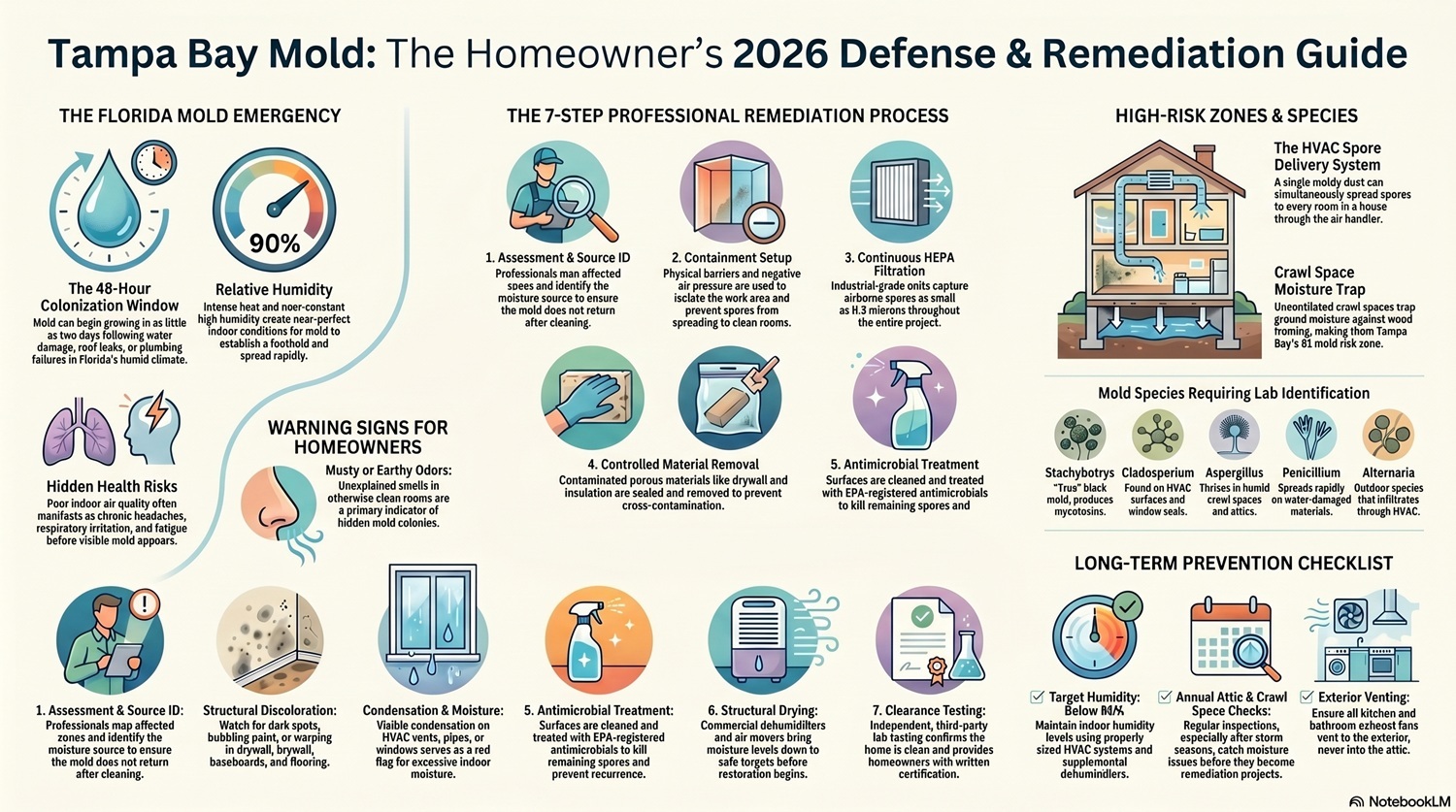
Florida’s humidity creates the perfect environment for mold growth. We’re talking about a state where outdoor relative humidity regularly sits at 90% or higher, and where a single afternoon storm can drive moisture into your walls, subfloor, and crawl space before you’ve had time to set out a towel.
The combination of intense heat, near-constant humidity, and frequent tropical storms creates near-perfect indoor conditions for mold to establish itself and spread. This isn’t a problem you can schedule for next month.
In 2026, we’ve responded to more post-storm mold calls across Tampa Bay than any previous season. The 48-hour colonization window is real, and once mold gets that foothold, a simple cleanup job becomes a full residential mold remediation and cleanup project — with containment, air filtration, material removal, and lab-certified results to prove the job is done right.
You cannot see what you are breathing, but poor indoor air quality can affect your family’s health in ways that show up as chronic headaches, respiratory irritation, and fatigue long before you spot the first dark patch on a wall.
Warning Signs That You Need Mold Remediation Tampa Professionals Right Now
Sometimes mold announces itself. Sometimes it doesn’t. Here’s what to watch for in a Tampa Bay home:
- ⚡ Musty or earthy odors in rooms that are otherwise clean
- ⚡ Dark spots or discoloration on walls, ceilings, grout lines, or wood framing
- ⚡ Warping, bubbling, or soft spots in drywall, baseboards, or flooring
- ⚡ Persistent allergy-like symptoms at home that clear up when you leave
- ⚡ Recent flooding, roof leaks, or plumbing failures with no professional moisture assessment
- ⚡ Visible condensation on windows, pipes, or HVAC vents regularly
- ⚡ A home that sat unoccupied during or after a storm season
Any one of these signs warrants a call for mold removal Tampa homeowners can count on. Two or more? Don’t wait another day.
What a Professional Mold Inspection Tampa Includes

A legitimate mold inspection Tampa isn’t just someone walking through your home with a flashlight. Our licensed inspectors use a structured, multi-method protocol to find what you can’t see with the naked eye.
Here’s exactly what a professional mold inspection Tampa service includes:
- 🛡️ Visual examination of all accessible surfaces, including inside cabinets, behind appliances, and in utility closets
- 🛡️ Moisture detection using calibrated meters that map hidden dampness inside walls and subfloors
- 🛡️ Air sampling to capture airborne spore counts in rooms throughout the home
- 🛡️ Surface sampling on suspected growth areas for lab analysis
- 🛡️ Thermal imaging to reveal moisture intrusion paths invisible to the naked eye
Every mold inspection Tampa we perform results in a comprehensive written report with findings, spore counts, and clear remediation recommendations. You know exactly what you’re dealing with before we do anything else.
We’ll never upsell you on services you don’t need. If the inspection comes back clean, we’ll tell you that, and we’ll tell you why.
Mold Testing Tampa: Lab-Certified Results, Not Guesswork
Visual identification alone is unreliable. Professional lab testing is the only accurate way to confirm mold species, and getting that wrong can lead to ineffective treatment, ongoing health exposure, and failed clearance tests down the road.
Our mold testing Tampa process sends air and surface samples to an accredited third-party laboratory. Results come back with species identification, spore concentration levels, and a baseline comparison to outdoor air samples so you have scientific context, not just a scary number.
This matters especially when black mold Tampa homeowners fear is suspected. Stachybotrys chartarum (the species most people refer to as black mold) produces mycotoxins that require specific remediation protocols. Treating it like a surface mold problem isn’t just ineffective; it’s dangerous.
Mold testing Tampa is also essential for clearance verification. After remediation is complete, we retest to confirm spore counts have returned to acceptable levels. Lab-certified results protect you, your family, and your property value.
The Residential Mold Remediation and Cleanup Process, Step by Step

Our residential mold remediation and cleanup process follows a proven, step-by-step methodology that meets EPA guidelines. Here’s what happens from the moment we arrive to the moment we hand your home back to you clean:
- Assessment: We confirm the scope, identify the moisture source, and map the affected zones before touching anything. Treating the symptom without fixing the source just means mold comes back.
- Containment Setup: We isolate the work area using physical barriers and negative air pressure to prevent spores from spreading to clean rooms during remediation.
- Air Filtration: Industrial-grade HEPA filtration units run continuously throughout the project, capturing airborne spores down to 0.3 microns.
- Material Removal: Contaminated porous materials (drywall, insulation, flooring) are carefully removed and sealed for proper disposal. We use non-destructive methods wherever possible to minimize structural impact.
- Cleaning and Treatment: All affected surfaces are cleaned, treated with EPA-registered antimicrobials, and dried to prevent recurrence.
- Drying: Commercial dehumidifiers and air movers bring structural moisture levels down to target before any restoration work begins.
- Clearance Testing: Independent post-remediation clearance testing confirms the home is clean. You get lab-certified results in writing.
A concise visual guide outlining the five essential steps in residential mold remediation and cleanup. Learn how to safely assess, contain, remove mold, and prevent future growth in homes.
Black Mold Tampa: The Species You Need to Identify Correctly
“Black mold” is probably the most misunderstood term in the residential mold world. Not everything dark is Stachybotrys, and not everything dangerous looks black. In Tampa Bay homes, our lab samples regularly reveal a wide variety of mold species, each requiring a different remediation approach.
The most common species we confirm in Tampa Bay homes include:
- Stachybotrys chartarum (true black mold Tampa homeowners fear most, associated with mycotoxin production)
- Cladosporium (very common in Florida, often found on HVAC surfaces and window seals)
- Aspergillus (thrives in humid conditions, found in crawl spaces and attics)
- Penicillium (spreads rapidly on water-damaged materials)
- Alternaria (an outdoor species that frequently infiltrates Tampa Bay homes through HVAC)
Black mold Tampa concerns are legitimate, but the only way to know what you’re actually dealing with is through proper mold testing Tampa lab analysis. We never guess, and we never assume.
Crawl Spaces, Attics, and HVAC: The Zones That Fuel Residential Mold Remediation and Cleanup Calls
Crawl spaces are Tampa Bay’s single biggest mold risk zone, but HVAC systems are close behind, and one moldy duct can spread spores to every room in your house simultaneously.
Here’s why these three areas generate more residential mold remediation and cleanup calls than anywhere else in a Florida home:
Crawl Spaces
Unventilated or poorly ventilated crawl spaces trap ground moisture against wood framing and insulation. In Tampa Bay’s soil conditions, that moisture never fully dries out without active moisture control measures like vapor barrier installation and mechanical ventilation.
Our crawl space mold remediation and removal services include full cleaning, antimicrobial treatment, and vapor barrier installation to break the moisture cycle permanently, not just temporarily.
Attics
Roof leaks, poor soffit ventilation, and bathroom exhaust fans vented directly into the attic space are the three biggest culprits we find in 2026 inspections. Attic mold often goes undetected for months because homeowners rarely go up there.
We remove contaminated insulation, treat the wood deck and framing, and verify ventilation improvements so the problem doesn’t return with the next rain season.
🌬️ HVAC Systems
Your air handler sits in a humid environment and moves moist air through ductwork every time it runs. Condensation builds on coil surfaces and inside ducts, and when mold colonizes that system, it becomes an active spore delivery mechanism pushing contaminated air to every room simultaneously.
HEPA filtration during remediation captures what’s already airborne. But your HVAC system needs to be assessed and treated as part of any complete residential mold remediation and cleanup, not as an afterthought.
Mold Remediation Tampa vs. DIY: Why This Is Not a Weekend Project
We understand the instinct. You see mold. You want to spray it and wipe it away. Done.
Here’s the problem. Consumer mold sprays and bleach solutions address surface growth on non-porous materials, but they don’t penetrate into drywall, wood framing, or insulation, and they absolutely do not neutralize mycotoxins. They also don’t address the moisture source, which means the mold comes right back, usually worse.
Professional mold remediation Tampa done correctly involves:
- Containment to protect unaffected rooms
- Negative air pressure to prevent cross-contamination
- HEPA filtration running continuously throughout the job
- EPA-registered antimicrobials applied to treated surfaces
- Controlled demolition of unsalvageable materials
- Post-remediation clearance testing with third-party lab analysis
None of that is available at a hardware store. And none of it can be replicated safely without proper training, licensed equipment, and an understanding of how mold behaves in Florida’s specific climate conditions.
“Through it all, our approach has stayed the same: treat every home like it’s our own.”
We’re not a franchise or a call center. When you call us, you’re talking to real people who live and work right here in Tampa Bay, people who understand what your home faces every storm season because our homes face it too.
Residential Mold Remediation and Removal Across All Five Counties
We serve Hillsborough, Pinellas, Pasco, Manatee, and Sarasota counties. All five. Every job gets the same protocol, the same equipment, the same lab-certified results, and the same personal oversight from David.
David personally oversees every project. No corporate runaround.
Whether you’re in South Tampa dealing with an aging crawl space, in Clearwater with storm damage to your attic, in Brandon facing a bathroom mold situation that’s gotten out of hand, or in Sarasota with an HVAC system that’s been spreading spores for months, the process is the same: thorough assessment, honest pricing, professional remediation, and a Breathe Easier guarantee backed by post-remediation clearance testing you can see in writing.
You can learn more about our full service scope at moldremediation.tampabaymold.net, where we document our methods, the mold species we commonly encounter, and the specific regional challenges Tampa Bay homes face in 2026.
How to Prevent Mold from Coming Back After Cleanup
The best mold problem is one that never happens. Prevention, once remediation is complete, comes down to three things: moisture control, airflow, and vigilance.
- 🛡️ Maintain indoor humidity below 60% using properly sized HVAC and supplemental dehumidifiers in high-risk zones
- 🛡️ Inspect your crawl space and attic annually, especially after any storm event
- 🛡️ Repair leaks immediately. The 48-hour colonization window doesn’t care how busy your schedule is
- 🛡️ Ensure HVAC systems are serviced regularly with filters changed on schedule
- 🛡️ Install or maintain a vapor barrier in your crawl space as a moisture control baseline
- 🛡️ Vent all bathroom and kitchen exhaust fans to the exterior, not into the attic
After any residential mold remediation and cleanup project we complete, we walk through these points with every homeowner directly. Not a flyer. Not a website link. A real conversation about what your specific home needs.
Conclusion: Residential Mold Remediation and Cleanup Is a Science, Not a Spray
Residential mold remediation and cleanup done right isn’t about scrubbing a wall and hoping for the best. It’s a structured, science-backed process built around containment, filtration, lab testing, and moisture control, and in Tampa Bay’s climate, it requires people who understand exactly what Florida throws at a home every single year.
We’ve built TampaBayMold.net around one principle: honest, owner-operated service that treats your home with the same care we’d want for our own families. Gator Guard is our promise. Breathe Easier is the result.
If you suspect mold in your home, don’t wait for it to spread. Get a professional mold inspection Tampa first, know exactly what you’re dealing with, and then let us handle the rest with lab-certified results and no corporate runaround.
Tampa Bay is our home. We’re here to protect yours.
Frequently Asked Questions
How much does residential mold remediation and cleanup cost in Tampa Bay in 2026?
The cost of residential mold remediation and cleanup varies significantly based on the scope, location, and materials affected. We provide honest, transparent pricing after a thorough mold inspection Tampa, with no hidden fees and no upselling on services you don’t need. Contact us directly for an accurate estimate for your specific home.
Is black mold Tampa homeowners find always Stachybotrys?
No, and this is one of the most common misconceptions we encounter. Black mold Tampa residents see is often Cladosporium, Aspergillus, or other dark-pigmented species. Visual identification alone is unreliable, which is exactly why mold testing Tampa through a certified lab is essential before any treatment begins.
How long does mold remediation Tampa take for an average home?
Most residential mold remediation Tampa projects take 1.5 to 5 days of active work, followed by post-remediation clearance testing that takes an additional day or two for lab results. More extensive cases involving crawl spaces, attics, and HVAC systems may take longer, and we’ll give you a realistic timeline upfront.
Can mold come back after professional mold removal Tampa services?
Professional mold removal Tampa eliminates the active mold growth and treats the affected materials, but mold can return if the underlying moisture source isn’t resolved. That’s why every residential mold remediation and cleanup we perform includes moisture source identification and moisture control recommendations to prevent recurrence.
Do I need a mold inspection Tampa before remediation, or can you just start cleaning?
A mold inspection Tampa before remediation is critical. Without it, you don’t know the full scope of the problem, the species involved, or whether hidden mold exists inside walls or under flooring. Skipping the inspection means you may be treating part of the problem while the rest continues to grow undetected.
What’s the difference between mold testing Tampa and a mold inspection?
A mold inspection Tampa is the physical examination of your home using visual, moisture, and thermal methods to identify where mold is present. Mold testing Tampa is the lab analysis of collected air and surface samples that tells you specifically what species are present and at what concentration. A complete assessment includes both, and we provide lab-certified results for every test we run.
Is residential mold remediation and cleanup covered by homeowner’s insurance in Florida?
It depends on the cause of the mold. If the growth resulted from a sudden, covered event like a burst pipe or storm damage, many policies will cover residential mold remediation and cleanup costs. Mold from long-term moisture neglect is typically excluded. We recommend contacting your insurance adjuster and requesting a professional inspection report, which we can provide, to support your claim.
One Reply to “Residential Mold Remediation and Removal: What Every Tampa Bay Homeowner Needs to Know in 2026”
Comments are closed.