
Can Mold Remediation Remove Black Mold Completely?
Article-At-A-Glance
- Black mold (Stachybotrys chartarum) thrives in Tampa Bay’s humid climate, making it one of the most common household threats in the region.
- Professional mold remediation does more than remove visible mold — it targets the moisture source to prevent regrowth.
- Nearly 70% of homes inspected in Hillsborough, Pinellas, and Pasco counties showed evidence of mold growth.
- There’s a critical difference between mold removal and mold remediation — and confusing the two can cost you.
- Keep reading to find out exactly when DIY removal is safe, and when it puts your household at serious risk.
Tampa Bay’s heat and humidity don’t just make summers uncomfortable — they make your home one of the most mold-friendly environments in the country.
If you’ve spotted dark patches on your walls, smelled something musty after heavy rain, or recently dealt with water damage, black mold may already be spreading in places you haven’t checked yet. The good news is that with the right approach, it can be addressed completely. TampaBayMold.net provides Tampa homeowners with local expertise specifically suited to Gulf Coast conditions, where generic mold advice often falls short.
What Is Black Mold and How Do You Identify It?
Black mold is not just a color — it’s a specific organism with specific behaviors. Understanding what you’re actually dealing with is the first step toward getting rid of it for good.
Stachybotrys Chartarum vs. Other Mold Types
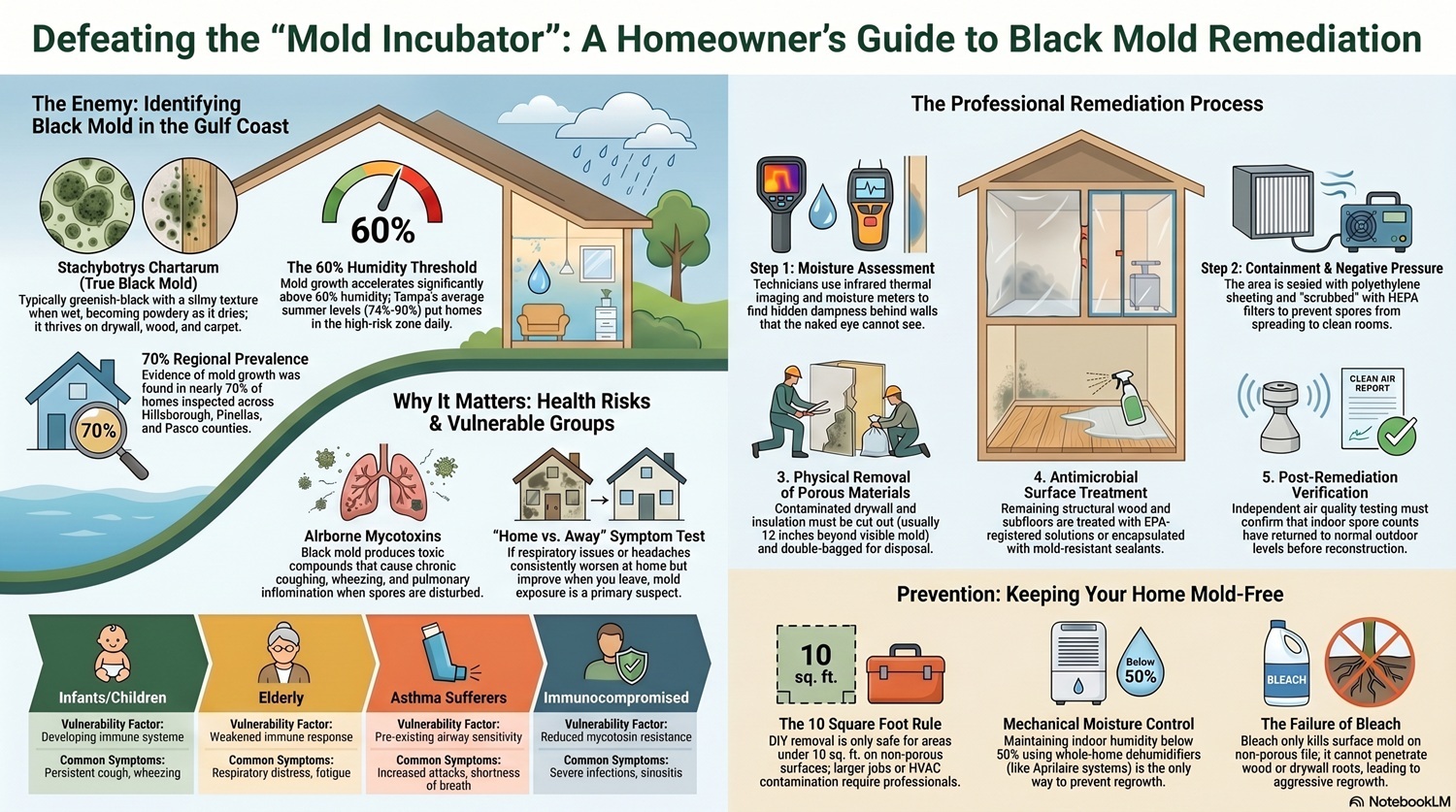
Not every dark-colored mold in your home is the infamous Stachybotrys chartarum. Tampa homes regularly host several mold species that can look nearly identical to the untrained eye. Aspergillus typically appears yellow-green to black. Cladosporium tends to show up as olive-green or brown. True black mold — Stachybotrys chartarum — is typically greenish-black and has a distinctly slimy texture when wet, becoming powdery as it dries.
The only reliable way to confirm you’re dealing with Stachybotrys is through professional testing. Visual identification alone is not enough, and treating the wrong mold type with the wrong method wastes time while the real problem continues to grow.
Common Signs of Black Mold in Tampa Homes
Black mold doesn’t always announce itself with a visible patch on the wall. In Tampa homes, it often starts silently — behind drywall, under flooring, or inside HVAC systems — before the signs become obvious. Watch for these indicators:
- A persistent musty or earthy smell, especially after rain or when the AC runs
- Visible dark green or black discoloration on walls, ceilings, or grout lines
- Warping, bubbling, or staining on drywall or ceiling tiles
- Household members experiencing unexplained respiratory issues, headaches, or fatigue
- Recent water intrusion, roof leaks, or plumbing failures that weren’t dried within 24–48 hours
Where Black Mold Hides Most Often
In Tampa’s climate, black mold gravitates toward areas with poor ventilation and residual moisture. Bathrooms without exhaust fans, crawl spaces, the space behind washing machines, under kitchen sinks, and inside air handler units are all prime locations. Attics are especially vulnerable after Florida’s intense storm seasons, where a single compromised roof seal can introduce enough moisture to sustain months of growth.
Why Tampa Homes Are Especially Vulnerable to Black Mold
Tampa Bay’s environment is essentially a mold incubator. The combination of subtropical heat, near-daily summer rainfall, and consistently high relative humidity creates conditions that are nearly impossible for mold to resist.
How Gulf Coast Humidity Accelerates Mold Growth
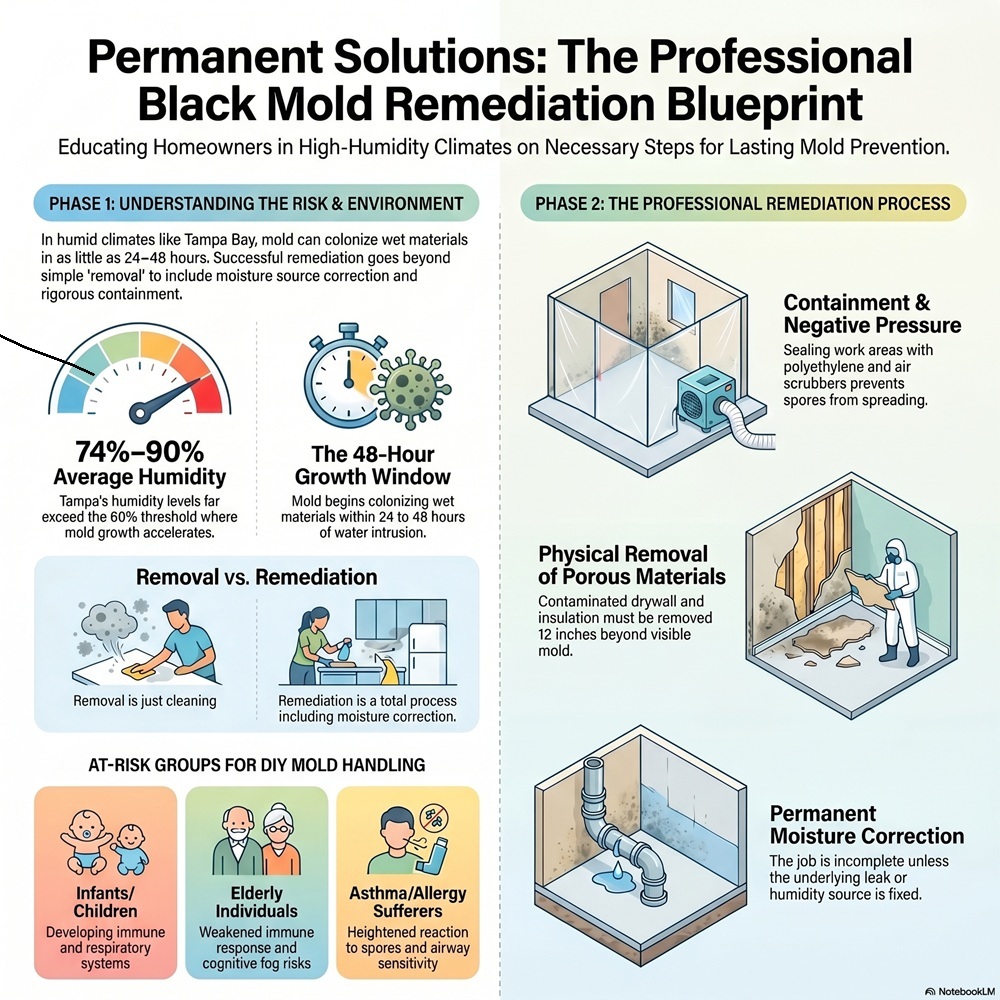
Mold needs three things to grow: a food source (like drywall, wood, or carpet), the right temperature, and moisture. Tampa delivers all three year-round. Average relative humidity in the Tampa Bay area hovers between 74% and 90% during summer months — well above the 60% threshold at which mold growth accelerates significantly.
That means even without a leak or flood event, ambient humidity alone can sustain active mold colonies inside walls, under floors, and in poorly ventilated spaces. Air conditioning systems, while helpful, create their own risk: the cold surfaces inside air handlers and ductwork are prone to condensation, and any organic debris in the system becomes mold food.
Homes with older construction, inadequate vapor barriers in crawl spaces, or single-pane windows face even greater risk. Condensation forms on cool surfaces and drips into wall cavities, creating hidden moisture reservoirs that never fully dry out.
Tampa Bay Humidity vs. Mold Risk:
Relative humidity above 60% creates favorable mold conditions. Tampa’s average summer humidity of 74%–90% means most homes are operating in the high-risk zone for mold growth every single day from May through October — even without any water damage event.
How Quickly Black Mold Spreads After Water Damage in Tampa
Speed matters enormously after any water intrusion. In Tampa’s climate, mold can begin colonizing wet materials in as little as 24 to 48 hours. Within a week of unaddressed water damage, what started as surface-level moisture can become a deep infestation inside wall cavities that requires full material removal to remediate.
The Health Risks of Black Mold Exposure
This isn’t about fear — it’s about facts. Prolonged black mold exposure has documented health consequences, and Tampa’s climate means exposure risks are elevated compared to drier regions of the country.
Respiratory Symptoms and Long-Term Effects
Stachybotrys chartarum produces mycotoxins — toxic compounds that become airborne when mold spores are disturbed. Inhaling these spores can cause chronic coughing, wheezing, sinus congestion, and throat irritation. In cases of prolonged exposure, more serious effects including pulmonary inflammation and immune system suppression have been documented.
Symptoms are often mistaken for seasonal allergies or recurring colds, which is one reason black mold infestations go unaddressed for months. If symptoms consistently worsen at home and improve when you leave, mold exposure should be high on your list of suspects.
Who Is Most at Risk in Your Household
While black mold affects everyone exposed to it, certain household members face significantly greater health risks from even moderate exposure levels.
| At-Risk Group | Why They’re More Vulnerable | Common Symptoms |
|---|---|---|
| Infants and young children | Developing immune and respiratory systems | Persistent cough, wheezing, frequent illness |
| Elderly individuals | Weakened immune response | Respiratory distress, fatigue, cognitive fog |
| Asthma sufferers | Pre-existing airway sensitivity | Increased asthma attacks, shortness of breath |
| Immunocompromised individuals | Reduced ability to fight mycotoxin effects | Severe respiratory infection, fungal sinusitis |
| People with allergies | Heightened reaction to mold spores | Chronic sneezing, itchy eyes, skin rashes |
Can Mold Remediation Remove Black Mold Completely?
Yes — but with an important distinction. The word “completely” requires context, because mold spores are naturally present in virtually every environment, including outdoor air. The goal of professional remediation is not to create a sterile, spore-free environment (which is neither achievable nor necessary). The goal is to return indoor mold levels to normal, naturally-occurring concentrations and eliminate the active colony and its moisture source.
When done correctly, professional remediation doesn’t just remove what’s visible. It uses containment, air filtration, physical removal of contaminated materials, and surface treatment to address the full scope of the infestation — not just the surface layer. Post-remediation testing then verifies that indoor spore counts have returned to acceptable levels.
The honest answer most remediation companies won’t volunteer: mold will return if the moisture problem that caused it isn’t fixed. No amount of chemical treatment or surface scrubbing will produce lasting results if the underlying humidity, leak, or ventilation failure remains unaddressed.
What “Complete Removal” Really Means: Successful black mold remediation means active colonies are eliminated, contaminated materials are removed, airborne spore counts return to normal outdoor levels, and the moisture source is permanently corrected. Anything short of all four criteria is an incomplete job.
What “Complete Removal” Actually Means
- Active mold colonies are physically removed or the affected materials are disposed of entirely
- Airborne spore concentrations are reduced to levels consistent with normal outdoor air
- The moisture source — whether a leak, condensation, or humidity — is identified and corrected
- Post-remediation air quality testing confirms clearance
- Affected structural areas are repaired and sealed to prevent re-entry of moisture
Remediation that skips any one of these steps is not complete remediation — it’s a temporary cosmetic fix. This is particularly important in Tampa, where ambient humidity means any residual moisture pathway will be exploited quickly.
Why Moisture Control Is the Real Key to Permanent Removal
Moisture is the single variable that determines whether black mold comes back. Remove the mold without fixing the moisture source and you’re essentially cleaning a surface that will be recontaminated within weeks. In Tampa Bay homes, moisture intrusion takes many forms — a slow roof leak, a sweating pipe inside a wall cavity, inadequate attic ventilation, or crawl space humidity that never drops below 70%. Each one creates a self-sustaining mold environment that surface treatments simply cannot overcome.
The most effective long-term strategy combines physical mold removal with mechanical moisture control. In Tampa’s climate, this typically means installing or upgrading dehumidification systems in crawl spaces, improving attic ventilation, sealing vapor barriers, and addressing any structural entry points for water. A dehumidifier maintaining indoor relative humidity below 50% is one of the most reliable tools for preventing regrowth after remediation.
Why Black Mold Returns After Improper Treatment
Improper treatment almost always comes down to one of three failures: treating only the visible surface while leaving colonized material in place, failing to identify and fix the moisture source, or using ineffective cleaning agents that don’t penetrate porous materials. Bleach, despite being widely recommended for DIY mold removal, is a perfect example — it kills surface mold on non-porous materials but cannot penetrate drywall, wood framing, or grout, leaving live mold roots intact beneath the surface.
When mold returns after treatment — and in Tampa’s climate, it will return quickly if any of these failures occurred — it often comes back more aggressively. The remaining colony has already established moisture pathways and structural footholds. What started as a 10-square-foot visible patch may represent a much larger hidden infestation by the time it reappears.
Mold Removal vs. Mold Remediation: They Are Not the Same Thing
These two terms get used interchangeably, but they describe fundamentally different scopes of work. Mold removal refers to the physical act of cleaning or disposing of mold-contaminated materials — it’s a single action. Mold remediation is a complete process that includes inspection, testing, containment, physical removal, air filtration, moisture correction, structural repair, and post-treatment verification. In Tampa’s high-humidity environment, mold removal without full remediation is a short-term fix that almost always results in recurring infestations. When you’re getting quotes from companies, ask specifically whether they offer full remediation or just removal — the answer will tell you everything about the quality of the outcome you can expect.
The Professional Black Mold Remediation Process in Tampa
A properly executed remediation job in Tampa follows a structured sequence of steps. Each one builds on the last, and skipping any step compromises the entire outcome. For more information on how black mold can be fully remediated, here’s what the full process looks like from start to finish:
- Inspection and moisture assessment using infrared cameras and moisture meters
- Air quality testing to establish baseline spore counts before work begins
- Full containment setup with negative air pressure to prevent cross-contamination
- Physical removal of all contaminated porous materials
- HEPA air filtration running continuously throughout the remediation
- Antimicrobial surface treatment on all affected structural components
- Moisture source correction — the step most DIY and cut-rate jobs skip entirely
- Post-remediation air quality testing to verify clearance before reconstruction
Step 1: Inspection and Moisture Assessment
Professional remediation in Tampa begins with a thorough inspection that goes well beyond what’s visible to the eye. Technicians use infrared thermal imaging cameras to detect temperature differentials in walls and ceilings that indicate hidden moisture pockets. Calibrated moisture meters confirm active dampness in structural materials. This step determines the true scope of the infestation, which is almost always larger than the visible surface area suggests — especially in homes that have experienced prolonged humidity exposure or undetected slow leaks.
Step 2: Containment to Stop Spore Spread
Before any physical disturbance of mold-contaminated materials, the work area must be fully contained. This means sealing off the affected zone with heavy-gauge polyethylene sheeting, establishing negative air pressure using HEPA-filtered air scrubbers, and creating a decontamination chamber at the entry point. Negative air pressure is critical — it ensures that when mold spores become airborne during removal, air flows into the contained zone rather than out of it, preventing cross-contamination of clean areas throughout the home.
Step 3: Physical Removal of Contaminated Materials
Any porous material that has been actively colonized by black mold must be physically removed and properly disposed of — there is no chemical treatment that can reliably decontaminate porous materials like drywall, insulation, or carpet padding. This is the most labor-intensive phase of remediation and the one most likely to be shortcut by inexperienced contractors.
Contaminated drywall is cut back to clean framing, typically removing at least 12 inches beyond the visible mold boundary to account for hidden growth. Insulation is bagged and removed entirely. Wood framing that shows active mold growth is treated with antimicrobial agents and, in severe cases, replaced or encapsulated with specialized sealants after treatment.
All removed materials are double-bagged in heavy-duty plastic sheeting, sealed, and disposed of according to local waste management guidelines. Materials are never transported through uncontaminated areas of the home without being fully sealed first.
Step 4: Air Filtration and Surface Treatment
With contaminated materials removed, HEPA air scrubbers run continuously to capture airborne spores released during demolition. HEPA filtration captures particles as small as 0.3 microns — mold spores range from 1 to 100 microns in size, meaning a properly rated HEPA unit captures them with high efficiency.
Remaining structural surfaces — exposed wall framing, subfloor, concrete block, and ceiling joists — are treated with EPA-registered antimicrobial solutions. In professional applications, these are typically applied by sprayer or fogger to ensure complete coverage, including into cracks and surface irregularities that a hand application would miss.
In some cases, particularly where mold has penetrated wood framing but full replacement isn’t structurally necessary, encapsulants are applied as a final barrier. These are mold-resistant sealants that lock any residual mold material beneath an impermeable coating, preventing future spore release from treated surfaces.
Step 5: Post-Remediation Testing and Verification
No remediation job is complete without independent post-remediation testing. Air samples are collected inside the treated area and compared against baseline outdoor air samples. Indoor spore counts must return to levels at or below outdoor concentrations before the area can be cleared for reconstruction. In Tampa, this testing step is particularly important — the local environment means ambient spore counts are already elevated compared to drier climates, and verification against the correct outdoor baseline is essential for an accurate clearance determination.
When DIY Black Mold Removal Is and Is Not Safe
DIY black mold removal occupies a narrow window of safe application. The circumstances where it’s appropriate are specific, and exceeding those boundaries puts your health and your home at significant risk. The key variables are the size of the infestation, the type of material affected, the location, and your confidence that you’ve identified the moisture source and can correct it permanently.
In Tampa’s climate, the bar for “this is a job I can handle myself” is higher than in drier states. Because ambient humidity is so consistently elevated, any incomplete treatment has an accelerated pathway to recurrence. What might remain dormant for months in a dry climate can reactivate within days in Tampa Bay’s summer heat.
The 10 Square Foot Rule and What It Means for Homeowners
The U.S. Environmental Protection Agency’s general guideline states that mold covering an area of 10 square feet or less — roughly a 3-by-3-foot patch — may be appropriate for homeowner self-remediation, provided it is on a non-porous surface and the moisture source has been fully corrected. Beyond 10 square feet, professional remediation is strongly recommended. In practice, if you’re finding that much visible mold in a Tampa home, the hidden extent is almost certainly larger — making professional assessment the safer call regardless of the visible surface area.
Protective Equipment You Need for Safe DIY Removal
If you do proceed with DIY removal within those guidelines, the right personal protective equipment is non-negotiable. At minimum, you need an N-95 respirator rated for mold spores — a standard dust mask provides no meaningful protection. Add chemical-resistant gloves (nitrile or rubber), safety goggles without ventilation holes, and disposable Tyvek coveralls to prevent spores from embedding in clothing and spreading to other areas of your home.
Your cleaning solution matters too. Bleach is not effective on porous surfaces. For non-porous materials like tile or sealed concrete, a diluted bleach solution (1 cup per gallon of water) can address surface mold. For wood or drywall, an EPA-registered fungicidal cleaner specifically formulated to penetrate porous surfaces is necessary. After cleaning, apply a mold-resistant primer before repainting any treated wall surfaces.
Situations That Always Require a Professional
Certain conditions remove the DIY option entirely, regardless of the visible size of the problem. If mold is present inside your HVAC system or ductwork, professional remediation is mandatory — a contaminated air handler distributes spores throughout every room in your home every time it runs, and cleaning ductwork requires specialized equipment and access that goes far beyond what a homeowner can achieve.
If the mold is located inside wall cavities, under flooring, in the attic, or in the crawl space, professional help is required. These areas require containment protocols and specialized equipment during material removal to prevent cross-contamination. Disturbing hidden mold without proper containment can rapidly elevate airborne spore counts to dangerous levels throughout the home.
Finally, if anyone in your household is immunocompromised, has asthma, or is an infant or elderly individual, the threshold for calling a professional drops to essentially zero. The health risk of improper mold disturbance in a household with vulnerable occupants is simply not a risk worth taking when professional remediation is available.
Black Mold Prevention After Remediation
Successful remediation gets you to a clean baseline — but maintaining that baseline in Tampa Bay requires active prevention. The same environmental conditions that caused the original infestation don’t go away after the remediation crew leaves. What changes is your knowledge of the vulnerabilities in your home and your ability to stay ahead of the conditions that allow mold to return.
Prevention in Tampa isn’t a one-time action — it’s an ongoing maintenance habit. Homes that stay mold-free after remediation do so because their owners treat humidity control and moisture monitoring as a regular part of home maintenance, the same way they treat HVAC filter changes or gutter cleaning.
Humidity Control Strategies for Tampa Homes
Keeping indoor relative humidity consistently below 50% is the single most effective preventative measure available to Tampa homeowners. A whole-home dehumidifier integrated with your HVAC system provides the most reliable control, particularly during the May through October rainy season when outdoor humidity makes passive control nearly impossible. For crawl spaces specifically, a dedicated crawl space dehumidifier — paired with an encapsulated vapor barrier that seals the ground and walls — creates a controlled environment that prevents the moisture migration that commonly feeds mold growth in first-floor walls and subfloor materials.
Portable dehumidifiers like the hOmeLabs 4,500 Sq. Ft Energy Star Dehumidifier work well for individual rooms or finished basements. For whole-home coverage in Tampa’s climate, systems like the Aprilaire 1850 Whole House Dehumidifier — rated for up to 4,200 square feet and capable of removing up to 95 pints of moisture per day — offer the capacity needed to keep up with Gulf Coast humidity levels during peak season. Pair any dehumidification system with a calibrated hygrometer to monitor actual humidity levels rather than relying on the unit’s built-in display alone.
How to Spot Early Warning Signs Before Mold Returns
Early detection is far less expensive than a second remediation. After your home has been treated, conduct a monthly visual inspection of the areas that were affected, plus any other high-risk zones: under sinks, around toilet bases, behind the washing machine, inside bathroom exhaust fan housings, and along the base of exterior walls in rooms that share a wall with the outdoors. You’re looking for any discoloration, soft spots in drywall, water staining on ceilings, or condensation on windows and pipes that wasn’t present before. For more details on how to handle mold effectively, consider reading about black mold remediation.
Pay attention to smell as much as sight. A returning musty odor — even without visible mold — is a reliable early indicator of renewed moisture accumulation. If you notice the smell in a specific room or area, use a moisture meter to check the walls and floor before calling a professional. Catching elevated moisture readings before mold colonies establish themselves is the ideal intervention point — addressing a moisture source at that stage costs a fraction of what a full remediation requires.
Professional Remediation Is the Only Reliable Path to a Mold-Free Tampa Home
Tampa Bay’s climate makes black mold one of the most persistent threats a homeowner in this region will face. The humidity, the heat, the storm season, and the construction characteristics of local homes all create conditions that mold exploits aggressively. Surface-level cleaning and DIY approaches have their place for small, contained problems on non-porous surfaces — but for any meaningful infestation, particularly in a Gulf Coast home where ambient conditions favor rapid regrowth, professional mold remediation is the only approach that addresses the full scope of the problem.
The combination of licensed inspection, proper containment, complete physical removal, moisture source correction, and independent post-remediation testing is not a premium option — it’s the baseline standard for a job that actually lasts. A home remediated to that standard, combined with active humidity control and routine monitoring, can remain mold-free indefinitely even in Tampa’s challenging environment.
Frequently Asked Questions
Tampa homeowners consistently ask the same practical questions when dealing with black mold. Here are direct answers to the most common ones.
Can black mold come back after professional remediation?
Yes, black mold can return after professional remediation — but only if the moisture source that caused the original infestation hasn’t been permanently corrected. A properly completed remediation that identifies and resolves the underlying moisture problem, removes all contaminated materials, and verifies clearance through post-remediation testing will not spontaneously regrow. Recurrence is always traceable to either an incomplete initial job or a new moisture intrusion event. This is why ongoing humidity control and periodic moisture monitoring are essential components of long-term prevention, not optional extras.
How long does black mold remediation take in Tampa?
- Small contained areas (under 10 sq ft, single room): 1–2 days
- Moderate infestations (multiple rooms or wall cavities): 3–5 days
- Large-scale or whole-home infestations: 1–2 weeks
- HVAC system contamination: Typically 1–3 days as a standalone service
- Post-remediation testing and clearance: Add 1–2 days for lab results after physical work is complete
Timeline also depends on the scope of structural repairs required after mold-contaminated materials are removed. Drywall replacement, insulation reinstallation, and finish work are typically scheduled separately after clearance testing confirms the remediated area is clean — adding additional time before the space is fully restored to its pre-damage condition.
In Tampa specifically, drying times during high-humidity months can extend remediation timelines. Structural materials need to reach acceptable moisture content levels before reconstruction begins, and achieving those levels in summer conditions may require extended dehumidification periods beyond what would be necessary in a drier climate.
Always get a written timeline estimate in your remediation contract, with specific milestones and a clear process for what happens if hidden mold is discovered during the work that expands the original scope.
Is black mold in Tampa more dangerous than in other states?
The mycotoxins produced by Stachybotrys chartarum are the same regardless of geography — the mold itself isn’t more toxic in Tampa than anywhere else. What differs is the scale and persistence of exposure. Tampa’s climate means infestations tend to be larger, more widespread, and longer-established by the time they’re discovered, compared to equivalent situations in drier climates. A Tampa homeowner may be exposed to a significantly larger active colony — and for a longer duration — than a homeowner in a drier state dealing with the same visible surface area of mold.
Additionally, Tampa’s ambient outdoor mold spore counts are naturally elevated compared to drier regions, meaning the total cumulative mold exposure for Tampa Bay residents — indoor plus outdoor — is higher than the national average even in homes without an active infestation. For households with vulnerable members, this makes proactive prevention and rapid response to any moisture event especially important.
How do I know if the black mold in my home is toxic?
You cannot determine whether black mold is Stachybotrys chartarum through visual inspection alone. The only reliable method is professional mold testing — either air sampling or surface swab samples sent to an accredited laboratory for analysis. A certified mold assessor can collect samples during an inspection and provide a species-level identification report, typically within 24 to 72 hours. Attempting to self-diagnose based on color or texture is unreliable because multiple mold species can appear nearly identical, and some non-toxic molds visually resemble Stachybotrys while some genuinely toxic varieties don’t conform to the classic greenish-black slimy appearance. When in doubt, test — it’s the only way to know what you’re actually dealing with.
Does homeowner’s insurance cover black mold remediation in Florida?
Florida homeowner’s insurance policies vary significantly in their mold coverage provisions. Most standard policies cover mold remediation only when the mold growth is a direct result of a covered peril — such as water damage from a burst pipe or storm intrusion — and only when the damage is reported promptly. Mold resulting from long-term humidity, slow leaks that weren’t reported, or maintenance failures is typically excluded. For more information on whether black mold is common in Tampa Bay, you can explore additional resources.
Florida law requires insurers to offer mold coverage as an optional endorsement, but it’s not automatically included in standard policies. Review your policy’s declarations page for any mold-specific sublimits — many Florida policies cap mold coverage at $10,000 regardless of the actual remediation cost, which may cover only a portion of a significant infestation.
Document everything before remediation begins if you intend to file a claim. Photograph all visible mold, save all moisture meter readings and inspection reports, and notify your insurer before any work commences — starting remediation before filing a claim can complicate or invalidate coverage. Your remediation contractor should be experienced with insurance documentation and able to provide a detailed scope of work that meets your insurer’s requirements.
If your claim is denied, Florida’s Department of Financial Services operates a consumer helpline and a mediation program for disputed property insurance claims. A public adjuster — a licensed professional who negotiates insurance claims on your behalf — can also be valuable if you’re dealing with a large claim or a disputed denial.
For Tampa Bay homeowners ready to address black mold at the source, TampaBayMold.net offers licensed mold remediation services specifically tailored to Gulf Coast conditions, from initial inspection through post-remediation clearance testing.
One Reply to “Can Mold Remediation Remove Black Mold Completely?”
Comments are closed.