
Different Types of Mold Found in Tampa Bay Homes: A Complete Identification Guide
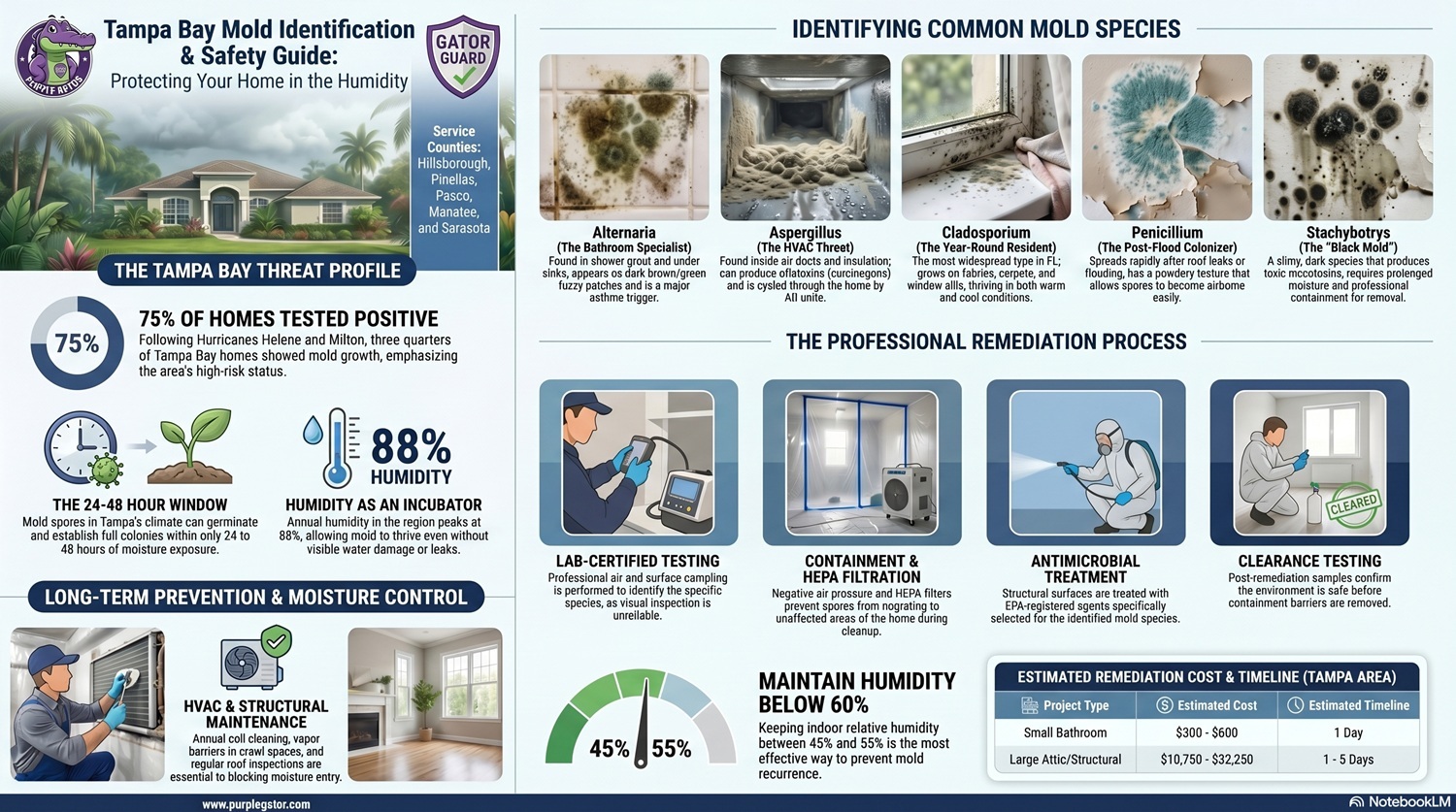
Understanding the different types of mold found in Tampa Bay homes is not optional — it is a matter of health and home safety. A staggering 75% of homes in the Tampa Bay area tested positive for mold growth following the flooding from Hurricanes Helene and Milton, and in 2026, that number continues to serve as a critical reminder that Florida’s humidity creates the perfect environment for mold growth year-round.
Key Takeaways
| Question | Answer |
|---|---|
| What are the most common types of mold found in Tampa Bay homes? | Cladosporium, Aspergillus, Penicillium, Alternaria, Stachybotrys (black mold), Chaetomium, and Ascospores are the most frequently identified species in Hillsborough, Pinellas, Pasco, Manatee, and Sarasota counties. |
| Can I identify mold type by color alone? | No. You can’t identify mold type by color alone — lab testing is needed to confirm the species present in your home. |
| Is a mold inspection in Tampa necessary after a flood or leak? | Yes. A professional mold inspection Tampa homeowners rely on uses air and surface sampling to detect mold that is not yet visible to the naked eye. |
| How fast can mold grow in a Tampa Bay home? | Mold spores can germinate and form colonies within 24 to 48 hours of moisture exposure in Tampa’s climate. |
| How much does mold remediation in Tampa cost? | Small bathroom mold can be addressed starting around $300-$600, while larger attic or structural projects involving severe HVAC contamination can reach $10,750 to $32,250. |
| What is black mold in Tampa and how dangerous is it? | Black mold Tampa residents most often encounter is Stachybotrys chartarum. It produces mycotoxins linked to serious respiratory illness and requires professional remediation. |
| How long does mold remediation take in Tampa Bay? | Small bathroom mold can be addressed in a day, while larger attic or basement projects may take longer, typically 1-5 days depending on scope. |
Why Florida’s Humidity Makes Tampa Bay Homes a Mold Hotspot
Tampa Bay’s annual humidity averages between 74% and 76%, frequently peaking at 88%. That is not just uncomfortable — it is a year-round incubator for every type of mold that can take hold inside a home.
We know the unique challenges our Florida climate creates, and we have the expertise to solve them. With 17 years of mold experience, 14 of those years specifically in Tampa Bay, we have seen what persistent moisture does to homes in Hillsborough, Pinellas, Pasco, Manatee, and Sarasota counties.
By the time you see or smell mold, the problem is often much bigger than it appears. Musty odors and visible dark spots are late-stage signals — what you cannot see behind drywall, under flooring, or inside your HVAC ducts is often far more extensive.
- High humidity enables mold to thrive even without visible water damage
- Post-storm moisture intrusion accelerates colony formation dramatically
- HVAC systems distribute spores throughout an entire home in hours
- Poor ventilation in Florida-style construction creates persistent moisture traps
- Seasonal rain events create repeated cycles of moisture exposure
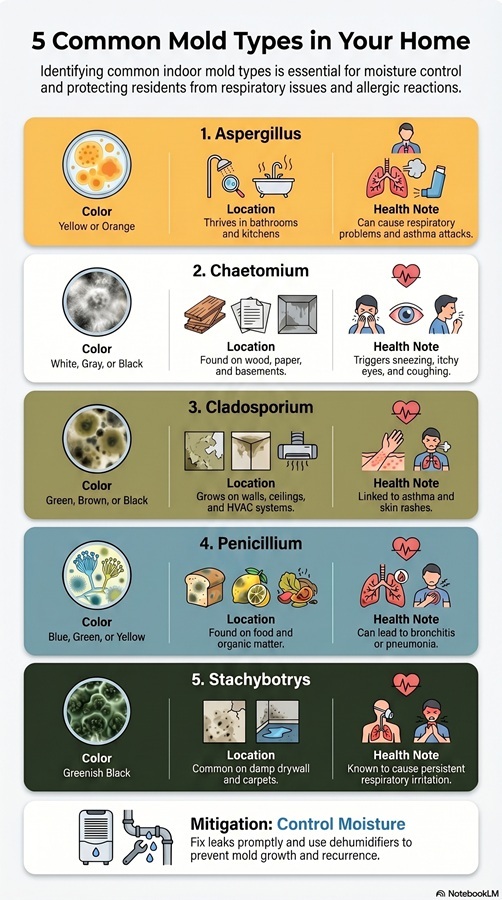
How to Identify the Different Types of Mold Found in Tampa Bay Homes
Step one is knowing what you are actually looking for. The different types of mold found in Tampa Bay homes range from surface-level nuisances to deeply embedded colonies producing dangerous mycotoxins.
Here is the critical rule: you can’t identify mold type by color alone — lab testing is needed. A dark patch in your bathroom could be Cladosporium, Alternaria, or Stachybotrys. A blue-green spot on your wall could be Penicillium or Aspergillus. Visual inspection alone tells you nothing definitive.
Air and surface samples processed through a certified laboratory are the only reliable method. This is why every one of our assessments begins with lab-certified sampling — not guesswork.
“By the time you see or smell mold, the problem is often much bigger than it appears.” Know exactly what you’re dealing with before any remediation begins.
The following sections break down each major mold species we identify through mold inspection Tampa Bay projects, what they look like, where they hide, and why they matter.
Alternaria: A Common Type of Mold Found in Tampa Bay Bathrooms
Alternaria is one of the most frequently identified mold types in Tampa Bay homes, particularly in high-moisture areas like bathrooms, under sinks, and around leaking fixtures.
It appears as dark brown or green patches with a fuzzy or velvety texture. It spreads aggressively in warm, humid environments, which means Tampa Bay’s climate practically invites it into any space with insufficient ventilation.
Where it hides:
- Shower grout and caulk lines
- Under bathroom and kitchen sinks
- Around window frames with condensation buildup
- Behind toilets and near water heaters
Health concerns: Alternaria is a well-documented allergen and a common trigger for asthma and respiratory irritation, particularly in children and the elderly.
If you notice a persistent musty odor near any of these areas, that is a red flag that Alternaria or another moisture-feeding species may already be established behind surfaces.
Aspergillus: The HVAC Mold Behind Many Tampa Bay Air Quality Problems
Aspergillus is one of the most dangerous different types of mold found in Tampa Bay homes because of where it grows: directly inside HVAC systems and ductwork.
It can appear in yellow, green, or white colonies depending on the species variant and the material it is colonizing. Once inside your air conditioning system, Aspergillus spores are continuously cycled throughout every room in the home.
Cladosporium and Aspergillus are the most frequently detected mold types in Florida homes, both known to trigger chronic respiratory symptoms and asthma.
Common locations:
- HVAC ducts and air handler units
- Water-damaged drywall and insulation
- Around roof leak penetration points
- Behind kitchen appliances with moisture exposure
Some Aspergillus species produce aflatoxins, a class of mycotoxins that are among the most potent naturally occurring carcinogens known. This is not a species to dismiss because it appears light-colored or small in area.

Cladosporium: One of the Most Widespread Types of Mold in Tampa Bay Homes
Cladosporium is, statistically, the mold most likely growing somewhere in your Tampa Bay home right now. It thrives in both warm and cool conditions, making it a year-round threat rather than a seasonal one.
It typically appears dark green, brown, or black — which is one reason why it is frequently misidentified as black mold Tampa homeowners fear most. Only lab testing distinguishes it from Stachybotrys or other darker species.
Prime locations for Cladosporium growth:
- HVAC duct liners and air filter housings
- Bathroom ceilings and tile grout
- Window sills and frames with condensation
- Fabrics, carpets, and upholstered furniture near exterior walls
- Crawl spaces and under-home moisture areas
Cladosporium does not require standing water to spread. Consistently elevated humidity above 70% is sufficient — and in Tampa Bay, that condition exists for most of the year.
Penicillium: The Post-Flood Mold Type Spreading Through Tampa Bay Homes
Penicillium spreads fast after water intrusion events — roof leaks, plumbing failures, and flood damage. It is one of the different types of mold found in Tampa Bay homes most commonly reported following hurricane seasons.
It typically presents as blue, green, or white growth on wallpaper, carpet backing, wood framing, and soft furnishings. Its powdery texture means spores detach and become airborne at the slightest disturbance.
Why Penicillium is particularly concerning in Tampa Bay:
- It spreads laterally across porous materials with remarkable speed
- It produces mycotoxins in several of its species variants
- It is a documented cause of hypersensitivity pneumonitis with repeated exposure
- Post-storm homes are ideal environments for rapid colony establishment
If your home sustained any water intrusion during the 2024 or 2025 storm seasons and you have not yet had a professional mold testing Tampa evaluation completed, Penicillium is a likely finding.
Stachybotrys: What You Need to Know About Black Mold in Tampa
Stachybotrys chartarum is the species most people mean when they say black mold Tampa. It has a distinct slimy, dark appearance and a characteristic musty, earthy odor that intensifies in enclosed spaces.
Unlike other types of mold that require only humidity, Stachybotrys requires prolonged, significant moisture and high-cellulose materials to become established. It is the mold found inside walls after slow leaks have gone undetected, in attics after roof damage, and in crawl spaces with persistent ground moisture.
Key facts about black mold Tampa homeowners need to understand:
- It produces trichothecene mycotoxins, which are among the most toxic mold byproducts
- Symptoms of exposure include chronic fatigue, respiratory distress, headaches, and cognitive impairment
- It requires EPA-compliant containment and HEPA filtration during removal
- DIY removal is not recommended — disturbing Stachybotrys without containment spreads spores throughout the home

The presence of black mold Tampa residents confirm through lab testing always triggers our full containment protocol. We use negative air pressure, full HEPA filtration, and proper disposal procedures on every Stachybotrys project.
Chaetomium, Ascospores, and Other Types of Mold Found in Tampa Bay Homes
Beyond the five most recognized species, Tampa Bay homes commonly test positive for several additional mold types that are equally important to identify and address.
Chaetomium
Chaetomium has a cottony texture and transitions from white to gray or dark brown as it matures. Its presence almost always indicates long-term, significant water damage behind walls or under flooring.
It produces chaetoglobosins, toxins with documented health effects. When Chaetomium appears in a lab report, it tells us that moisture intrusion was not recent — it has been ongoing, often for months or longer.
Ascospores
Ascospores are airborne fungal spores that appear on air quality sampling reports when indoor moisture levels are persistently elevated. They are an important indicator species — elevated ascospore counts in indoor air samples point directly to an active moisture problem that is feeding mold growth somewhere in the structure.
Basidiospores and Bipolaris
Basidiospores and Bipolaris are additional species regularly found in Florida air sampling results. Bipolaris, in particular, is associated with sinus infections and allergic fungal sinusitis in immunocompromised individuals.
Every species we identify through lab-certified testing gets documented in your full written report. Know exactly what you’re dealing with before any remediation plan is designed.
How Mold Testing Tampa Confirms Which Mold Type Is in Your Home
Mold testing Tampa homeowners need is not a surface swab with a store-bought kit. Those consumer kits are wildly unreliable and routinely produce false negatives on the most dangerous species.
Professional mold testing Tampa relies on two core sample types: air samples (which capture spore counts by species throughout the living space) and surface samples (which identify active colonies at specific locations). Both are sent to an accredited laboratory for full mycological analysis.
Our mold inspection Tampa process includes four key steps:
- Visual inspection using thermal imaging and moisture meters to locate hidden moisture and suspect growth areas
- Air sampling from multiple rooms, including the HVAC return, to capture the full spore profile of the indoor environment
- Surface sampling from any visually identified suspect areas to confirm species and concentration
- Lab analysis and written report with species identification, spore count comparison to outdoor baseline, and specific remediation recommendations
Owner-operated, David personally oversees every project. No corporate runaround. When you schedule a professional mold inspection Tampa with us, you get that same personal oversight on your project from start to written clearance report.
How Mold Remediation Tampa Eliminates Each Mold Type Correctly
Once lab results confirm the different types of mold present in your Tampa Bay home, the remediation protocol is built around those specific findings. Not every species is handled identically.
Stachybotrys and Chaetomium require full containment and negative air pressure. Cladosporium in HVAC ductwork requires duct cleaning with HEPA filtration. Penicillium spread across soft materials often requires content disposal in addition to structural treatment. The species matters — which is precisely why testing before remediation is non-negotiable.
Our mold remediation Tampa process:
- Containment: Physical barriers and negative air pressure units prevent spore migration to unaffected areas during removal
- Removal: Affected materials are removed, bagged, and disposed of per Florida state guidelines
- HEPA filtration: Air scrubbers with HEPA filtration run continuously throughout the project to capture airborne spores
- Treatment: Remaining structural surfaces are treated with EPA-registered antimicrobial agents appropriate for the identified species
- Clearance testing: Post-remediation air and surface sampling confirms the work is complete before containment is removed
We are not a franchise or a call center. We have protected over 3,000 homes across Tampa Bay with this exact process. Small bathroom mold can be addressed in a day, while larger attic or basement projects may take longer — typically 1-5 days depending on scope and species involved.
For full project details and a no-obligation estimate, visit our mold remediation Tampa service page or get a direct assessment at moldremediation.tampabaymold.net.
Moisture Control: The Permanent Solution Behind Mold Prevention in Tampa Bay
Removing mold without addressing the underlying moisture source is temporary. The same conditions that allowed the first colony to form will allow another to establish within weeks.
Effective moisture control for Tampa Bay homes includes:
- HVAC maintenance: Coil cleaning, drain pan inspection, and duct assessment on an annual schedule
- Humidity monitoring: Keeping indoor relative humidity below 60% year-round — ideally between 45% and 55%
- Vapor barriers: Proper crawl space encapsulation to block ground moisture migration
- Roof and window sealing: Regular inspection of penetration points where water can enter undetected
- Ventilation improvements: Bathroom exhaust fans, kitchen range hoods, and attic ventilation all reduce the moisture load that feeds mold growth
We discuss all of these recommendations with every homeowner after completing a project. Treat every home like it’s our own — which means we do not consider the job done until you understand how to keep mold from returning.
Conclusion: Know the Different Types of Mold Found in Tampa Bay Homes
The different types of mold found in Tampa Bay homes range from common surface molds like Cladosporium and Alternaria to highly toxic species like Stachybotrys chartarum. Florida’s humidity creates the perfect environment for mold growth, and the only way to know exactly what is present in your home is through professional lab-certified testing.
Whether you have noticed musty odors, visible dark spots, or simply experienced a recent water event, the clock starts immediately. Mold spores establish colonies within 24 to 48 hours in Tampa’s climate. The sooner you act, the smaller the problem stays.
We are owner-operated, lab-certified, and have 17 years of mold experience — 14 of those right here in Tampa Bay. No hidden fees. No corporate runaround. Just honest, professional mold services for homeowners across Hillsborough, Pinellas, Pasco, Manatee, and Sarasota counties.
Ready to breathe easier? Schedule your mold inspection, mold testing Tampa lab analysis, or full mold removal Tampa project today. Over 3,000 Tampa Bay families already have.
Frequently Asked Questions
What are the most dangerous types of mold found in Tampa Bay homes in 2026?
Stachybotrys chartarum (black mold) and certain Aspergillus species are considered the most dangerous types of mold found in Tampa Bay homes due to their mycotoxin production. Both require professional mold removal Tampa protocols including containment, HEPA filtration, and post-remediation clearance testing to ensure safe elimination.
How do I know if I have black mold in my Tampa home?
Visual inspection alone cannot confirm black mold Tampa identification — a slimy, very dark appearance and a strong musty odor are warning signs, but lab testing is the only reliable confirmation method. Stachybotrys is often found behind walls, under flooring, or in attics where significant water damage has occurred over an extended period.
How much does mold testing in Tampa cost in 2026?
Professional mold testing Tampa typically runs $300-$600 for a standard inspection with air and surface sampling, depending on the size of the property and the number of sample locations required. That cost includes your full lab report with species identification — not just a pass/fail result.
Can Tampa Bay mold come back after remediation?
Mold remediation Tampa removes existing colonies, but mold can return if the underlying moisture source is not corrected. Proper moisture control — including HVAC maintenance, humidity monitoring, and vapor barriers in crawl spaces — is the permanent solution that prevents recurrence of the different types of mold found in Tampa Bay homes.
Is a mold inspection Tampa necessary even if I cannot see mold?
Yes, absolutely. The absence of visible mold does not mean the absence of mold. Many of the most problematic species grow inside walls, under flooring, and within HVAC ductwork where they are completely invisible until a professional mold inspection Tampa with thermal imaging and air sampling is conducted.
What does Cladosporium look like in a Tampa Bay home?
Cladosporium typically appears as dark green, brown, or black spots in humid areas including bathroom ceilings, window sills, and HVAC duct liners. It is one of the most common different types of mold found in Tampa Bay homes and is a frequent trigger for chronic respiratory symptoms and asthma — though lab testing is required to distinguish it from other dark-colored species.
How long does mold remediation in Tampa Bay take from start to clearance?
Small bathroom mold can be addressed in a day, while larger attic or basement projects may take longer, typically 1-5 days for the active remediation phase plus 24-48 hours for post-remediation lab results to confirm clearance. The total timeline depends on the species involved, the extent of contamination, and whether affected materials require removal and replacement.