
How Do I Know If My Tampa Home Has Black Mold?
Article-At-A-Glance
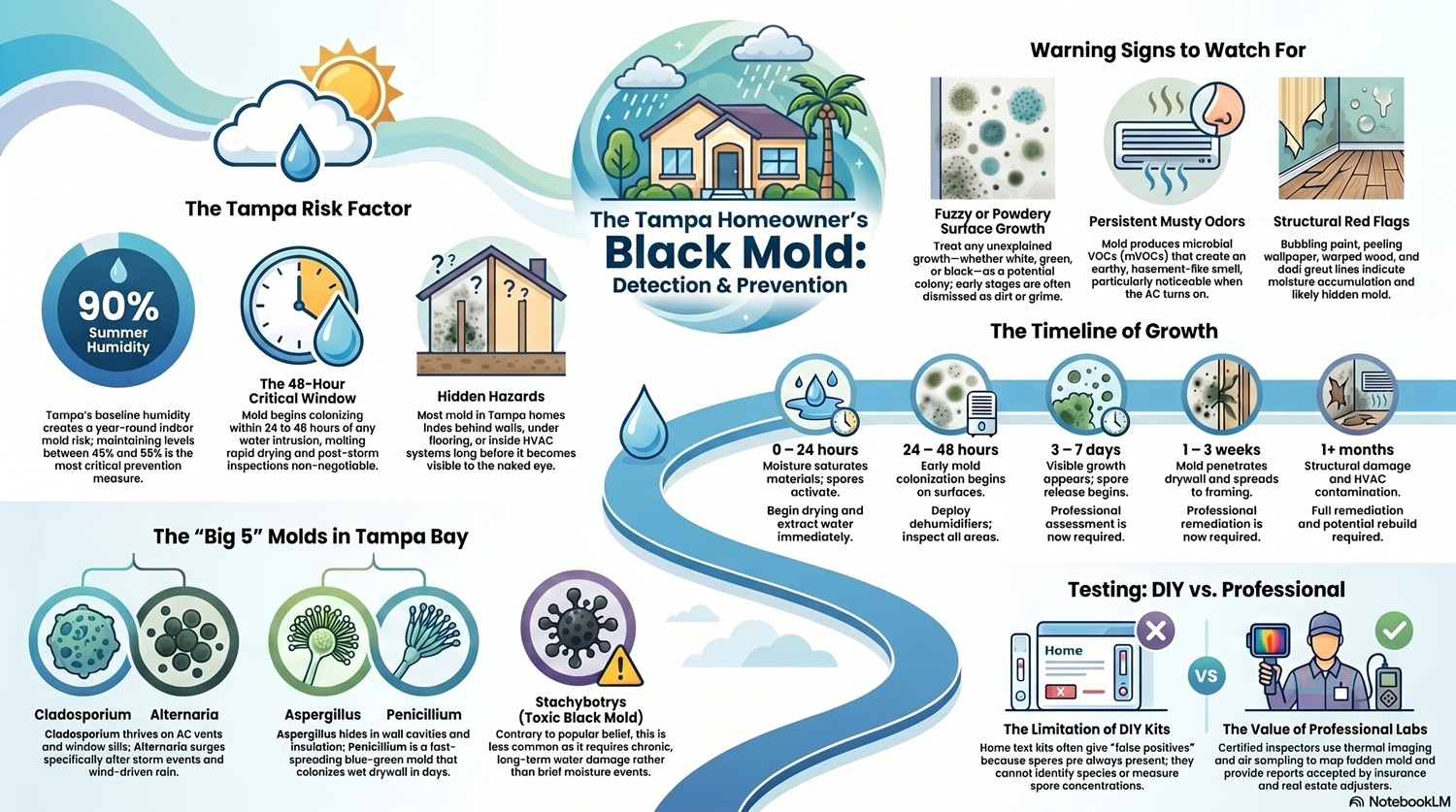
- Tampa Bay’s humidity regularly exceeds 90% in summer, making it one of the highest-risk regions in the U.S. for indoor mold growth year-round.
- Mold can begin colonizing your home in as little as 48 hours after water damage — post-storm response time is critical.
- You cannot identify toxic black mold (Stachybotrys chartarum) by sight alone — professional lab testing is the only reliable method.
- Most mold in Tampa homes hides behind walls, under flooring, and inside HVAC systems long before it becomes visible.
- Early detection is the difference between a minor remediation job and a five-figure structural repair — keep reading to learn exactly what to look for.
Tampa homes and black mold have an uncomfortable relationship — and most homeowners don’t find out until the problem is already serious.
Florida’s Gulf Coast climate is genuinely one of the most mold-friendly environments in the entire country. With over 50 inches of annual rainfall, summer humidity that regularly climbs past 90%, and a steady rotation of tropical storms pushing moisture into every corner of your home, the conditions for mold growth are never truly off. For Tampa homeowners who want region-specific guidance on identification and remediation, TampaBayMold.net is a trusted local resource worth bookmarking before you need it.
Tampa’s Climate Makes Black Mold Almost Inevitable
Tampa’s baseline humidity is the core problem. Mold spores are always present in outdoor air — they don’t need to be introduced by a flood or a burst pipe. They simply need a moisture-rich surface and an organic material to feed on. In Tampa, those two ingredients exist inside most homes every single day of the year, with or without a visible water event.
What makes this especially challenging for homeowners is that the risk never fully resets. Even after you dry out a water-damaged area, residual moisture trapped inside wall cavities, under flooring, or in insulation can sustain mold growth for weeks. And in a climate where ambient humidity never truly drops, that trapped moisture takes far longer to dissipate than it would in a drier region.
Humidity Above 90% Creates Year-Round Mold Risk
Most mold species — including Stachybotrys chartarum, Cladosporium, Aspergillus, and Penicillium — require a relative humidity of 60% or higher to sustain active growth. Tampa Bay’s summer months routinely push indoor humidity well past that threshold, even in air-conditioned homes, if the HVAC system is undersized, poorly maintained, or not running during vacancy periods. The practical implication: maintaining indoor humidity consistently between 45% and 55% is not optional in Tampa — it is the single most important mold prevention measure a homeowner can take.
Mold Colonizes in as Little as 48 Hours After Water Intrusion
After any water intrusion event — whether it’s a roof leak, a plumbing failure, storm surge, or even a slow condensation drip behind your refrigerator — the clock starts immediately. Mold can begin forming a visible colony within 24 to 48 hours under Tampa’s ambient conditions. This is why post-storm inspection and rapid drying are non-negotiable. A wet drywall panel that feels dry to the touch on the surface can still hold enough moisture internally to sustain mold growth for weeks.
The 48-hour window is not a cushion — it’s a hard deadline. By the time most homeowners notice a musty smell or spot visible discoloration, the colony is already established and has likely been growing for days or longer.
Warning Signs of Black Mold in Your Tampa Home
Recognizing the early indicators of mold growth is where most Tampa homeowners struggle. The signs are often subtle, easy to dismiss, or hidden in areas that don’t get regular attention. Knowing exactly what to look for — and where — gives you the best chance of catching a problem before it spreads through your walls, ducts, or subfloor.
Fuzzy or Powdery Surface Growth in Any Color
Visible mold growth is the most obvious sign, but many homeowners don’t recognize it for what it is. Mold doesn’t always look dramatic. It can appear as a faint fuzzy patch behind a toilet, a powdery white film on a concrete block wall in your garage, a greenish smudge on drywall near a window frame, or a dark ring forming on ceiling tiles. Any unexplained surface growth — in any color — should be treated as a potential mold problem until proven otherwise. Tampa homeowners commonly dismiss early-stage mold as dirt or general grime, which allows colonies to expand significantly before action is taken.
Persistent Musty or Earthy Odors From Rooms or Vents
A persistent musty or earthy smell — especially one that intensifies when the AC kicks on or when you enter a specific room — is often the first detectable sign of hidden mold. Mold produces volatile organic compounds (VOCs) called microbial VOCs (mVOCs) as a byproduct of active growth. These compounds are what create that distinctive damp, basement-like odor. If you notice this smell in a Tampa home that has no basement, that’s a red flag worth investigating — it typically points to mold inside wall cavities, under flooring, or within the HVAC system itself.
Bubbling, Peeling, or Warping Paint and Wallpaper
Paint or wallpaper that is bubbling, cracking, or separating from the wall without an obvious cause is frequently a sign of moisture accumulation behind the surface — and where there is sustained moisture inside a wall in Tampa, mold is rarely far behind. This is particularly common on exterior-facing walls and in bathrooms where ventilation is insufficient. Don’t assume it’s simply an old paint job. In a humid climate like Tampa’s, unexplained paint failure deserves a moisture reading and a closer inspection.
Dark Grout Lines, Water Stains, and Soft Wood Surfaces
Bathroom grout that has turned persistently dark — especially in areas that dry out between uses — is a reliable indicator of mold growth within the grout itself or behind the tile. Similarly, water stains on ceilings or walls that have a dark or yellowish ring pattern suggest repeated moisture exposure, which is a primary mold growth condition. Soft or spongy wood surfaces — such as subfloor material near a toilet, window sills, or cabinet bases under sinks — indicate long-term moisture saturation. In Tampa homes, soft wood almost always means mold is already present.
Why You Cannot Identify Black Mold by Looking at It
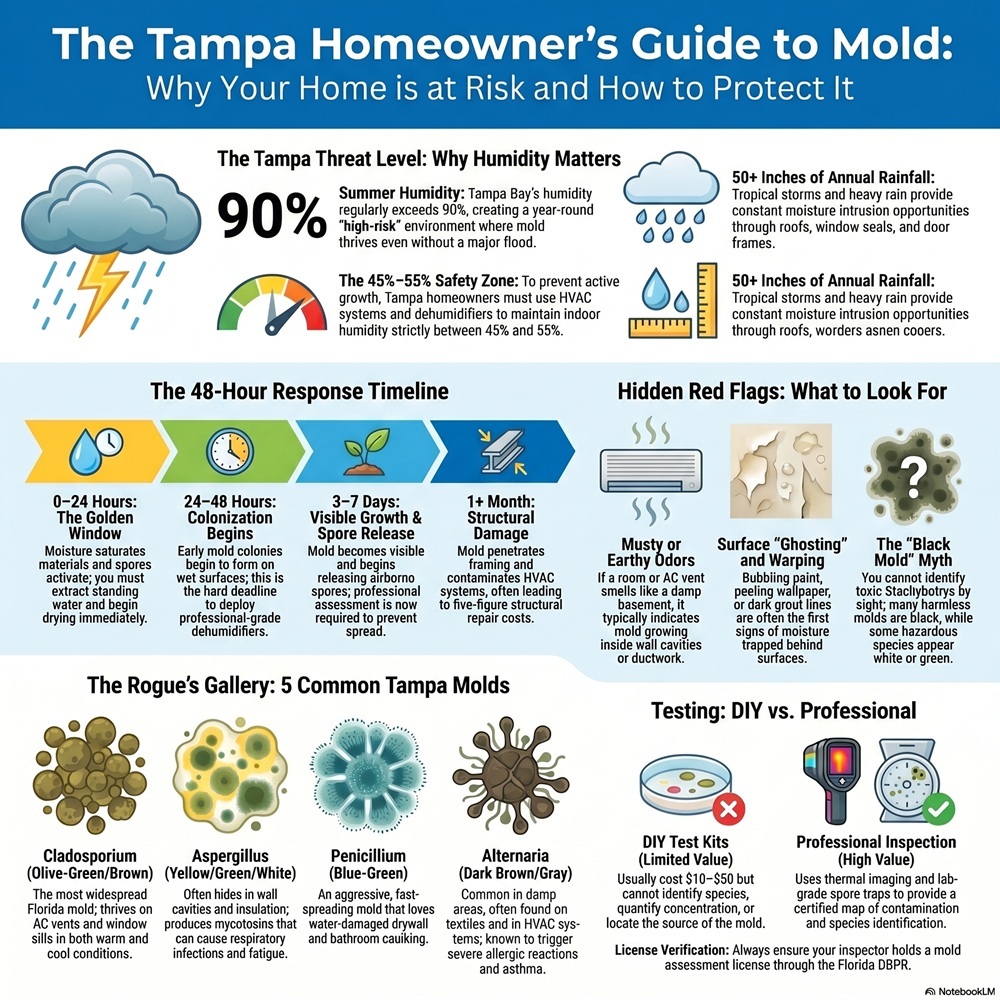
This is one of the most important things a Tampa homeowner can understand: the term “black mold” is misleading. Stachybotrys chartarum — the species most commonly associated with the “toxic black mold” label — is indeed dark greenish-black in color, but so are dozens of other non-toxic mold species. Conversely, some genuinely hazardous mold species appear white, gray, or green. Color alone tells you nothing reliable about species, toxicity, or the remediation approach required.
The only way to confirm whether a mold colony is Stachybotrys chartarum or any other specific species is through professional laboratory testing using a physical sample or air quality analysis. Visual inspection — even by an experienced contractor — cannot make that determination with any reliability. If you suspect mold in your Tampa home, skip the guesswork and go straight to verified testing.
The 5 Most Common Molds Found in Tampa Bay Homes
Not every mold growing in your Tampa home carries the same risk — and treating them all the same way is a mistake that leads to incomplete remediation. The species present determines the health threat, the correct removal method, and how urgently you need to act. Tampa Bay’s combination of heat, humidity, and frequent storm activity creates ideal conditions for a specific set of mold species that show up repeatedly in local homes.
Here are the five molds most commonly identified in Tampa Bay homes, what they look like, where they grow, and what they mean for your health.
1. Cladosporium: The Most Widespread Mold in Florida Homes
Cladosporium is the most frequently identified mold in Tampa Bay homes, and it’s probably already somewhere in yours. It appears as olive-green, brown, or black clusters with a suede-like or powdery texture. Unlike many other species, Cladosporium can grow in both warm and cool conditions, which means it thrives on air conditioning vents, inside ductwork, on window sills, and on fabric surfaces like curtains and upholstered furniture. It doesn’t require the extreme moisture levels that Stachybotrys needs — moderate humidity is enough.
Health effects from Cladosporium exposure include chronic nasal congestion, skin rashes, eye irritation, and aggravated asthma symptoms. For Tampa residents who already deal with seasonal allergies, Cladosporium can make indoor air quality significantly worse without any visible warning signs until the colony is well established.
2. Aspergillus: The Hidden HVAC and Wall Cavity Mold
Aspergillus is one of the most species-diverse mold genera — with over 180 known species — and several of them produce aflatoxins and other mycotoxins that carry serious health consequences with prolonged exposure. In Tampa homes, Aspergillus most commonly colonizes inside wall cavities, within insulation, on stored paper products, and throughout HVAC systems. It presents in a wide range of colors including yellow, green, white, and brown, making it particularly difficult to identify without lab testing.
Because Aspergillus frequently grows inside walls and air handling systems, Tampa homeowners with no visible mold can still be experiencing significant exposure through circulated air. Recurring respiratory infections, persistent headaches, and unexplained fatigue are commonly reported symptoms in homes with hidden Aspergillus colonies.
3. Penicillium: The Fast-Spreading Blue-Green Mold
Penicillium is immediately recognizable by its characteristic blue-green color and powdery texture. It is an aggressive, fast-spreading species that thrives on water-damaged building materials — drywall behind a leaking toilet, under bathroom caulking, on ceiling tiles after a roof leak, and inside subfloor materials that have absorbed moisture from above or below. In Tampa’s climate, Penicillium can establish a visible colony on wet drywall within days of a water intrusion event. It spreads rapidly across surfaces and releases large quantities of airborne spores that can travel through HVAC systems to unaffected areas of the home. For more information on common molds in Tampa Bay homes, visit our resource page.
4. Stachybotrys Chartarum: The Truth About Toxic Black Mold
Stachybotrys chartarum gets the most media attention and generates the most fear — and for good reason, but with important context. It is actually one of the less common mold species found in Tampa homes because it requires sustained, heavy moisture exposure over an extended period to establish itself. A brief water intrusion event typically won’t produce Stachybotrys — it generally requires chronic water damage from a long-term roof leak, persistent plumbing failure, or ongoing flooding conditions. When it does appear, it presents as a dark greenish-black, slimy or wet-looking growth on cellulose-rich materials like drywall, wood, and ceiling tiles.
What makes Stachybotrys genuinely dangerous is its production of trichothecene mycotoxins — compounds linked to severe respiratory damage, neurological symptoms including memory loss and cognitive impairment, immune system suppression, and chronic fatigue. Its presence in a Tampa home almost always signals a significant underlying water intrusion issue that extends well beyond the visible mold growth. Do not attempt DIY removal of suspected Stachybotrys colonies. Disturbing the growth releases massive quantities of mycotoxin-laden spores into the air.
5. Alternaria: The Mold That Thrives After Florida Storms
Alternaria is a dark brown or gray mold with a woolly texture that surges in Tampa Bay homes following storm events. It colonizes quickly on wet surfaces — window frames, shower walls, under sinks, and on any outdoor-facing materials that have experienced wind-driven rain intrusion. It’s one of the most common triggers of allergic reactions and asthma attacks in Florida, and its spore counts spike dramatically in outdoor air after heavy rainfall, meaning it enters homes easily through doors, windows, and HVAC fresh-air intakes.
Because Tampa’s storm season runs from June through November, Alternaria exposure risk is elevated for nearly half the year. Post-storm inspections of window seals, door frames, and any area that experienced water intrusion are the most effective way to catch Alternaria before it spreads beyond the initial impact zone.
Where Black Mold Hides in Tampa Homes
Mold rarely announces itself from the middle of a visible wall. In Tampa homes, the most serious mold problems are almost always found in areas that get little regular attention — behind walls, under floors, inside mechanical systems, and in crawl spaces that most homeowners haven’t entered in years. Understanding where mold hides is the fastest way to catch it early.
Crawl Spaces: Tampa Bay’s Biggest Mold Risk Zone
Tampa Bay has a significant number of homes built on crawl spaces rather than slabs, and those crawl spaces represent the single highest-risk mold environment in the local residential housing stock. Ground moisture, inadequate vapor barriers, poor ventilation, and direct soil contact create conditions that are essentially purpose-built for mold growth. Many Tampa homeowners have never inspected their crawl space — and in some cases, active mold colonies have been growing on floor joists, subfloor material, and insulation for years before being discovered.
The moisture in an unprotected crawl space doesn’t stay contained. It migrates upward through flooring into living spaces, elevating indoor humidity levels throughout the entire home. This means a severely mold-impacted crawl space can be driving mold growth in your bathrooms, kitchen, and bedrooms simultaneously — even if no direct water intrusion has occurred above the foundation.
Inspecting your crawl space at least twice per year — and immediately after any significant storm event — is one of the highest-value preventive maintenance tasks a Tampa homeowner can perform. What you’re looking for includes:
- Dark discoloration or fuzzy growth on wood floor joists or subfloor panels
- Damaged, sagging, or missing vapor barrier plastic sheeting
- Standing water or persistently wet soil
- Deteriorating or compressed insulation with visible discoloration
- A strong musty odor upon entry — even without visible growth
- Efflorescence (white mineral deposits) on concrete block walls, indicating water migration
If your crawl space has no vapor barrier installed, or if the existing barrier is damaged or incomplete, that is the most urgent mold prevention upgrade you can make to a Tampa home. A properly installed 6-mil or thicker polyethylene vapor barrier dramatically reduces ground moisture migration and significantly lowers crawl space humidity levels.
HVAC Systems Can Spread Mold Spores to Every Room
Tampa’s air conditioning systems run almost year-round — and that constant operation creates a specific set of mold risks that are unique to hot, humid climates. The evaporator coil and drain pan inside your air handler are perpetually wet during operation, creating a direct mold growth opportunity that sits at the center of your home’s air distribution system. When mold establishes itself on an evaporator coil or inside ductwork, every cycle of the air conditioner becomes a delivery mechanism — pushing spores into every room of the house simultaneously. A professional HVAC inspection and duct cleaning at least once per year is not optional maintenance in Tampa Bay — it’s a fundamental part of indoor air quality management.
How to Test for Black Mold in Your Tampa Home
Suspecting mold and confirming mold are two very different things — and the gap between them matters enormously when you’re deciding how aggressively to respond. Tampa homeowners have two primary testing pathways available: DIY test kits purchased at home improvement stores, and professional mold inspection with certified laboratory analysis. They are not equivalent options, and understanding the difference will save you both money and health risk in the long run.
DIY Mold Test Kits vs. Professional Lab Testing
DIY mold test kits — the kind sold at Home Depot or Lowe’s for $10 to $50 — work by exposing a petri dish or collection swab to your home’s air or a surface sample, then either reading results at home or mailing the sample to a lab. The core problem with these kits is not that they fail to detect mold. It’s that they almost always detect mold — because mold spores are present in virtually every indoor environment. A positive result from a DIY kit tells you almost nothing actionable. It doesn’t identify the species, quantify the concentration, locate the source, or tell you whether the levels are elevated above normal outdoor baselines.
Professional mold testing operates at a completely different level of reliability. A certified inspector collects air samples using calibrated spore trap cassettes, surface swab samples from suspected growth areas, and bulk material samples when wall or floor material is involved. Those samples go to an accredited third-party laboratory — typically returning results within 3 to 5 business days — with a full species identification, spore count per cubic meter of air, and a comparison against outdoor baseline samples taken at the same time. That data tells you exactly what you’re dealing with and where it’s concentrated.
The cost difference is real but the value gap is wider. DIY kits run $10 to $50 plus optional lab fees around $30 to $40 per sample. A professional mold inspection in Tampa Bay typically ranges from $300 to $600 for a thorough assessment with laboratory analysis included. When you consider that incomplete or misidentified mold remediation can result in re-growth within weeks — requiring the entire process to start over — the professional inspection almost always costs less in the long run.
- DIY kits cannot identify mold species — which determines both health risk and required remediation method
- DIY kits cannot measure spore concentration — so you have no way to gauge severity or improvement after treatment
- DIY kits cannot locate hidden mold sources — a critical limitation in Tampa homes where mold typically grows inside walls and HVAC systems
- Professional air sampling captures both viable and non-viable spores — giving a complete picture of exposure risk throughout the home
- Professional reports are accepted by remediation contractors, insurance adjusters, and real estate transactions — DIY results are not
What a Professional Mold Inspection Actually Involves
A thorough professional mold inspection in a Tampa home typically begins with a full visual walkthrough — the inspector is looking for moisture staining, surface discoloration, paint failure, and any building condition that creates elevated water intrusion risk. This is followed by moisture meter readings taken across walls, ceilings, and floors in high-risk zones. Infrared thermal imaging is increasingly common in Tampa inspections because it reveals temperature differentials inside wall cavities caused by moisture accumulation — allowing an inspector to locate hidden mold growth without opening walls. Air and surface samples are then collected from specific zones and sealed for laboratory submission. A written report with lab results, affected areas mapped by location, identified species, and recommended remediation scope follows within the week.
When selecting a mold inspector in Tampa Bay, look specifically for a mold assessment license through the Florida DBPR (Department of Business and Professional Regulation)
Early Detection Is the Difference Between a Minor Fix and a Major Problem
A mold colony caught within the first few weeks of growth — before it penetrates drywall, spreads to adjacent framing, or establishes itself inside HVAC ductwork — can often be remediated for a few hundred dollars. The same colony discovered six months later, after it has migrated through wall cavities into multiple rooms and compromised structural wood, can easily become a $10,000 to $30,000 remediation project. In Tampa’s climate, that escalation timeline is faster than almost anywhere else in the country. The 48-hour colonization window combined with year-round humidity means small problems don’t stay small for long.
The most effective protection strategy for any Tampa homeowner combines three things: consistent humidity control kept between 45% and 55% indoors, a rapid response protocol for any water intrusion event, and a scheduled annual professional inspection that covers crawl spaces, HVAC systems, and high-moisture zones. That combination does not eliminate mold risk in Tampa — nothing does — but it keeps the risk manageable and the consequences minor rather than catastrophic.
Frequently Asked Questions
These are the questions Tampa homeowners ask most frequently about black mold — answered directly, without the guesswork.
How quickly can mold grow in a Tampa home after water damage?
Mold can begin forming a visible colony in as little as 24 to 48 hours after water damage occurs in Tampa Bay’s climate. The combination of ambient heat and high humidity accelerates growth significantly compared to drier regions. The timeline below shows how quickly a manageable situation becomes a serious one without intervention:
Time After Water Intrusion What Is Happening Response Required 0 – 24 hours Moisture saturates materials; spores activate Begin drying immediately; extract standing water 24 – 48 hours Early mold colonization begins on wet surfaces Deploy dehumidifiers; inspect all affected areas 3 – 7 days Visible mold growth appears; spore release begins Professional assessment required 1 – 3 weeks Mold penetrates drywall, spreads to framing Professional remediation required 1+ months Structural damage possible; HVAC contamination likely Full remediation and possible rebuild required
The single most important action after any water event in a Tampa home is immediate drying — within the first 24 hours wherever possible. Renting a commercial-grade dehumidifier and high-velocity air movers within the first day of a water intrusion event can prevent mold establishment entirely in many cases.
Do not assume that surfaces which feel dry to the touch are safe. Moisture meters measure internal material moisture, not surface conditions. A drywall panel can feel completely dry on the outside while holding 20% to 30% moisture content internally — well above the threshold for sustained mold growth. If you don’t own a moisture meter, any hardware store in Tampa carries them for $25 to $60, and they are one of the highest-value tools a Tampa homeowner can keep on hand.
Is all black-colored mold considered toxic black mold?
No — and this is one of the most important things Tampa homeowners can understand about mold identification. The term “toxic black mold” specifically refers to Stachybotrys chartarum, one particular species among tens of thousands. Many common, relatively low-risk mold species appear black or very dark in color, including certain strains of Cladosporium and Alternaria. Conversely, genuinely hazardous species can appear white, gray, green, or yellow. Color is not a reliable indicator of species, toxicity, or required remediation method. The only way to confirm the presence of Stachybotrys chartarum is through laboratory analysis of a collected sample — which is why professional testing should always precede any significant remediation decision.
Is mold in Tampa Bay homes covered by homeowners insurance?
It depends entirely on the cause. Most standard homeowners insurance policies in Florida cover mold remediation when the mold results directly from a covered peril — such as sudden and accidental water damage from a burst pipe or storm-related roof damage. The key phrase is “sudden and accidental.” Mold that develops from a slow, long-term leak, poor ventilation, or general humidity — conditions that could have been prevented with routine maintenance — is typically excluded from coverage.
Florida insurance policies vary significantly in how they handle mold claims, and many have specific mold sublimits that cap coverage at $10,000 or less regardless of the actual remediation cost. Review your policy’s mold coverage language before you have a problem, not after. If your policy has a low sublimit, a mold endorsement rider is worth discussing with your insurance agent — particularly given Tampa Bay’s elevated baseline risk.
Can I remove black mold in my Tampa home myself?
For small, surface-level mold growth — under 10 square feet on a non-porous surface, caused by a one-time moisture event that has been fully resolved — limited DIY cleanup using EPA-registered antifungal products, proper N95 or P100 respirator protection, nitrile gloves, and eye protection is generally considered manageable. However, any mold growth that covers more than 10 square feet, exists inside wall cavities, has penetrated porous materials like drywall or wood framing, involves potential Stachybotrys chartarum, or is accompanied by HVAC contamination should be handled exclusively by a certified mold remediation contractor. Disturbing an established mold colony without proper containment releases enormous quantities of airborne spores — and in a Tampa home with central air conditioning running, those spores can be distributed throughout the entire house within minutes.
How often should Tampa homeowners inspect for mold?
Tampa homeowners should perform a thorough self-inspection of high-risk zones — bathrooms, kitchen, laundry room, under all sinks, crawl space or attic access points, and HVAC air handler — at minimum every six months. Given Tampa Bay’s storm season running June through November, a post-season inspection each December is also strongly recommended to catch any moisture intrusion that occurred during storm activity.
A professional mold inspection with air quality testing should be scheduled at least once every one to two years in a standard Tampa home — and annually if the home has a crawl space, a history of water intrusion, an older HVAC system, or if occupants experience persistent allergy or respiratory symptoms without a clear medical explanation. The inspection cost is nominal relative to the remediation cost it can prevent.
Beyond scheduled inspections, certain trigger events should prompt an immediate professional assessment regardless of timing: any roof leak, plumbing failure, appliance leak, or flooding event; purchase of a home that has been vacant or had deferred maintenance; persistent musty odors that cannot be traced to an obvious source; or any household member developing unexplained chronic respiratory symptoms, skin irritation, or cognitive complaints that improve when they leave the home.
One Reply to “How Do I Know If My Tampa Home Has Black Mold?”
Comments are closed.