
Does Tampa’s Humidity Cause More Mold Problems Than Other Cities?
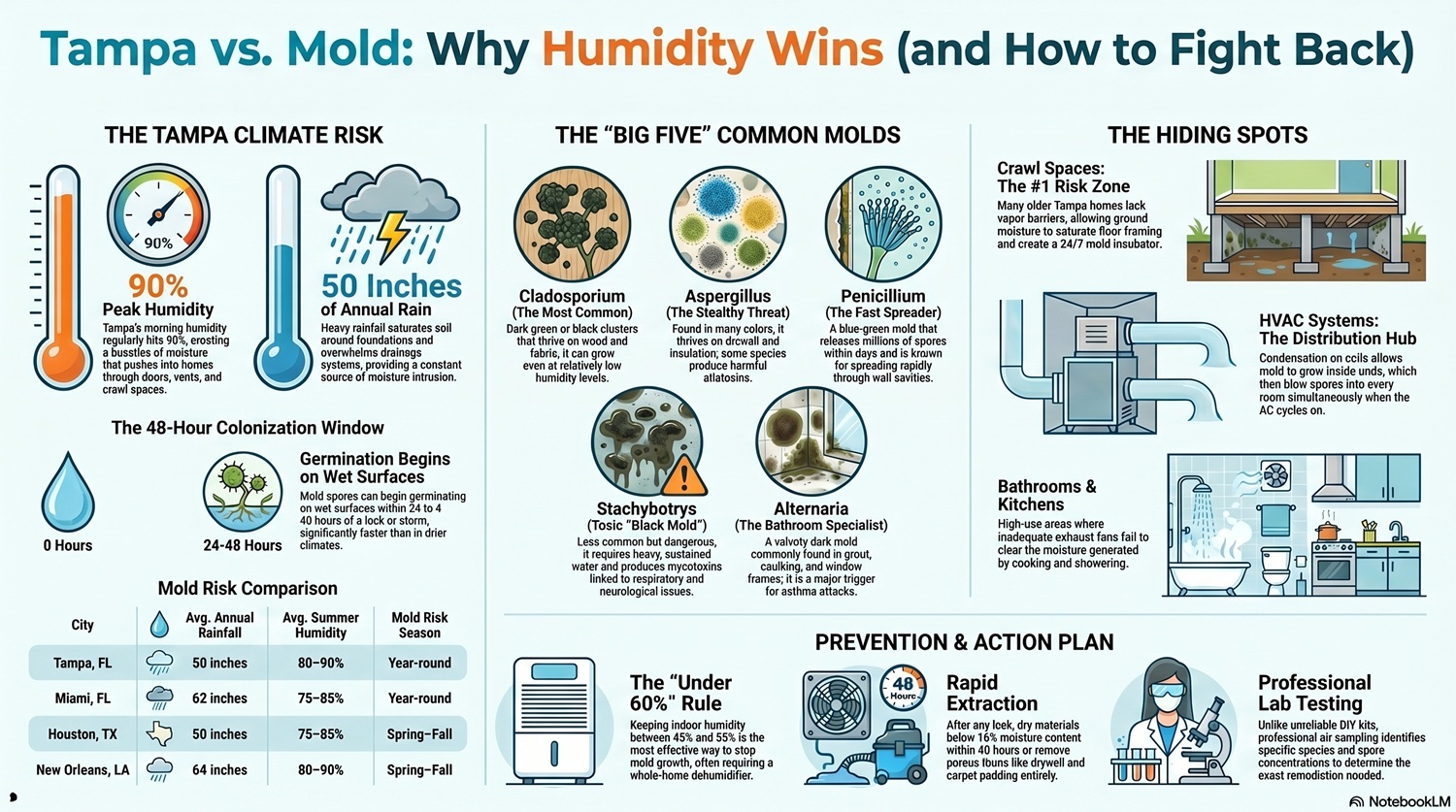
- Tampa’s summer humidity regularly exceeds 90% — making it one of the highest-risk cities in the U.S. for indoor mold growth year-round.
- Mold only needs 48 hours and a damp surface to begin colonizing your home after any water intrusion event, which is why post-storm response time is critical in Tampa Bay.
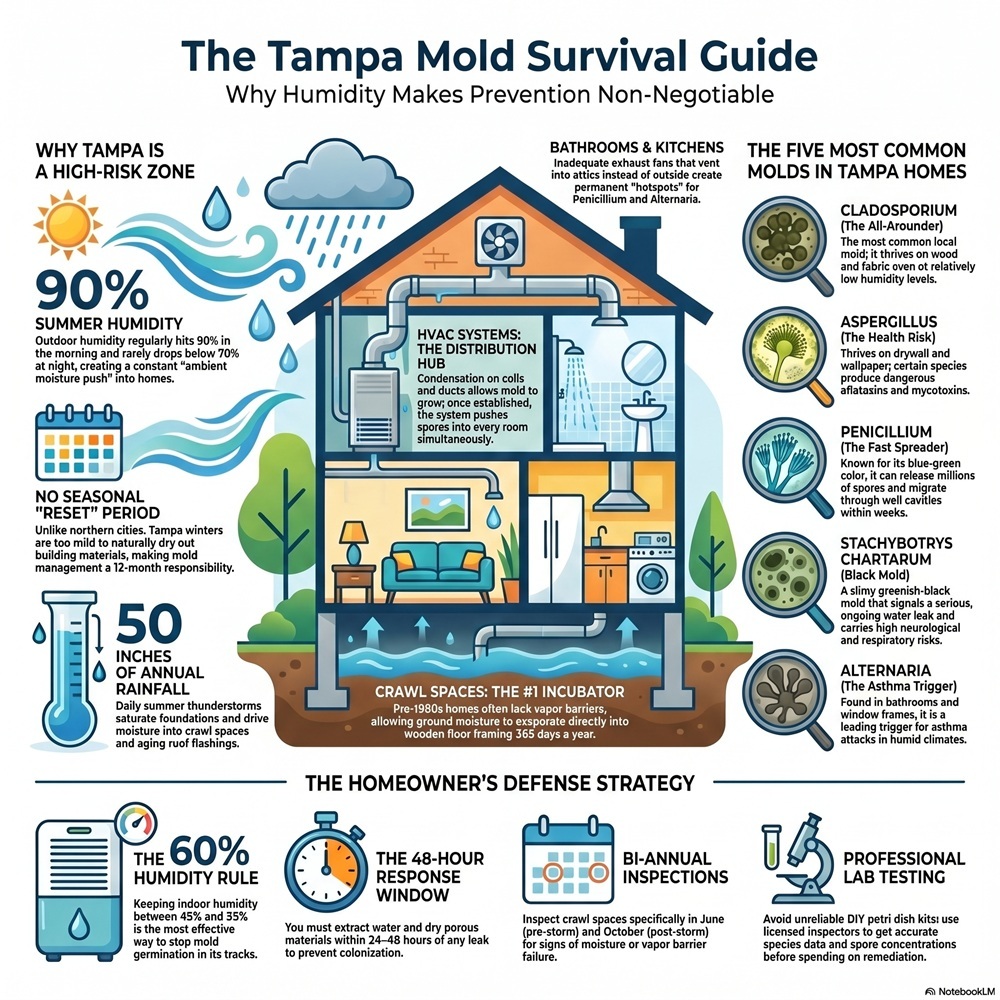
- The five most common molds in Tampa homes are Cladosporium, Aspergillus, Penicillium, Stachybotrys chartarum, and Alternaria — each with different health risks and preferred hiding spots.
- Crawl spaces and HVAC systems are the two biggest mold blind spots in Tampa Bay homes — and one contaminated duct can spread spores to every room simultaneously.
- Keeping indoor humidity consistently below 60% is the single most effective thing a Tampa homeowner can do to prevent mold — but in this climate, that takes more than just running the AC.
Tampa’s humidity doesn’t just make summers uncomfortable — it makes mold growth inside your home nearly inevitable without active prevention.
The combination of intense Gulf Coast heat, near-daily summer rainfall, and baseline outdoor humidity that rarely drops below 70% creates conditions where mold spores — which are always present in the air — have almost everything they need to grow year-round. The only variable you can actually control is moisture inside your home. TampaBayMold.net has documented how consistently these conditions translate into active indoor mold problems across Hillsborough, Pinellas, and Pasco counties.
Tampa’s Humidity Makes Mold Almost Inevitable
Tampa sits on the western edge of Florida’s peninsula, sandwiched between Tampa Bay and the Gulf of Mexico. That geography means moisture is constant — not just during rain events, but around the clock. Even on clear summer days, outdoor relative humidity in Tampa regularly sits between 80% and 90% by morning, only dropping to the 60s or low 70s in the afternoon heat. That ambient moisture pushes directly into homes every time a door opens, every time an air conditioning system cycles off, and every time a crawl space or attic goes uninspected.
Tampa Averages Over 50 Inches of Rain Per Year
Tampa receives an average of 46 to 50+ inches of rainfall annually, with the bulk concentrated between June and September. During these months, afternoon thunderstorms are nearly daily events — some dropping several inches of rain in under an hour. That volume of water doesn’t just run off. It saturates soil around foundations, drives moisture into crawl spaces, finds its way through aging roof flashing, and overwhelms gutters and drainage systems. Every one of those entry points is a potential mold trigger inside your home.
What makes Tampa’s rainfall particularly dangerous for indoor air quality is not just the volume — it’s the combination with heat. When warm, saturated outdoor air meets the cooler surfaces inside an air-conditioned home, condensation forms. On drywall, wood framing, insulation, and HVAC components, that condensation provides exactly the moisture film mold spores need to germinate.
Indoor Humidity Above 60% Is All Mold Needs to Grow
Mold doesn’t require standing water. It doesn’t need a flood or a burst pipe. Most common indoor mold species — including all five of the most prevalent types in Tampa Bay homes — can begin growing at relative humidity levels above 60%. In a Tampa home without active humidity control, indoor humidity frequently exceeds that threshold, especially in rooms with poor air circulation like closets, bathrooms, and utility spaces. The EPA recommends keeping indoor humidity between 30% and 50%. In Tampa, maintaining even the upper range of 50% to 60% requires deliberate, consistent effort.
Mold Can Colonize Your Home in as Little as 48 Hours After Water Damage
After any water intrusion event — a roof leak, storm surge, appliance overflow, or burst pipe — the clock starts immediately. Mold spores already present in your home’s air can begin germinating on wet surfaces within 24 to 48 hours. Tampa Bay’s baseline humidity means those spores are always viable and always present. A wet patch of drywall that would take four or five days to become a mold problem in a dry climate can become one in two days here. Speed of response is not optional — it is the single most important factor in preventing a manageable water event from becoming a serious remediation project.
How Tampa’s Humidity Compares to Other U.S. Cities
Tampa is not the only humid city in America, but the specific combination of factors that define its climate — high baseline humidity, extreme summer rainfall, year-round warmth, and Gulf Coast geography — makes it uniquely challenging for mold prevention compared to most other major U.S. cities.
Tampa vs. Miami, Houston, and New Orleans
| City | Avg. Annual Rainfall | Avg. Summer Humidity | Avg. Winter Low Temp | Mold Risk Season |
|---|---|---|---|---|
| Tampa, FL | ~50 inches | 80–90% | 50–55°F | Year-round |
| Miami, FL | ~62 inches | 75–85% | 60–65°F | Year-round |
| Houston, TX | ~50 inches | 75–85% | 45–50°F | Spring–Fall |
| New Orleans, LA | ~64 inches | 80–90% | 45–50°F | Spring–Fall |
Miami actually receives more annual rainfall than Tampa, and New Orleans matches Tampa’s peak summer humidity levels. But Tampa’s mold risk is compounded by its relatively mild winters — temperatures rarely drop low enough to create a meaningful dry season indoors. That means there is no annual reset period where cold, dry air naturally suppresses mold activity the way northern and even some Gulf Coast cities experience.
Why Gulf Coast Humidity Is Worse for Indoor Mold Than Coastal Northeast Cities
Cities like Boston, New York, and Philadelphia deal with significant humidity during summer months, but their winters drop to temperatures that naturally dry out building materials, kill off surface mold colonies, and reduce indoor humidity without mechanical intervention. Tampa homeowners do not get that seasonal reprieve. Mold management here is a 12-month responsibility, not a warm-weather concern.
Additionally, Gulf Coast air carries higher concentrations of marine moisture than inland or northern coastal cities. Salt air, combined with heat and rain, accelerates the degradation of building materials — particularly wood framing, roof decking, and window seals — creating more entry points for moisture intrusion over time. Older Tampa Bay homes built before modern vapor barrier standards are especially vulnerable to this compounding effect.
The 5 Most Common Molds Found in Tampa Bay Homes
Not all mold is the same, and the type growing in your home determines both the health risk and the remediation approach. Here are the five species most commonly identified in Tampa Bay residential properties.
1. Cladosporium
Cladosporium is the most commonly found mold in Tampa Bay homes and one of the most widespread mold species in the world. It appears as dark green, brown, or black clusters and thrives on organic materials like wood, fabric, carpet, and insulation. Unlike some molds that require sustained heavy moisture, Cladosporium can grow at relatively low humidity levels — which makes it particularly aggressive in Tampa’s climate. It is a known trigger for allergic reactions, asthma flare-ups, and sinus irritation, particularly in children and elderly residents.
You’ll find it most often in closets with poor airflow, on window sills where condensation collects, and underneath carpeting in rooms that experience temperature fluctuations. Its dark coloring makes it easy to mistake for dirt or general discoloration, which is why infestations frequently go unaddressed until they are well established.
2. Aspergillus
Aspergillus encompasses over 180 species and is the second most common mold genus found in Tampa Bay residential properties. It presents in a wide range of colors — white, yellow, green, brown, and black — which makes visual identification unreliable without lab testing. Aspergillus is particularly concerning because several of its species produce aflatoxins and other mycotoxins that pose serious health risks, especially for individuals with compromised immune systems. It thrives on high-starch materials like drywall paper facing, wallpaper, and ceiling tiles — all common in Florida construction.
3. Penicillium
Penicillium is easily recognized by its distinctive blue-green coloring and powdery texture. It spreads faster than almost any other common household mold — a single colony can release millions of spores within days of establishing itself. In Tampa Bay homes, it most commonly appears behind water-damaged walls, under wet flooring, and inside HVAC systems where condensation accumulates on coil surfaces. Penicillium is a potent allergen and has been linked to chronic sinus infections, lung inflammation, and in prolonged exposure cases, hypersensitivity pneumonitis.
What makes Penicillium particularly problematic in Tampa is its ability to spread horizontally through a structure rapidly. A small water leak behind a bathroom wall can produce a Penicillium colony that migrates through wall cavities into adjacent rooms within weeks. By the time visible signs appear on a surface, the infestation is typically already well beyond the point of simple surface cleaning.
4. Stachybotrys Chartarum (Black Mold)
Stachybotrys chartarum — commonly called black mold — gets the most media attention, but it’s actually one of the less frequently occurring molds in Tampa homes. That said, when it does appear, it demands immediate professional attention. It requires sustained, heavy moisture to grow, which means its presence almost always signals a significant, ongoing water intrusion event — not just surface condensation. Stachybotrys produces trichothecene mycotoxins, toxic compounds linked to serious respiratory damage, neurological symptoms, chronic fatigue, and immune suppression. It appears as a slimy, dark greenish-black coating and is most commonly found on water-damaged drywall, ceiling tiles, and wood framing in areas with prolonged moisture exposure.
5. Alternaria
Alternaria is a dark-colored mold — typically dark green or brown with a velvety texture — most commonly found in Tampa Bay bathrooms, under sinks, and around window frames where outdoor moisture makes frequent contact with interior surfaces. It is one of the leading mold-related triggers for asthma attacks and allergic responses, and it spreads aggressively in humid conditions. Tampa’s climate is essentially ideal for Alternaria growth throughout the entire warm season.
Unlike some molds that require a specific substrate or prolonged water exposure, Alternaria can establish itself on nearly any organic surface with intermittent moisture. In practical terms for Tampa homeowners, this means grout lines, caulking, wooden window frames, and even fabrics stored in poorly ventilated spaces are all viable growth sites. Early identification and humidity control are the most effective defenses against this particular species.
Where Mold Hides in Tampa Homes
Mold in Tampa Bay homes rarely announces itself early. By the time you see visible growth or smell that distinct musty odor, a colony is almost always well-established and has likely been growing for weeks or months. Knowing the specific locations where Tampa’s climate creates the most favorable mold conditions is what separates homeowners who catch problems early from those who face full-scale remediation projects.
The locations where mold most commonly hides in Tampa Bay homes are not random — they follow moisture patterns specific to the region’s climate, construction styles, and building materials. Understanding those patterns lets you inspect more strategically and intervene before a small problem becomes a structural one.
Crawl Spaces: Tampa’s Biggest Mold Risk Zone
Crawl spaces are the single highest-risk location for mold in Tampa Bay homes, and they are also the most consistently neglected. Many Tampa-area homes built before the 1990s have crawl spaces with little to no vapor barrier protection, leaving exposed soil directly beneath the home’s wooden floor framing. Ground moisture evaporates upward constantly, saturating the wood joists, subfloor decking, and insulation above. Combined with the limited airflow typical of enclosed crawl spaces, this creates a near-perfect mold incubator that operates 24 hours a day, 365 days a year. Cladosporium and Penicillium dominate in these environments, and infestations here frequently go undetected for years.
HVAC Systems Spread Spores to Every Room
A moldy HVAC system is not just an air quality problem in one room — it is a whole-home distribution system for mold spores. Tampa’s climate means air conditioning systems run almost continuously from April through October, and that constant operation creates persistent condensation on evaporator coils and inside ductwork. When mold establishes itself on those coil surfaces or in the duct lining, every cycle of the system pushes spores into every room of the house simultaneously. Warning signs include a musty smell immediately when the system turns on, visible dark streaking around supply vents, and occupants experiencing allergy or respiratory symptoms that worsen indoors but improve when they leave. For more information, check out this guide on common mold in Tampa homes.
Bathrooms and Kitchens Are Constant Hotspots
Bathrooms and kitchens generate moisture consistently — through showering, cooking, dishwashing, and the simple act of running water. In Tampa’s already-humid environment, that additional moisture load pushes these spaces into almost continuous mold-risk territory. Penicillium and Alternaria are the dominant species here, appearing in grout lines, under sink cabinets, behind toilets, around window frames, and on the underside of bath mats. Inadequate exhaust fan performance is the most common contributing factor — many Tampa homes have exhaust fans that are either undersized, vented into the attic rather than outside, or simply not used consistently enough to make a difference.
Health Risks From Tampa Bay’s Most Common Molds
Mold exposure in Tampa Bay homes is not a theoretical health concern — it is a documented, measurable risk that affects residents across a wide spectrum of age groups and health conditions. The specific health effects depend on the mold species present, the duration of exposure, the concentration of spores in the air, and the individual’s existing health status. However, even mold species that are considered lower-risk can cause significant symptoms with sustained daily exposure in a household setting.
Children, elderly residents, pregnant women, and individuals with existing respiratory conditions or compromised immune systems face the most serious risks. But healthy adults are not immune — prolonged exposure to elevated indoor mold spore concentrations has been linked to the development of new sensitivities and respiratory conditions in people with no prior history of allergies or asthma.
Respiratory Effects From Prolonged Mold Exposure
The most consistently documented health effects from indoor mold exposure are respiratory in nature. Chronic nasal congestion, persistent coughing, throat irritation, wheezing, and shortness of breath are the most common reported symptoms among Tampa Bay residents with active mold problems in their homes. In homes with Aspergillus or Stachybotrys contamination, more serious conditions including hypersensitivity pneumonitis — a lung inflammation that mimics pneumonia — have been documented. What makes mold-related respiratory effects particularly difficult to identify is that they develop gradually, and many sufferers attribute their symptoms to seasonal allergies or recurring colds rather than their indoor environment.
Which Mold Species Pose the Most Serious Health Risks
Among the five most common Tampa Bay molds, Stachybotrys chartarum carries the highest individual risk profile due to its mycotoxin production. Aspergillus follows closely, particularly for immunocompromised individuals, with certain species capable of causing invasive aspergillosis — a serious fungal infection of the lungs and sinuses. Penicillium and Alternaria are the most likely to trigger or worsen asthma and allergic responses in otherwise healthy individuals. Cladosporium, while the most widespread, generally poses the lowest acute health risk but remains a significant allergen with long-term exposure. No mold species found in residential settings should be considered harmless at sustained indoor concentrations.
How to Keep Mold Out of Your Tampa Home
Prevention in Tampa’s climate requires a more active, year-round approach than what works in drier regions. The factors that make Tampa’s humidity mold issues so persistent — constant ambient moisture, frequent rain events, mild winters, and the specific construction characteristics of Florida homes — do not go away. But they are all manageable with the right habits and targeted home improvements.
The most effective mold prevention strategy for Tampa Bay homeowners combines humidity control, rapid water damage response, regular inspection of high-risk zones, and professional testing when needed. Each of these elements addresses a specific vulnerability in the Tampa environment, and together they create a defense that holds up even in the most challenging summer conditions.
Keep Indoor Humidity Consistently Below 60%
The single most impactful thing a Tampa Bay homeowner can do to prevent mold is maintain indoor relative humidity consistently below 60% — ideally between 45% and 55%. At those levels, most common mold species cannot sustain growth even when spores are present in the air. A calibrated digital hygrometer (available for under $20 at most hardware stores) placed in high-risk rooms like bedrooms, bathrooms, and utility spaces gives you real-time data to act on rather than guessing.
In Tampa’s climate, achieving sub-60% indoor humidity requires more than just running the air conditioner. Whole-home dehumidifiers integrated into the HVAC system are the most effective solution for consistent control — standalone units work well for single rooms but cannot keep pace with Tampa’s ambient moisture load across an entire house. Sealing crawl space vents, installing vapor barriers under the home, and ensuring all exhaust fans vent directly outside (not into the attic) are the structural improvements that make humidity targets achievable long-term.
Respond to Water Intrusion Within 24 to 48 Hours
After any water intrusion event — storm flooding, a roof leak, a burst pipe, or even a significant appliance overflow — you have a narrow window to act before mold colonization begins. In Tampa’s climate, that window is 24 to 48 hours at most. The immediate priority is extraction and drying: get standing water out first using a wet/dry vacuum or pump, then deploy industrial air movers and dehumidifiers to bring affected materials below 16% moisture content as quickly as possible. Any porous material — drywall, insulation, carpet padding — that cannot be dried within that window should be removed and discarded rather than dried in place. Attempting to dry saturated porous materials in Tampa’s ambient humidity almost always results in mold growth regardless of surface drying efforts.
Inspect Crawl Spaces and HVAC Systems on a Regular Schedule
Given that crawl spaces and HVAC systems represent Tampa Bay’s two highest-risk mold zones, both deserve scheduled inspections rather than reactive attention. Crawl spaces should be physically inspected at minimum twice per year — once before summer storm season begins in June, and once after it ends in October. Look specifically for visible mold growth on wood framing, deteriorating or absent vapor barriers, standing water or soil moisture, and pest damage that may have compromised the vapor barrier. HVAC systems should have evaporator coils professionally cleaned annually and ductwork inspected every two to three years, with particular attention to flex duct sections where condensation commonly accumulates and liner degradation creates mold-friendly surfaces.
Get Professional Lab Testing Before Committing to Remediation
If you suspect mold but cannot confirm the species or scope visually, professional air quality testing with lab analysis is worth the investment before committing to a remediation approach. A licensed mold inspector can collect both air samples and surface swab samples, with results analyzed by an accredited laboratory that identifies species and quantifies spore concentrations. This matters because the remediation protocol for a contained Cladosporium surface colony is significantly different — and less expensive — than what is required for a Stachybotrys infestation inside wall cavities. Getting the data first prevents both under-treatment (leaving active mold behind) and over-treatment (paying for full remediation when targeted cleaning would have been sufficient).
Tampa’s Mold Problem Is Serious, But It Is Manageable
Tampa’s climate is not going to get less humid, and mold spores are not going away. But the factors that create mold risk in Tampa Bay homes — ambient humidity, frequent rainfall, mild winters, and the specific vulnerabilities of Florida construction — are all factors you can actively work against. The homeowners who avoid serious mold problems in this climate are not the ones who get lucky. They are the ones who treat humidity control as a year-round maintenance priority, respond to water events with urgency, and inspect the spaces that mold prefers before visible symptoms appear.
Prevention is dramatically less expensive than remediation — in both financial and health terms. A whole-home dehumidifier, a semi-annual crawl space inspection, and an annual HVAC cleaning cost a fraction of what a mid-sized mold remediation project runs in Tampa Bay. The investment is not just in your property. It is in the air quality that every person in your home breathes every single day.
Frequently Asked Questions
Tampa homeowners consistently have the same core questions about mold — and getting accurate, specific answers matters more here than in most U.S. cities, because the stakes of misunderstanding the risks are higher in this climate. The following addresses the questions that come up most often.
What humidity level causes mold to grow indoors?
Most common indoor mold species can begin growing when relative humidity exceeds 60% at a surface level and can begin to germinate in 24 hours if the humidity is above 70%. The EPA recommends maintaining indoor humidity between 30% and 50% for optimal air quality. In Tampa, the practical target is keeping humidity below 60% consistently — even brief spikes above that threshold on surfaces like drywall, wood framing, or HVAC components can initiate germination if mold spores are present, which in Tampa Bay, they always are.
Is Tampa one of the worst cities in the U.S. for mold?
Yes — Tampa consistently ranks among the highest-risk cities in the continental United States for residential mold problems. The combination of factors is what sets it apart: high baseline ambient humidity year-round, concentrated summer rainfall that frequently causes water intrusion, mild winters that eliminate any natural mold-suppression period, and a large percentage of older housing stock built before modern vapor barrier and moisture management standards.
Cities like New Orleans and Miami receive more annual rainfall, and Houston matches Tampa’s humidity profile during summer months. But Tampa’s specific combination of near-constant humidity, frequent storm events, year-round warmth, and Gulf Coast marine moisture gives it one of the most persistently challenging mold environments in the country for residential properties.
What makes Tampa particularly difficult compared to even other Florida cities is the relative lack of elevation and the high water table across much of Hillsborough and Pinellas counties. Homes sit closer to saturated soil, crawl spaces are more directly affected by ground moisture, and drainage after heavy rain events is slower — all of which extend the window of moisture exposure that drives mold growth inside homes.
What is the most dangerous mold found in Tampa Bay homes?
Stachybotrys chartarum — commonly called black mold — carries the most serious individual health risk profile of any mold commonly found in Tampa Bay residential properties. It produces trichothecene mycotoxins linked to severe respiratory damage, neurological symptoms, chronic fatigue, and immune suppression. However, it is also one of the less frequently occurring molds in Tampa homes because it requires sustained, heavy moisture to grow — not just high humidity.
In terms of how frequently a mold species causes health problems across the Tampa Bay population, Aspergillus and Penicillium are responsible for a far greater number of cases simply because they are more prevalent and easier to establish. Aspergillus in particular poses serious risks for immunocompromised individuals, with certain species capable of causing invasive fungal infections. The practical takeaway is this: no mold species found in your home should be dismissed as harmless, regardless of color or appearance.
How do I know if my HVAC system has mold?
The most reliable early indicator of HVAC mold in a Tampa Bay home is a musty or earthy smell that appears immediately when the system cycles on and dissipates when it turns off. Additional signs include dark streaking or discoloration around supply vents, unexplained worsening of allergy or respiratory symptoms indoors, and visible growth on or around the air handler unit itself. Because mold inside ductwork is not visible without physical inspection, the absence of visible signs does not mean the system is clean — particularly if it has not been professionally serviced within the past 12 months in Tampa’s climate.
Do I need a professional to test for mold or can I do it myself?
DIY mold test kits — the type sold at hardware stores that involve leaving a petri dish open and mailing it to a lab — are largely unreliable for making meaningful decisions about remediation. They will confirm that mold spores are present (which is always true in any indoor environment), but they cannot provide accurate species identification, spore concentration data, or comparison to outdoor baseline levels that make the results actionable.
Professional testing performed by a licensed mold inspector using calibrated air sampling equipment and accredited laboratory analysis gives you data you can actually use. It identifies which species are present, at what concentrations, whether indoor levels are elevated compared to outdoor baseline, and where the contamination is likely originating. That information directly determines what remediation approach is appropriate and whether any remediation is needed at all.
One Reply to “Does Tampa’s Humidity Cause More Mold Problems Than Other Cities?”
Comments are closed.