
Should I Get A Mold Inspection After A Flood Or Water Damage In Tampa?
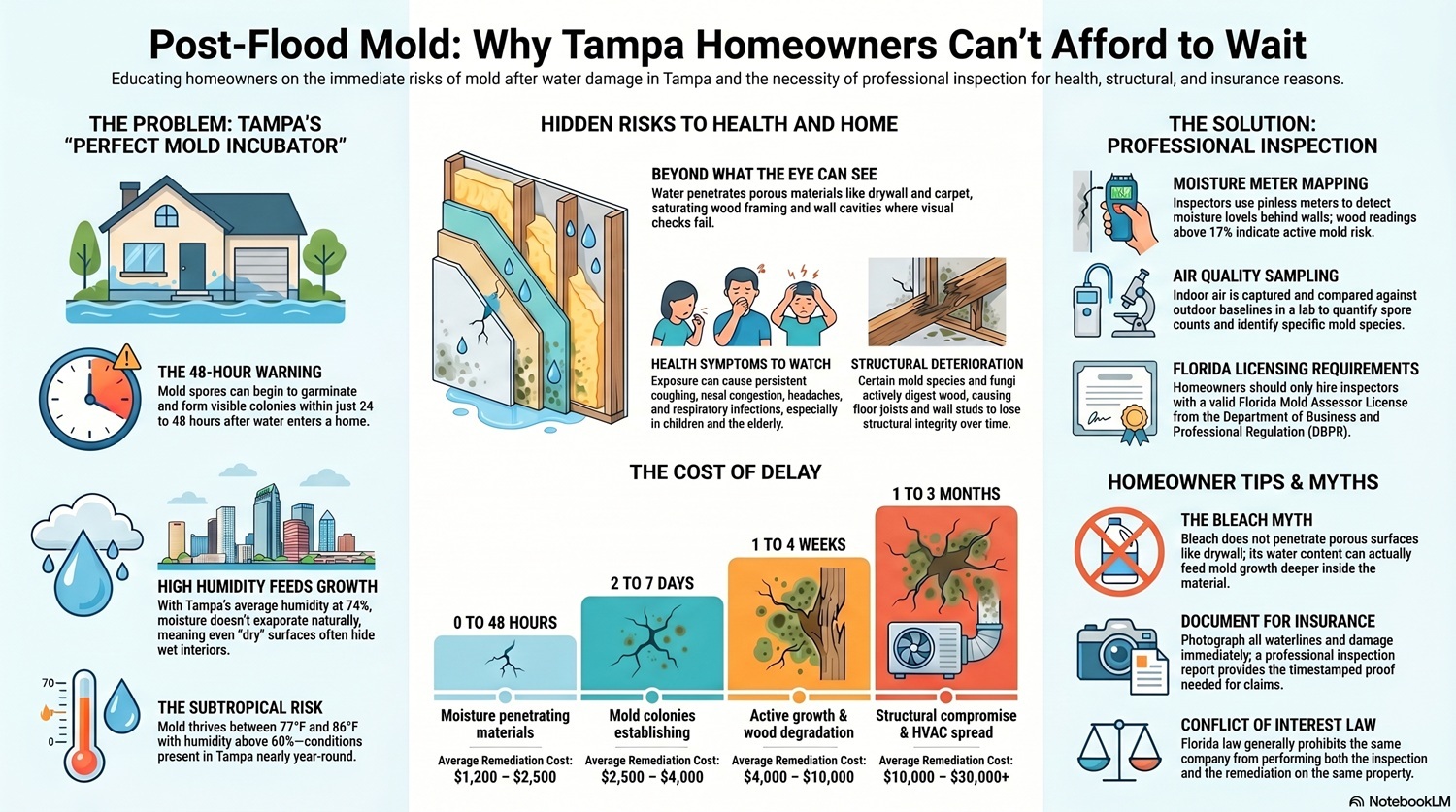
- Mold can begin growing in as little as 24 to 48 hours after flood water enters your home — Tampa’s heat and humidity make that timeline even shorter.
- A professional mold inspection uses moisture meters, air sampling, and lab testing to find mold you can’t see with the naked eye.
- Skipping a mold inspection after a flood can lead to hidden structural damage, worsened health symptoms, and complicated insurance claims.
- Tampa homeowners should look for inspectors with Florida license from the Department of Business and Professional Regulation(DBPR).
- There’s a critical DIY check you can do right now before the inspector even arrives — keep reading to find out what it is.
After a flood, the water you can see is not your biggest problem — the moisture hiding inside your walls, under your floors, and above your ceiling is.
Tampa homeowners face one of the highest mold risks in the entire country. The combination of subtropical heat, near-constant humidity, and a city that sits at sea level makes mold growth after flooding not just likely — it’s almost guaranteed without fast action. If you’ve recently experienced water damage from a hurricane, storm surge, burst pipe, or even a slow leak, getting a mold inspection isn’t something to put on the back burner.
For homeowners navigating water damage and mold concerns in the Tampa Bay area, TampaBayMold.net provides licensed mold assessments and has deep experience with the specific conditions that drive rapid mold growth in Florida homes.
Yes, You Need A Mold Inspection After A Flood In Tampa
A lot of homeowners make the mistake of thinking that once the water is gone and everything looks dry, the danger has passed. That’s not how mold works. Water doesn’t just sit on top of surfaces — it penetrates drywall, soaks into insulation, gets under subflooring, and saturates wood framing. Even after surfaces feel dry to the touch, moisture content inside building materials can remain dangerously high for weeks.
A mold inspection after a flood is about confirming what you cannot see. It’s about knowing whether the air your family is breathing is safe, and whether the structure of your home is compromised. In Tampa’s climate, this step isn’t cautious — it’s essential.
- Floodwater carries bacteria, sewage, and organic debris that feed mold colonies
- Porous materials like drywall and carpet absorb water deep below the surface
- Mold can grow inside wall cavities where no visual inspection will catch it
- Tampa’s average humidity of 74% means moisture doesn’t evaporate quickly indoors
- HVAC systems can spread mold spores throughout the entire home within hours
The stakes are high, and acting quickly makes a significant difference in both cost and health outcomes. The longer mold has to establish colonies, the more invasive and expensive the remediation process becomes.
Mold Can Start Growing Within 24-48 Hours After Water Damage
This is not an exaggeration. Under the right conditions — warm temperatures, moisture, and an organic food source like drywall paper or wood — mold spores that are naturally present in any indoor environment can begin to germinate and form visible colonies within 24 to 48 hours. In Tampa, where indoor temperatures regularly stay above 75°F even after a storm, those conditions are almost always present.
By the time you notice a musty smell or see dark spots forming on a wall, the mold has likely been growing for several days already. What you’re seeing on the surface is just the visible portion of a colony that has already pushed deeper into the material behind it.
Why Tampa’s Heat And Humidity Make Mold Growth Faster
Tampa’s climate is classified as humid subtropical. Average summer temperatures sit between 80°F and 91°F, and relative humidity frequently exceeds 80% during and after storm events. Mold thrives between 77°F and 86°F with humidity levels above 60% — Tampa essentially operates as a perfect mold incubator for most of the year.
Compare that to a home in a drier climate like Phoenix or Denver, where floodwater evaporates faster and ambient humidity doesn’t continue feeding moisture into building materials after the initial event. In Tampa, even after you’ve removed standing water and run fans, the ambient humidity outside is continuously reintroducing moisture into your home unless you have active dehumidification running. This is exactly why mold inspections in Tampa carry more urgency than nearly anywhere else in the continental United States.
Health Risks Of Mold After A Flood
Mold isn’t just an aesthetic or structural problem. Prolonged exposure to mold spores and mycotoxins — the toxic compounds some mold species produce — can cause a range of health issues that are easy to misattribute to allergies, a cold, or general post-storm stress.
Common Symptoms Of Mold Exposure
Mold exposure symptoms vary depending on the species of mold, the concentration of spores in the air, and the individual’s sensitivity. The most common symptoms include persistent coughing and sneezing, nasal congestion, itchy or watery eyes, skin irritation, headaches, and fatigue. In homes with heavy mold contamination, residents may also experience shortness of breath or worsening asthma symptoms.
What makes this particularly tricky after a flood is that these symptoms often get dismissed as stress responses or as reactions to the disruption of the event itself. If your household members have been feeling persistently unwell since the flooding occurred, mold exposure deserves serious consideration as a contributing cause.
Who Is Most At Risk In Your Household
Not everyone reacts to mold the same way, but certain groups face significantly higher risks. Children, elderly adults, pregnant women, and anyone with a pre-existing respiratory condition like asthma, COPD, or chronic allergies are especially vulnerable. People with weakened immune systems — whether from illness, medication, or medical treatment — are also at elevated risk for severe reactions to mold exposure, including respiratory infections that can escalate quickly.
How Long It Takes For Mold To Affect Indoor Air Quality
Once mold colonies are established, they continuously release spores into the surrounding air. Indoor air quality can begin to degrade within days of initial mold growth. In an enclosed space like a closed bedroom or a home with limited ventilation — which is common when windows are shut and AC is running — spore concentrations build up rapidly.
Important: The EPA recommends that any visible mold covering more than 10 square feet should be handled by a professional. After a flood, mold is rarely limited to one small area — it spreads across multiple surfaces and inside building materials simultaneously, making professional assessment critical rather than optional.
Air quality testing, which is part of a professional mold inspection, measures the actual spore count in your indoor air and identifies the specific species present. This data is essential for understanding the severity of contamination and for building an effective remediation plan.
What A Professional Mold Inspection Covers
A professional mold inspection is far more comprehensive than walking through your home with a flashlight. Certified inspectors use a combination of visual assessment, specialized equipment, and laboratory analysis to build a complete picture of mold risk throughout your property.
Here’s what a thorough mold inspection in Tampa should include — and what you should expect from any inspector you hire.
Visual Inspection Of Water-Damaged Areas
The inspector begins with a systematic walk-through of every area affected by or adjacent to the flood event. This isn’t a casual look around — they’re checking baseboards, window frames, crawl spaces, attic spaces, bathroom ceilings, and anywhere water could have traveled by gravity or capillary action. Discoloration, bubbling paint, warped wood, and visible dark spotting are all documented with photographs that become part of your official inspection report.
Moisture Meter Testing Behind Walls And Floors
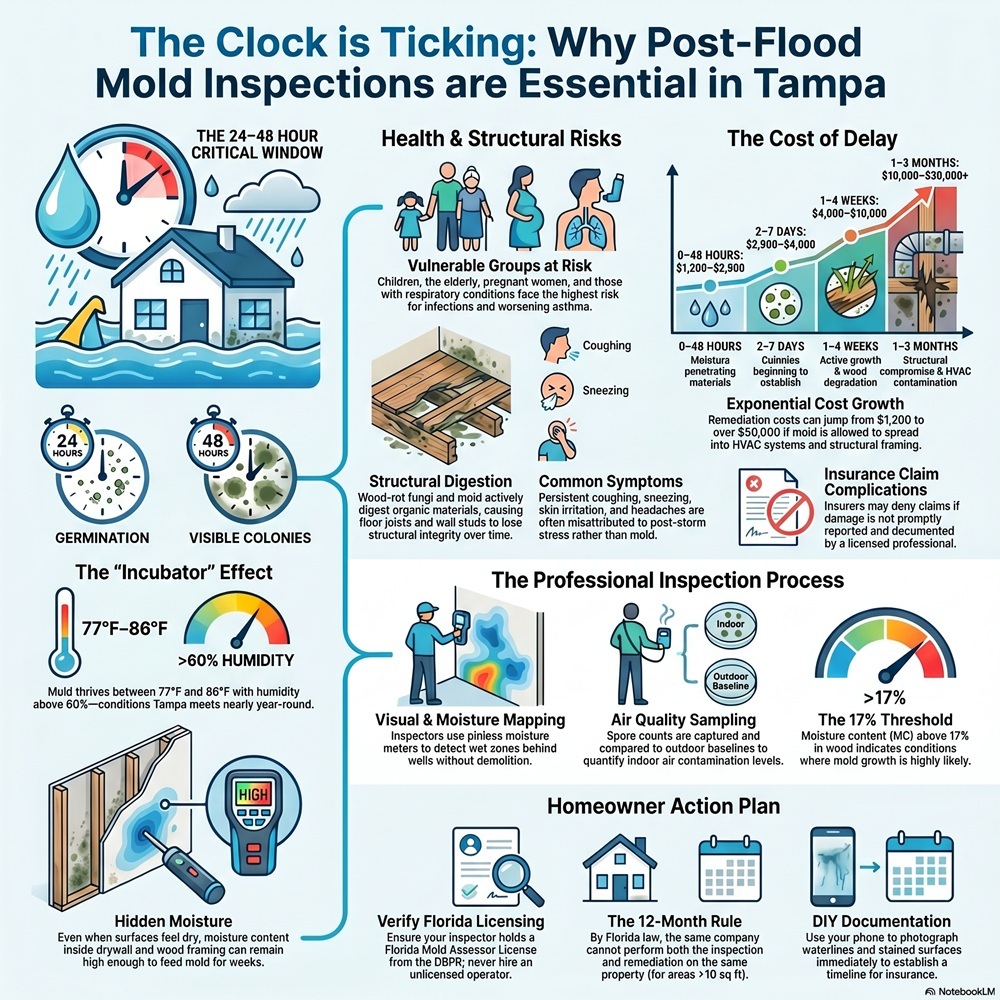
This is where professional inspections separate themselves from anything you can do on your own. Moisture meters — specifically pin-type and pinless meters to measure the moisture content inside drywall, wood framing, and subflooring without requiring demolition. A reading above 17% moisture content(MC) in wood or above 4.5%(MC) in concrete is considered elevated and indicates conditions where mold growth is either already occurring or highly likely. Inspectors map these readings across your home to identify hidden wet zones that look completely dry on the surface.
Air Quality Sampling And Lab Testing
Air sampling involves drawing a measured volume of indoor air through a collection cassette that captures airborne mold spores. These samples are sent to an accredited third-party laboratory — typically with results returned within 24 to 72 hours — where technicians identify the species present and quantify spore counts per cubic meter of air. The results are compared against an outdoor baseline sample taken at the same time, so you can see exactly how much your indoor air quality has deviated from normal. This lab data is also what insurance companies and remediation contractors use to scope the extent of the problem.
DIY Checks You Can Do Before The Inspector Arrives
While nothing replaces a professional inspection, there are meaningful checks you can perform immediately after a flood to assess initial risk and document conditions for your insurance claim. Start by walking every room and using your senses deliberately — smell for musty or earthy odors, which are produced by microbial volatile organic compounds (mVOCs) that mold colonies release even before they’re visible. Check along the bottom foot of every wall, around window and door frames, and inside closets that share exterior walls.
Use your phone camera to document everything. Photograph waterlines on walls, stained grout, discolored drywall, and any soft or spongy spots in your flooring. These images establish a timeline that proves the damage occurred during the flood event — which matters enormously if an insurance dispute arises later. Do not attempt to clean or paint over any suspected mold areas before the inspection. Doing so can interfere with accurate sampling and may void coverage under some insurance policies.
What Happens If You Skip The Mold Inspection
Choosing to skip a mold inspection after a Tampa flood is one of the costliest decisions a homeowner can make — not just financially, but in terms of long-term health and property value. The problems that develop from undetected post-flood mold don’t stay contained. They grow, spread, and compound until what could have been a targeted remediation job becomes a whole-home restoration project.
The three biggest consequences of skipping the inspection are hidden mold growth, structural deterioration, and insurance complications — and each one feeds into the others in ways that are genuinely difficult to untangle once they’ve progressed.
Hidden Mold Inside Walls Spreads Silently
Mold growing inside a wall cavity has everything it needs to thrive — darkness, moisture, organic material in the drywall paper and wood studs, and limited airflow to dry things out. Without an inspection to detect it, that colony can grow for months completely undetected. A single 12-inch square patch of mold inside a wall can release millions of spores per day into your living space through electrical outlets, light switches, and gaps in baseboards.
By the time hidden mold becomes obvious — usually through a persistent smell, worsening allergy symptoms, or visible staining bleeding through paint — the colony has typically spread to multiple wall cavities and potentially into your HVAC ductwork. At that point, the remediation scope (and cost) is dramatically larger than it would have been with early detection.
Structural Damage That Gets Worse Over Time
Mold doesn’t just discolor surfaces — certain species actively digest the organic materials they colonize. Wood-rot fungi, which frequently accompany mold growth in flood-damaged homes, break down the cellulose and lignin in structural lumber. Floor joists, wall studs, and roof decking can lose meaningful structural integrity over a period of months when left in persistently damp, mold-affected conditions.
In Tampa’s older housing stock — particularly homes built before 1990 that may already have aging lumber — this degradation accelerates. A floor that felt slightly soft after a flood and was never inspected can become genuinely unsafe within a single rainy season. The cost difference between treating mold early versus replacing structurally compromised framing is substantial.
Timeline After Flood What’s Happening Structurally Average Remediation Cost Range 0 to 48 hours Moisture penetrating building materials $1200 – $2,500 2 to 7 days Mold colonies beginning to establish $2,500 – $4,000 1 to 4 weeks Active mold growth, early wood degradation $4,000 – $10,000 1 to 3 months Structural compromise, HVAC contamination $10,000 – $30,000+
Insurance Claims That Get Complicated Without Documentation
“Mold damage resulting from a flood that was not promptly reported or remediated may be excluded from coverage under your policy” — this is language that appears in many standard homeowners insurance policies, and it exists specifically to create a basis for claim denial when homeowners delay action.
A professional mold inspection creates a timestamped, laboratory-backed document that proves mold was detected within a reasonable period following the flood event. This documentation is often the single most important factor in whether a mold-related claim gets approved or denied. Without it, insurers can argue that the damage resulted from long-term neglect rather than the specific flood event you’re claiming.
Beyond claim approval, inspection reports also establish the scope of necessary remediation. This matters because insurers will often only pay for work that is clearly documented as necessary by a qualified inspector. If a remediator identifies additional mold mid-project that wasn’t in the original inspection report, getting supplemental coverage approved becomes a drawn-out negotiation rather than a straightforward process.
How To Choose A Mold Inspector In Tampa
Not all mold inspectors operate at the same standard, and in Florida — where the mold industry has historically had issues with unqualified operators — knowing exactly what credentials and practices to look for is critical. The inspector you choose will produce a legal document that affects your insurance claim, your remediation scope, and potentially your home’s resale value. That’s not a decision to make based on whoever shows up first in a Google search.
Certifications To Look For In Florida
Florida is one of the few states that actually licenses mold assessors and mold remediators separately under Chapter 468, Part XVI of the Florida Statutes. This means the inspector you hire must hold a valid Florida Mold Assessor License issued by the Florida Department of Business and Professional Regulation (DBPR). You can verify any inspector’s license status directly on the DBPR website before you ever let them into your home. Do not hire anyone who cannot provide their license number on the spot.
Also confirm that the inspector uses an accredited third-party laboratory for their air and surface samples. Labs accredited by the American Industrial Hygiene Association (AIHA) follow strict chain-of-custody and analytical protocols that make their results defensible in insurance disputes and legal proceedings. If an inspector sends samples to an in-house lab or can’t name the laboratory they use, walk away.
Why Your Mold Inspector Should Be Separate From Your Remediator
This is actually codified in Florida law. Under Florida Statute 468.8419, a licensed mold assessor is prohibited from also performing the remediation on the same property within 12 months of the assessment unless the visible mold present is less than 10 sq ft. Small areas of visible mold that are less than 10 sq ft considered non-regulated. In those cases, companies can perform both the inspection and the remediation
In practice, what this means for you is straightforward: get your inspection done first, receive your written mold assessment report, and then use that report to get competitive bids from licensed remediators. The inspection report defines the scope of work objectively, which means remediators are bidding on the same defined problem.
A Mold Inspection After A Tampa Flood Is Not Optional
Tampa’s climate, the nature of flood water, and the biology of mold growth combine to make post-flood mold not a possibility but a near-certainty without fast, professional intervention. Every day without an inspection is a day that hidden moisture is doing damage you haven’t documented, mold colonies are establishing deeper into your building materials, and the window for straightforward insurance reimbursement is narrowing.
The homeowners who come out of a flood event in the best position — financially, structurally, and health-wise — are the ones who treat the mold inspection as the first non-negotiable step in their recovery process, not an afterthought once the floors are dry. Schedule it within 24 to 72 hours of the water receding, get your documentation in order, and let a licensed professional give you a complete picture of what you’re actually dealing with.
Frequently Asked Questions
Here are the most common questions Tampa homeowners ask when deciding whether to get a mold inspection after a flood or water damage event.
How Soon After A Flood Should I Get A Mold Inspection In Tampa?
Schedule your mold inspection within 24 to 72 hours of the floodwater receding. Given that mold can begin forming colonies within the first 48 hours in Tampa’s heat and humidity, every additional day you wait increases both the extent of potential growth and the cost of remediation. Even if you’ve already begun drying out the space with fans and dehumidifiers, moisture trapped inside wall cavities and under flooring requires professional measurement to confirm it has actually been eliminated.
How Much Does A Mold Inspection Cost In Tampa?
A professional mold inspection in Tampa typically ranges from $350 to $600 for a standard residential assessment, with larger homes or more complex inspections that include multiple air samples and surface swabs running $600 to $1,000 or more. Laboratory analysis fees are sometimes included in the inspection quote and sometimes billed separately — confirm this upfront before booking.
That cost needs to be weighed against the alternative. A remediation project that could have been scoped and handled for $2,000 to $4,000 with early detection can grow into a $15,000 to $30,000+ project when hidden mold is left to spread for weeks or months. The inspection fee is almost always the least expensive decision you’ll make in the entire post-flood process.
Can I Just Use Bleach To Kill Mold After A Flood?
Bleach is effective at removing visible mold staining on non-porous surfaces like tile and glass, but it does not penetrate porous materials like drywall, wood, or grout. When you apply bleach to mold growing on drywall, the water component of the bleach solution actually absorbs into the material and can increase moisture levels, potentially feeding further growth while the chlorine evaporates at the surface. This creates a situation where the mold looks gone but is actively growing deeper inside the material.
More importantly, cleaning visible mold with bleach before a professional inspection can compromise air and surface sampling results by altering the surface mold load without addressing the underlying contamination. If you’re planning to file an insurance claim, using bleach before documentation is completed can weaken your position significantly. Use bleach only as directed by a professional remediator after a full inspection has been completed and documented.
Does Homeowners Insurance Cover Mold Inspections After A Flood In Tampa?
Standard homeowners insurance policies in Florida typically cover mold damage only when it results directly from a covered peril — such as a burst pipe or storm-driven water intrusion — and only when the homeowner took reasonable steps to mitigate the damage promptly. Flood damage specifically is usually covered under a separate National Flood Insurance Program (NFIP) policy or a private flood insurance rider, not under standard homeowners coverage. Review your specific policy language carefully, and call your insurance agent before your inspection so you understand exactly what documentation they require to process a mold-related claim.
What Is The Difference Between A Mold Inspection And Mold Remediation?
A mold inspection is an assessment — it identifies whether mold is present, where it is located, what species are involved, and how extensively it has spread. The inspector produces a written report with findings, laboratory data, and recommendations. No mold is removed during an inspection.
Mold remediation is the physical process of removing mold contamination from a property. This includes containing the affected area to prevent cross-contamination, removing mold-affected materials, applying antimicrobial treatments, and restoring the space to a clean, dry condition. Remediation is performed by a separately licensed mold remediator — not the inspector — and should always follow a written scope of work derived from the inspection report.
Think of it this way: the inspection is the diagnosis, and the remediation is the treatment. Skipping the inspection and going straight to remediation is like asking a surgeon to operate without running any tests first — the remediator is working without a complete picture when an inspection is before starting the remediation.
If you’re dealing with post-flood mold concerns in the Tampa Bay area, TampaBayMold.net provides licensed mold assessments backed by accredited laboratory testing to give you the complete, documented picture your home and your insurance claim deserve.
5 Replies to “Should I Get A Mold Inspection After A Flood Or Water Damage In Tampa?”
Comments are closed.