
Mold Remediation in Tampa – 5 Articles About Mold Remediation Information For Homeowners

May 4, 2026

Mold Remediation in Tampa – 5 Articles About Mold Remediation Information For Homeowners

Mold Remediation in Tampa – 5 Articles About Mold Remediation Information For Homeowners | TampaBayMold.net
Tampa's Mold Remediation Authority Free Consultation

Mold Remediation Content Series

Five authoritative articles regarding "mold remediation in Tampa,".

1 2 3 4 5 INSPECTION & Assessment CONTAINMENT Negative Pressure REMOVAL HEPA Extraction TREATMENT EPA Antimicrobials CLEARANCE Lab Verification SEALED MOLD REMEDIATION IN TAMPA, FL — THE COMPLETE REMEDIATION PROCESS TampaBayMold.net · 550 N. Reo St. Suite #300, Tampa FL 33609
Remediation Process May 2026 01 / 05

The Complete Guide to Mold Remediation in Tampa: What the Process Actually Involves

Many Tampa homeowners confuse "mold removal" with true mold remediation. The difference — and the gap in outcomes — is significant. Here is what a licensed mold remediation in Tampa looks like from start to finish.

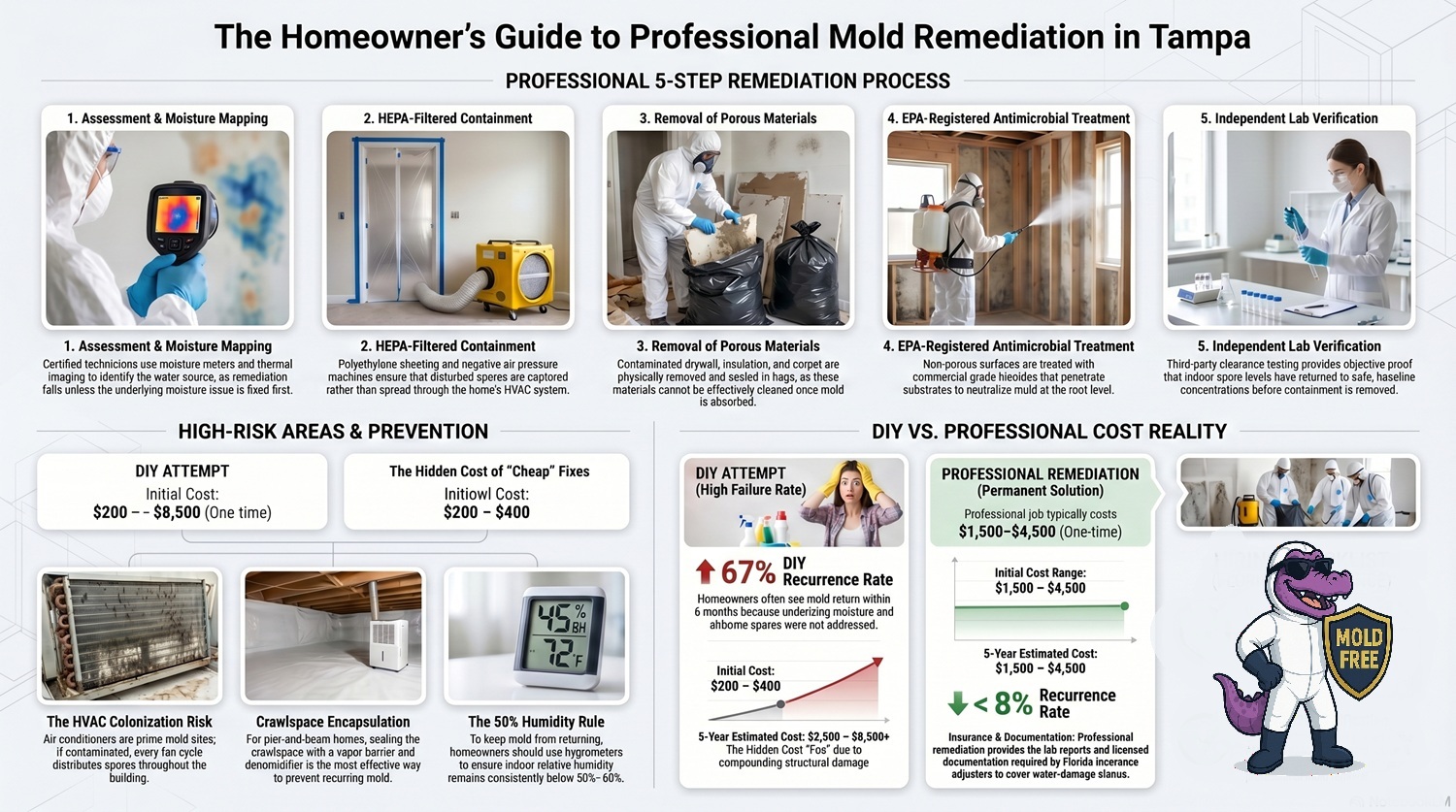
The term "mold remediation" is used liberally in the home services industry, but not all companies offering it deliver the same scope of work. In Tampa, where subtropical heat and persistent humidity make mold one of the most prevalent residential and commercial property threats, understanding what legitimate mold remediation actually entails is essential knowledge for every property owner. True mold remediation is not surface cleaning. It is a systematic comprehensive professional process of identifying, containing, removing, and cleaning mold growth, as well as fixing the underlying moisture source to prevent regrowth.

Step 1: Thorough Assessment and Moisture Source Identification

No remediation project should begin without a comprehensive assessment. A certified Tampa mold remediator will use calibrated moisture meters,sometimes thermal imaging cameras & borescopes, and in many cases air and surface sampling sent to an accredited mycology laboratory. The assessment identifies not only the visible extent of mold growth but — critically — the moisture source that is sustaining it. According to IICRC S520, remediation cannot achieve lasting results unless the underlying moisture problem is corrected first. In Tampa's climate, common sources include leaking roof systems, condensation from improperly sized HVAC systems, plumbing failures, and storm-related water intrusion through envelope gaps.

Step 2: Containment to Prevent Cross-Contamination

Before any mold is disturbed, the affected area must be isolated. Professional mold remediation in Tampa requires the establishment of containment zones using polyethylene sheeting sealed at all penetrations, combined with negative air pressure machines equipped with HEPA filters. Negative pressure containment to ensure that airborne spores released during remediation are captured by the HEPA filtration system rather than migrating to clean areas of the structure. The EPA warns that disturbing mold colonies without proper containment can spread spores throughout an entire building via the HVAC system within minutes.

TampaBayMold.net performs mold remediation throughout Tampa Bay — from initial inspection through post-remediation verification. Their licensed technicians establish commercial polyethylene containment, operate continuous HEPA air scrubbers, and use EPA-registered antimicrobial treatments. Call 813-348-4766 or visit TampaBayMold.net for a free remediation estimate.

Step 3: Safe Removal and Disposal of Contaminated Materials

Porous building materials that have absorbed mold — drywall, insulation, carpet padding, and ceiling tiles — cannot typically be cleaned in place. IICRC S520 specifies that porous materials meeting contamination thresholds must be physically removed and disposed of in sealed, labeled bags in compliance with applicable regulations. Semi-porous materials such as concrete and certain wood surfaces may be wire-brushed, HEPA-vacuumed, and treated if structural integrity is maintained. Non-porous surfaces — metal, glass, plastic — are cleaned in place using appropriate antimicrobial agents.

Step 4: EPA-Registered Treatment of All Affected Surfaces

After physical removal of contaminated materials, all remaining affected surfaces are treated with EPA-registered antimicrobial products. These are not household bleach solutions — they are commercial-grade biocides formulated to penetrate porous substrates and neutralize mold at the root level, not merely at the surface.

Step 5: Independent Post-Remediation Verification

The final and most important step of any legitimate mold remediation in Tampa is clearance testing — air and surface sampling conducted by a inspector who was not involved in the remediation if it is a regulated mold project where visble mold was more than 10 sq ft per Florida regulations. Third-party clearance testing provides an objective, legally defensible confirmation that indoor spore levels have returned to acceptable baseline concentrations before containment is removed and the space is reoccupied.

"Mold removal is wiping the surface. Mold remediation fixes the cause, eliminates the colony, and proves it with results from a certifed lab."

For Tampa homeowners navigating a mold problem — whether freshly discovered or long-suspected — understanding this five-step process is the foundation of making an informed decision about hiring a remediation contractor. Verify that any contractor you consider is licensed as a mold remediator under Florida Statutes Chapter 468.

Get a Free Estimate →
DIY vs. PROFESSIONAL MOLD REMEDIATION — TAMPA COST REALITY DIY Initial Cost: ~$200–$400 Recurrence: 58–67% within 6 months DIY True 5-yr Cost: $3,200–$8,500+ Repeated failures compound costs Professional: $1,500–$4,500 (typical) 92%+ long-term success rate Certified + Lab-Verified Clearance Includes insurance documentation REMEDIATED PROFESSIONAL MOLD REMEDIATION IN TAMPA — IS THE COST WORTH IT? TampaBayMold.net · Serving All Tampa Bay · tampabaymold.net
Cost & Value May 2026 02 / 05

How Much Does Mold Remediation in Tampa Cost — and Is DIY Ever a Smart Option?

Mold remediation pricing in Tampa spans a wide range depending on contamination scope, species, and the remediator's credentials. Understanding what drives costs — and what corners cannot be cut — helps Tampa property owners make decisions they won't regret.

When Tampa homeowners first discover mold, one of the most immediate questions is: what will this cost? The honest answer is that the cost of professional mold remediation in Tampa varies significantly based on the size of the contamination area, the species of mold present, the building materials affected, and whether the underlying moisture source requires repair. But perhaps the more important financial question is not what professional remediation costs — it is what failing to remediate properly will cost over time.

Typical Mold Remediation Costs in Tampa

For a small, isolated mold problem — a bathroom ceiling or a limited area behind a sink cabinet involving less than 10 square feet of affected material — a Tampa homeowner might expect professional remediation costs in the range of $1200 to $2,500. Mid-range projects involving crawlspace mold, attic contamination, or water-damaged wall assemblies covering 10 to 100 square feet typically run $2,500 to $4,500. Large-scale remediation projects — those involving HVAC system contamination, multiple rooms, or post-hurricane flooding — can range from $4,500 to $15,000 or more, particularly when significant structural material requires removal and replacement.

Comprehensive lab testing, which is essential for accurate scope determination and post-remediation verification, typically adds $300 to $600 to the overall project cost. This cost is not optional — it is what separates a professional remediation from a surface cleaning with no accountability for results.

The True Cost of DIY Mold Remediation in Tampa

Industry data consistently shows that Tampa homeowners who attempt DIY mold remediation experience recurrence rates of 58 to 67% within six months. The reasons are well-documented: consumer-grade products lack the penetrating power of commercial antimicrobials; DIY attempts rarely address the underlying moisture source; and without containment equipment, disturbing a mold colony releases millions of spores into the home's air, spreading the problem to previously clean areas. Over a five-year period, repeated DIY treatment attempts ultimately cost Tampa homeowners an estimated $3,200 to $8,500 more than a single professional remediation would have cost at the outset.

TampaBayMold.net provides transparent, detailed estimates before any remediation work begins. Their certified team covers all scope categories — from small bathroom mold to large-scale post-storm remediation. Comprehensive lab testing packages range from $300 to $600. Visit TampaBayMold.net for a free visual consultation and written estimate.

What Your Mold Remediation Quote Should Include

A legitimate mold remediation estimate from a Tampa contractor should itemize the following: initial assessment mold affected area, containment installation and maintenance, HEPA air scrubbing for the duration of the project, physical removal and disposal of contaminated materials, EPA-registered antimicrobial treatment of all affected surfaces, moisture source repair or coordination with a plumber or roofer, and post-remediation clearance testing by an independent third party.

Florida Statutes Chapter 468 requires mold remediators operating in the state to be separately licensed from mold assessors. This licensing requirement exists precisely to protect consumers from unqualified contractors who may charge remediation prices while delivering cleaning-level results. Before accepting any estimate for mold remediation in Tampa, verify the contractor's Florida mold remediator license number through the Florida Department of Business and Professional Regulation's online database.

"Professional remediation typically saves Tampa homeowners thousands in repeated treatment costs compared to DIY approaches."

When Insurance Covers Mold Remediation

Many Tampa homeowner's insurance policies cover mold remediation when mold results from a covered peril — a sudden pipe burst, appliance leak, AC condensation overflow, or storm damage. Documentation is everything: a professionally produced mold inspection report, thermal scans, laboratory results, and a detailed remediation scope of work are exactly the evidence Florida insurance adjusters require. Policies that exclude mold may still cover the water damage event that caused it, making thorough documentation valuable even in ambiguous coverage situations.

Get a Written Estimate →
BEFORE / AFTER BEFORE REMEDIATION LAB REPORT CLEARED ✓ Spores: NORMAL RH: <50% IICRC S520 AFTER REMEDIATION MOLD REMEDIATION IN TAMPA — WHAT LICENSED RESULTS LOOK LIKE TampaBayMold.net · Lab-Verified Remediation · tampabaymold.net
HVAC & Hidden Mold May 2026 03 / 05

Hidden Mold in Tampa Homes: Why HVAC Systems Are the Most Overlooked Remediation Target

In Tampa's climate, air conditioning is not a luxury — it runs nearly year-round. That makes HVAC systems one of the most common — and most dangerous — sites for mold colonization in Tampa homes and businesses.

Walk through almost any Tampa neighborhood in July, and you will hear the constant hum of air conditioning. It is as essential to life in the Tampa Bay area as sunscreen and hurricane shutters. But Tampa's reliance on HVAC systems creates a significant and frequently overlooked mold risk: the air handler unit, evaporator coil, drain pan, ductwork, and air distribution system can become a mold colony's ideal habitat — and when mold establishes inside an HVAC system, every cycle of the fan distributes spores throughout the entire structure.

Why Tampa HVAC Systems Are So Vulnerable to Mold

The physics of air conditioning create the perfect conditions for mold growth inside the system. Warm, humid Tampa air is drawn across a cold evaporator coil, causing moisture to condense on the coil surface. If the condensate drain pan is even slightly clogged — a common occurrence in systems that are not serviced regularly — standing water accumulates. Combined with the cellulose content of many standard air filters and the organic dust that accumulates on coil surfaces over time, this moisture creates an environment where mold can establish and grow continuously as long as the system operates.

The Institute of Inspection, Cleaning and Restoration Certification notes that 30 to 40% of mold growth in structures occurs in hidden areas — behind walls, under flooring, and within HVAC ductwork — where occupants cannot detect it visually. An HVAC system in a Tampa home that has not been professionally serviced within the past year should be considered a potential mold site, particularly if occupants have experienced unexplained respiratory symptoms.

Recognizing Signs of HVAC Mold Contamination

The symptoms of HVAC mold contamination are often diffuse, which contributes to delayed detection. Occupants may notice a musty odor that intensifies when the air handler cycles on, increased allergy or asthma symptoms that improve when leaving the building, visible discoloration or spottiness around supply registers, or a general decline in air quality that cannot be attributed to an obvious source. Any of these signs warrants immediate professional assessment, including inspection of the air handler, coil, drain pan, and a representative sample of ductwork.

TampaBayMold.net includes HVAC system assessment in their comprehensive mold inspection services throughout Tampa Bay. When HVAC contamination is confirmed, recommendations will be made for cleaning of HVAC unit and/or duckwork by a licensed contractor. Contact TampaBayMold.net to schedule an assessment that includes your HVAC system.

How HVAC Mold Remediation in Tampa Works

Mold remediation targeting an HVAC system involves several specialized steps that differ from standard surface remediation. The system must be shut down before any remediation work begins — the EPA is explicit that running a potentially contaminated HVAC system during remediation will spread mold throughout the building. The air handler cabinet is opened and visually inspected; the evaporator coil, drain pan, and adjacent ductwork are sampled if contamination is suspected. Contaminated ductwork sections may require physical cleaning with HEPA-equipped duct cleaning equipment, antimicrobial fogging, or in severe cases, section replacement.

Post-remediation verification for HVAC-related mold requires air sampling from multiple supply and return registers to confirm that spore counts in the conditioned air have returned to acceptable baseline levels. The repair of the underlying moisture problem — whether a clogged drain, an undersized system creating excess condensation, or a refrigerant leak producing abnormal coil icing — is a prerequisite for any lasting remediation outcome.

"Do not run the HVAC system if you know or suspect contamination — it could spread mold throughout the entire building." — U.S. Environmental Protection Agency

Tampa homeowners who have their HVAC systems professionally serviced at least twice per year — with coil cleaning, drain pan treatment, and filter replacement — dramatically reduce their risk of HVAC mold colonization. For those who have already discovered or suspect mold in their system, professional mold inspection by a licensed Tampa mold inspector is the only approach that addresses the full scope of the problem and verifies the result independently.

HVAC Mold Assessment →
FLORIDA TAMPA FL STATUTE CH. 468 Mold Assessors & Remediators must be separately licensed Verify license at DBPR.gov LICENSED IICRC CERTIFIED HIRING CHECKLIST FL Mold Remediator License (DBPR) IICRC S520 Certification General Liability Insurance Accredited Lab Partner Independent 3rd-Party Clearance Written Scope & Itemized Estimate CHOOSING A LICENSED MOLD REMEDIATION COMPANY IN TAMPA, FL TampaBayMold.net · Fully Licensed & Insured · tampabaymold.net
Licensing & Compliance May 2026 04 / 05

How to Choose a Licensed Mold Remediation Company in Tampa — A Florida Homeowner's Checklist

Florida has stricter mold remediation licensing laws than most states. Knowing how to verify a Tampa remediator's credentials before signing a contract is the single most important step in protecting your home and your investment.

Tampa's mold remediation industry includes a wide spectrum of companies — from highly credentialed, independently verified professional firms to unlicensed contractors who use the language of remediation while delivering little more than a surface clean. The difference is not always obvious from a website or a phone call, and the consequences of choosing the wrong contractor can be severe: recurring mold, wasted expenditure, health risks from inadequate containment, and a property that cannot pass a mold clearance inspection when it matters most — at sale time or during an insurance claim.

Florida's Mold Remediation Licensing Law

Florida is among a minority of states that requires mold remediators to be separately licensed by the state. Under Florida Statutes Chapter 468, individuals performing mold remediation for compensation must hold a Florida mold remediator license issued by the Department of Business and Professional Regulation (DBPR). Crucially, the law also prohibits the same individual or company from serving as both the mold assessor and the mold remediator on the same project is visible mold is more than 10 sq ft — a protection designed to prevent conflicts of interest and ensure that remediation scope is determined by an independent assessment, not by the company that profits from the remediation work.

Every Tampa homeowner should verify their prospective remediator's license before signing any contract. The DBPR's online license verification database allows instant lookup by name or license number and confirms current active status, any disciplinary history, and the specific license type held.

Industry Certifications That Matter

Beyond state licensing, look for IICRC (Institute of Inspection, Cleaning and Restoration Certification) certification — specifically the Applied Microbial Remediation Technician (AMRT) credential. IICRC-certified technicians have completed rigorous training in IICRC Standard S520, the technical document that governs professional mold remediation practice. NORMI (National Organization of Remediators and Inspectors) certification is another recognized industry credential. Companies holding both state licensure and active IICRC or NORMI certification represent the highest standard of professional qualification available in the Tampa mold remediation market.

TampaBayMold.net holds all required Florida mold remediation and mold assessment licenses. They operate under full separation of assessment and remediation functions where Florida regualtions apply — their inspection findings are documented with air and surface samples being analyzed by an accredited and certified lab before any remediation scope is proposed. Insurance is current, references are available, and all projects include written estimates with scope of work before any project begins. Verify their credentials and schedule a consultation at TampaBayMold.net.

What a Professional Contract Should Specify

A professional mold remediation contract in Tampa should specify the cost, the remediation scope — areas of containment, specific materials to be removed, treatment products to be applied, and the standard to which the project will be remediated to achieve clearance .

Take the time to verify credentials and request a written scope.

Verify Our Credentials →
VAPOR BARRIER ENCAPSULATION DEHUMIDIFIER RH < 50% SEALED VENTED MOLD PREVENTION AFTER REMEDIATION IN TAMPA, FL Crawlspace · Encapsulation · Moisture Control · TampaBayMold.net
Prevention & Long-Term May 2026 05 / 05

Mold Remediation in Tampa Is Only the Beginning: How to Keep Mold from Coming Back

Professional mold remediation eliminates the existing colony — but without addressing Tampa's relentless humidity, mold will return. This is the post-remediation prevention strategy that licensed Tampa mold professionals actually recommend.

A successful mold remediation in Tampa clears the existing problem, verifies results with independent laboratory testing, and restores a property to a safe, healthy baseline. But for Tampa homeowners, remediation is not the finish line — it is the starting point of a long-term moisture management strategy. Florida's climate does not change after remediation. The same subtropical humidity, the same storm-season rainfall, and the same air conditioning dynamics that allowed mold to colonize in the first place remain entirely unchanged. Without deliberate, ongoing preventive measures, mold will return.

Understanding Why Tampa Mold Recurs

The single most important principle in mold prevention is moisture control. Mold requires sustained moisture — either from direct liquid contact with a porous surface or from relative humidity consistently above approximately 60% — to survive and grow. The National Institutes of Health and the EPA both identify moisture source elimination as the non-negotiable prerequisite for any durable mold remediation outcome. In Tampa, moisture reaches building materials through multiple pathways: HVAC condensation, roof and window leaks, plumbing failures, groundwater intrusion through foundations, and the vapor drive that pushes moisture-laden outdoor air through building envelopes when outdoor humidity exceeds indoor conditions.

Each of these pathways must be evaluated and addressed as part of a comprehensive post-remediation prevention plan. A Tampa property that has been professionally remediated but returned to the same moisture conditions that created the original problem will typically see mold re-colonization within weeks to months — particularly in summer.

Crawlspace Encapsulation And Conditioning: Tampa's Most Impactful Prevention Measure

For the many Tampa-area homes built on pier-and-beam foundations with vented crawlspaces, encapsulation is the single highest-impact mold prevention investment available. Vented crawlspaces in Florida do not function as intended — the conventional wisdom that cross-ventilation dries a crawlspace was developed for dry northern climates. In Tampa's humid environment, outside air drawn through crawlspace vents is almost always more humid than the crawlspace air, introducing moisture rather than removing it.

Crawlspace encapsulation seals the crawlspace from the surrounding soil and exterior air using heavy-duty polyethylene vapor barriers installed across the ground and up the foundation walls, sealed at all penetrations. A dedicated crawlspace dehumidifier then maintains relative humidity in the encapsulated space below 50% year-round. This approach eliminates the ground moisture evaporation and warm humid air infiltration that cause joists, subfloor, and insulation to remain continuously damp — the most common cause of recurring mold in Tampa homes with crawlspaces.

Beyond remediation, TampaBayMold.net offers comprehensive mold prevention services for Tampa Bay properties — including crawlspace encapsulation assessment, dehumidification system recommendations, HVAC moisture management consultation, and air quality monitoring for post-remediation properties. Their team helps Tampa homeowners establish the long-term moisture management strategy that keeps remediation results permanent. Learn more at TampaBayMold.net.

HVAC Maintenance as Mold Prevention

In Tampa, where air conditioning runs for the majority of the year, the HVAC system is both the most important humidity management tool and one of the most common mold growth sites in a structure. Post-remediation HVAC maintenance should include professional coil cleaning and drain pan treatment at least twice per year, quarterly air filter replacement using filters rated MERV 8 or higher, annual duct inspection for moisture or visible contamination, and verification that the system is properly sized for the conditioned space — an oversized system short-cycles without adequately dehumidifying the air, producing indoor humidity levels that sustain mold growth even when no liquid water is present.

"Without eliminating the moisture source, treated areas will re-colonize within 24 to 72 hours under sustained wet conditions." — EPA Mold Guidance

Monitoring Indoor Humidity After Remediation

Every Tampa home that has undergone mold remediation should have at least one calibrated digital hygrometer — ideally one in the most humidity-prone areas of the house, such as the primary bathroom, the laundry room, and any area that previously experienced mold growth. The target is a consistent indoor relative humidity below 50%, and certainly below 60%. Readings consistently above 60% signal that active moisture management measures — dehumidification, HVAC service, or investigation of a new moisture source — are needed before mold re-colonization begins.

For Tampa commercial property owners and landlords, periodic post-remediation air quality testing — annual or semi-annual air sampling by a certified mold assessor — provides the objective documentation that indoor air quality is being maintained at a healthy baseline. This documentation protects property owners legally, supports tenant confidence, and provides early warning if moisture conditions are again approaching the threshold at which mold becomes a risk. Mold remediation in Tampa, done right and followed by a deliberate prevention strategy, is a permanent solution — not a temporary fix.

Prevention Consultation →

Content series produced for TampaBayMold.net — Tampa Bay's mold remediation authority.

550 N. Reo St., Suite #300, Tampa, FL 33609 · tampabaymold.net


Leave a Reply

Your email address will not be published. Required fields are marked *