
How Much Does Mold Remediation Cost In Tampa Bay?
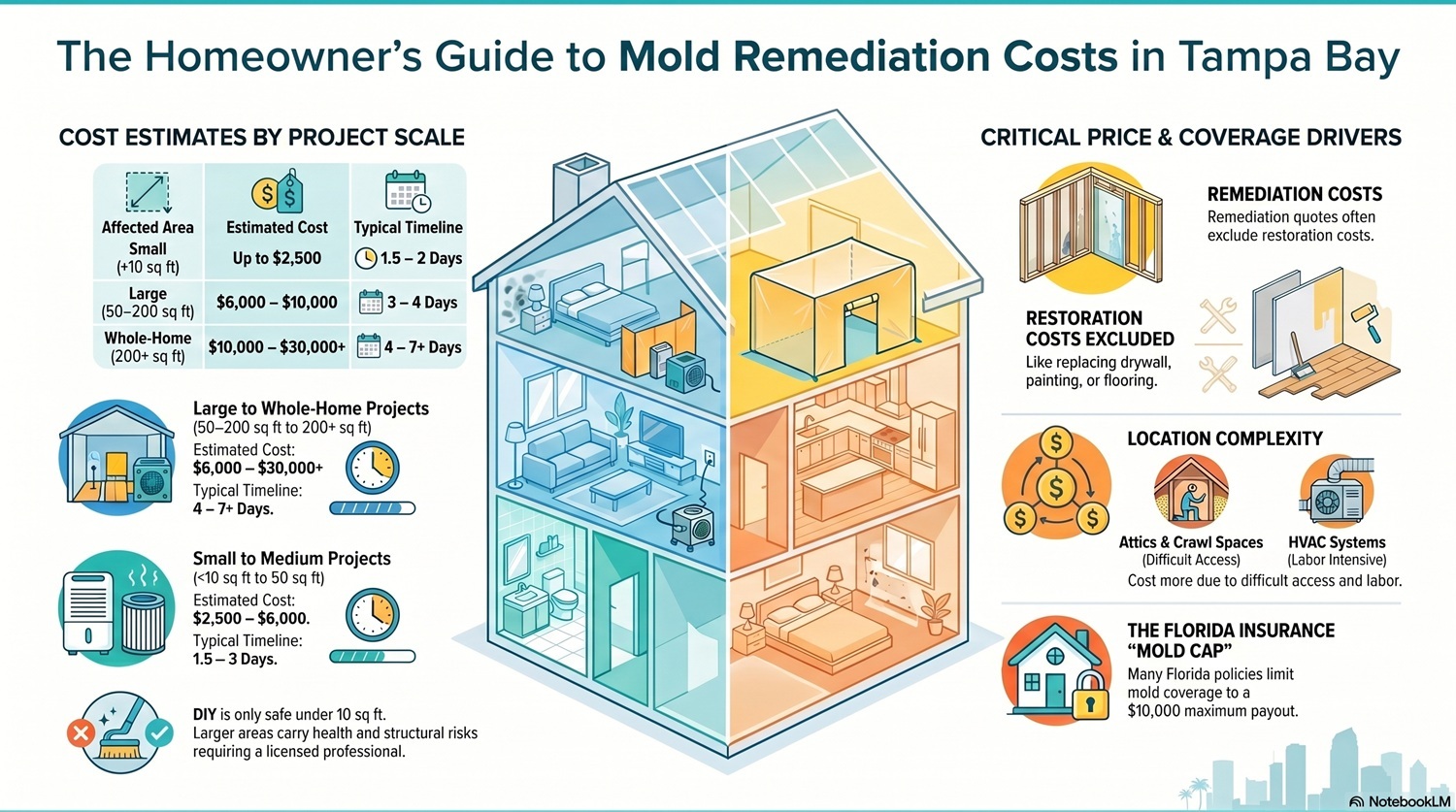
- Tampa Bay mold remediation costs range from under $2,500 for small contained areas to $30,000+ for whole-home treatment — the size of the affected area is the single biggest cost driver.
- Florida’s humidity and frequent storm activity make Tampa homes especially vulnerable to recurring mold, meaning a fix today isn’t always a fix forever without addressing the moisture source.
- Not all mold companies quote the same way — some exclude post-remediation testing, restoration work, or clearance inspections, which can add thousands to your final bill.
- TampaBayMold.net has been serving the area for 14+ years and provides homeowners with transparent, detailed estimates that reflect the full scope of work needed.
- DIY mold removal is only safe for areas under 10 square feet — anything larger in Tampa’s climate carries real health and structural risks that require a licensed professional.
Tampa Bay Mold Costs At A Glance
Tampa’s heat and humidity aren’t just uncomfortable — they’re a mold factory. With average relative humidity sitting above 70% for much of the year and a hurricane season that pushes water into walls, attics, and crawl spaces, mold remediation is one of the most common and costly home repairs Tampa Bay homeowners face. Knowing what it should cost before you call a company puts you in control of the conversation.
For a quick reference, here’s what remediation typically costs based on project scope in the Tampa Bay market:
| Contamination Level | Visibly Affected Area | Estimated Cost | Typical Timeline |
|---|---|---|---|
| Small | Under 10 sq ft | Up to $2,500 | 1.5 – 2 days |
| Medium | 10–50 sq ft | $2,500 – $6,000 | 2–3 days |
| Large | 50–200 sq ft | $6,000 – $10,000 | 3–4 days |
| Whole-Home | 200+ sq ft | $10,000 – $30,000+ | 4–7+ days |
| *Estimates reflect Tampa Bay market rates and do not include post-remediation restoration costs such as drywall replacement or repainting. | |||
These figures are starting points. Your actual cost depends on several variables that a qualified Tampa Bay mold professional will evaluate on-site. TampaBayMold.net offers detailed estimates that break down exactly what you’re paying for.
What Drives Mold Remediation Costs Up Or Down
No two mold jobs are the same. A spot on a bathroom ceiling and black mold spreading through an HVAC system are both “mold problems,” but they sit at completely opposite ends of the cost spectrum. Here’s what matters most when a company builds your estimate.
Size Of The Affected Area
Square footage is the most direct cost driver. Remediation companies in Tampa price jobs largely based on how much surface area is contaminated, because that determines labor hours, containment materials, equipment use, and disposal volume. A 5-square-foot patch on a bathroom wall is a very different job than mold that has spread across an entire attic deck.
Type Of Mold And How Far It Has Spread
Not all mold is created equal. Stachybotrys chartarum (commonly called black mold) and Aspergillus require more aggressive containment and personal protective protocols than common surface molds like Cladosporium. The deeper mold penetrates into porous materials — drywall, insulation, wood framing — the more material has to come out, which pushes costs higher fast.
Location In The Home
Location affects both the complexity of the work and the equipment needed. Crawl spaces and attics are physically difficult to access and remediate, which adds labor time. HVAC systems require specialized cleaning equipment and carry the added risk that contaminated air has already been circulated through the entire home. Mold inside walls means opening them up, which triggers additional restoration costs on top of the remediation itself.
Materials That Need To Be Removed
Porous materials that have been colonized by mold — drywall, insulation, carpet, ceiling tiles — typically cannot be cleaned and must be removed and safely disposed of. Non-porous surfaces like tile, glass, and sealed concrete can often be treated without removal. The more porous material involved, the higher your labor, disposal, and eventual restoration costs will be.
Mold Remediation Cost Ranges In Tampa Bay
Here’s a closer look at each cost tier so you know exactly what to expect before anyone steps foot in your home.
Small Contained Areas: Under 10 Square Feet
This is the category where homeowners most often consider DIY — and in some cases, it’s appropriate. A small patch of surface mold on a non-porous material in a well-ventilated space can sometimes be addressed without professional help. However, professional remediation for a small job in Tampa Bay typically runs under $2,500 and can usually be completed in a 1.5 – 2 days.
The important caveat: small visible mold is often the tip of the iceberg. What looks like a 6-square-foot patch on drywall can hide significant mold growth behind the wall. A professional inspection before assuming it’s a small job is always worth it in Tampa’s humid climate.
Medium Contamination: 10–50 Square Feet
This range — $2,500 to $6,000 — is where most single-room remediation jobs fall. A bathroom with mold behind the tile, a laundry room with mold on the walls and ceiling, or a section of bedroom drywall that got wet after a roof leak all typically land in this tier. Expect 2–3 days of work, containment barriers, HEPA air filtration, and surface treatment or material removal depending on what’s affected.
At this level, professional remediation is not optional. Attempting to clean 10–50 square feet of mold without proper containment can spread spores to adjacent rooms, turning a medium problem into a large one very quickly.
Large Contamination: 50–200 Square Feet
Large-scale mold contamination covering 50 to 200 square feet typically costs between $6,000 and $10,000 in the Tampa Bay market and takes 3–4 days to complete. This often involves multiple rooms, significant material removal, and more extensive HEPA air filtration. Attic mold from a slow roof leak or mold spread across multiple walls following flooding or hurricane damage typically falls into this range.
Whole-Home Remediation: 200+ Square Feet
Whole-home mold remediation is the most serious and most expensive category, with costs ranging from $10,000 to $30,000 or more. This level of contamination usually results from long-term moisture intrusion, a major flooding event, or an undetected HVAC mold problem that has been recirculating spores throughout the home for months or years.
At this scale, remediation timelines stretch to 4–7+ days and often require homeowners to temporarily vacate the property. Costs also escalate because whole-home jobs almost always involve structural material removal, extensive air filtration, and post-remediation clearance testing — none of which are cheap, but all of which are necessary to do the job right.
Room-By-Room Cost Breakdown
Where mold grows in your home matters just as much as how much of it there is. Each area of the home presents unique access challenges, material types, and moisture conditions that directly affect what you’ll pay. Here’s what to expect by location.
Bathroom And Laundry Room Mold
Bathrooms and laundry rooms are the most common sources of residential mold calls in Tampa Bay — and for good reason. Persistent steam, poor ventilation, and hidden plumbing leaks create near-perfect mold conditions year-round. Mold in these spaces typically appears on grout lines, caulking, drywall behind tile, and under flooring. Remediation for a single bathroom usually falls in the $1500 to $3,000 range depending on whether tile needs to come off the wall to access the mold behind it. For more detailed information, you can refer to this mold remediation guide.
Laundry rooms add the complication of mold growing behind appliances and inside wall cavities around washing machine connections. If your washer has had a slow leak, assume the wall behind it has been affected and factor in potential drywall removal when budgeting.
Attic And Crawl Space Mold
Attic mold is one of the most frequently missed and most expensive problems Tampa homeowners face. Inadequate ventilation combined with Tampa’s heat causes condensation to build on roof decking, creating a persistent mold environment that can go undetected for years. Crawl space mold is driven by ground moisture vapor and flooding. Both spaces are physically difficult to work in, which drives up labor costs significantly. Expect to pay $3,000 to $15,000 depending on the extent of contamination and whether structural wood components need treatment or replacement.
HVAC And Air Duct Mold
HVAC mold is in a category of its own because a contaminated system actively distributes spores to every room in your home every time it runs. Duct cleaning alone runs $300 to $700 for a standard system, but if mold has colonized the air handler, evaporator coil, or duct lining, full remediation with component replacement can reach $3,000 to $10,000. In Tampa’s climate, where AC systems run nearly year-round, HVAC mold is both common and particularly damaging to indoor air quality.
The Mold Remediation Process Step By Step
Understanding what a professional mold remediation actually involves helps you verify that the company you hire is doing the job correctly — and not cutting corners that will cost you more money later. A legitimate remediation follows a structured protocol, not just a spray-and-wipe approach.
Here’s the full process a qualified Tampa Bay mold remediation company should follow from start to finish.
Step 1: Initial Evaluation
Before any work begins, a trained inspector assesses the scope of contamination. This includes visual inspection, moisture meter readings, and often air or surface sampling to identify mold species and concentration levels. This step is done by a different company is visible mold is more than 10 sq ft . This step determines whether you have a contained problem or a systemic one — and it’s the foundation of an accurate cost estimate.
Step 2: Containment
Why Containment Matters: During mold removal, disturbing a colony releases millions of spores into the air. Without proper containment, those spores settle in other areas of your home and start new colonies. Proper containment is what separates professional remediation from making the problem worse.
Remediation crews establish physical containment barriers using heavy-duty plastic sheeting sealed with tape around the affected area. Negative air pressure machines are set up to pull air out of the contained zone rather than letting it escape into the rest of the home. Entry and exit points are controlled with zipper doors to minimize spore transfer during the work.
In Tampa Bay homes with open floor plans or central air systems, containment setup can be more complex — particularly if the HVAC system has been running with mold present. In those cases, the air handler may need to be shut down or isolated as part of the containment protocol.
Any areas outside the containment zone that show signs of secondary contamination — dust on surfaces, musty odors in adjacent rooms — should be flagged and tested before the job is considered complete. A thorough company will do this automatically.
Step 3: Air Filtration
HEPA air scrubbers run continuously throughout the remediation process, capturing airborne mold spores down to 0.3 microns in size. This is non-negotiable in a professional job. The number of air scrubbers deployed depends on the size of the affected area — larger jobs require multiple units running simultaneously to maintain acceptable air quality during active removal work.
In Tampa’s climate, air filtration is especially important because high ambient humidity can keep spores airborne longer than in drier environments. A quality remediation company will run air scrubbers for the full duration of the project and conduct air quality checks before removing equipment.
Step 4: Removal And Treatment
Porous materials that are colonized — drywall, insulation, carpet, wood framing with deep penetration — are physically removed, bagged in sealed containers, and disposed of according to Florida regulations. Non-porous surfaces are cleaned using EPA-approved antifungal and antimicrobial solutions. After cleaning, an encapsulant is sometimes applied to treated surfaces as a final barrier, particularly on wood framing in attics and crawl spaces.
One detail many homeowners don’t know: mold-stained wood that has been properly treated and encapsulated does not need to be replaced unless the structural integrity of the wood itself is compromised. A reputable Tampa company will tell you the truth about this rather than recommending unnecessary demolition to pad the bill.
Step 5: Post-Remediation Verification Testing
Post-remediation clearance testing — performed by an independent third party, not the same company that did the work — confirms that mold spore levels have returned to normal background levels. In Tampa Bay, this typically costs an additional $350 to $575 and should always be part of your remediation plan. Without it, you have no documented proof the job was completed successfully.
Remediation vs. Restoration: Two Separate Costs
One of the most common billing surprises Tampa homeowners encounter is discovering that mold remediation and mold restoration are quoted — and billed — separately. Remediation is the process of removing and treating the mold. Restoration is everything that comes after: replacing the drywall that was torn out, repainting, reinstalling flooring, rebuilding cabinetry. These are two distinct scopes of work and often involve two different contractors.
On a medium-scale remediation job that costs $4,000, restoration work — drywall replacement, texture matching, and repainting — can add another $1,500 to $4,000 on top. Always ask your remediation company whether their quote includes restoration, and if not, get a restoration estimate before you commit so you understand your true total cost.
Does Florida Homeowners Insurance Cover Mold Remediation
Florida homeowners insurance coverage for mold is one of the most misunderstood aspects of the entire remediation process. The short answer: it depends entirely on what caused the mold. Insurance companies in Florida distinguish sharply between sudden, accidental water damage and long-term moisture issues — and that distinction determines whether you get a check or a denial.
Florida’s humid climate has made insurers increasingly strict about mold coverage, and many standard homeowners policies include a specific mold cap — often $10,000 — regardless of the total remediation cost. Reading your policy’s mold endorsement before you file a claim can save you from a denial that damages your claims history without resulting in any payout.
When Insurance Will Cover Mold Removal
Insurance will generally cover mold remediation when the mold is a direct result of a covered peril — meaning a sudden and accidental event that your policy already covers. A pipe that bursts behind a wall, an appliance that fails and floods a room, or storm-driven rain that enters through a roof damaged by a named hurricane are the scenarios most likely to result in a successful mold claim in Florida.
When filing a claim for mold tied to water damage, documentation is everything. Take photos and video of both the water damage and the mold growth immediately. Get a written assessment from a licensed mold assessor that ties the mold directly to the covered water event. Insurance adjusters in Florida are trained to look for any reason to separate the mold from the covered cause, so your paper trail needs to be airtight from day one.
Some Florida policies offer optional mold endorsements that increase your mold coverage cap above the standard limit. If you live in Tampa Bay and haven’t reviewed your policy’s mold endorsement recently, it’s worth a call to your agent — especially before hurricane season starts. Adding enhanced mold coverage is far cheaper than paying out of pocket for a major remediation job after a storm.
If your claim is approved, your insurer will typically pay the remediation company directly or reimburse you after the work is completed, minus your deductible. Make sure any mold remediation company you hire provides detailed, itemized invoices — vague billing is one of the fastest ways to have a claim partially denied even after initial approval.
Quick Reference: When Mold Is Typically Covered
✔ Burst or leaking pipe (sudden and accidental)
✔ Appliance failure causing water damage
✔ Storm damage allowing rain intrusion (hurricane coverage required)
✔ Accidental overflow from plumbing fixturesCoverage is subject to your policy’s mold cap, which is often $10,000 in Florida. Always verify with your specific policy documents.
When Insurance Will Not Cover Mold Removal
The most common reason mold claims are denied in Florida is that the mold resulted from long-term moisture intrusion or neglected maintenance — and insurers consider that the homeowner’s responsibility. Mold growing from a slow roof leak that wasn’t repaired, condensation buildup from a poorly maintained HVAC system, or chronic bathroom humidity from an exhaust fan that stopped working years ago all fall squarely outside standard coverage.
Flood damage is another major coverage gap that catches Tampa Bay homeowners off guard. Standard homeowners insurance does not cover flooding — that requires a separate flood insurance policy, typically through the National Flood Insurance Program (NFIP). If your home took on water during a storm surge or heavy rainfall event and mold developed as a result, your homeowners policy will almost certainly deny the mold claim unless you have separate flood coverage.
One scenario that surprises many homeowners: if mold is discovered during a renovation or inspection and there’s no clear triggering event tied to a covered peril, insurance will not pay regardless of how severe the contamination is. This is especially common in Tampa Bay’s older housing stock, where homes built in the 1970s and 1980s often have years of hidden moisture damage that was never tied to a single insurable event.
When Mold Claims Are Typically Denied
✘ Long-term roof leaks or deferred maintenance
✘ Flooding from storms without separate flood insurance
✘ HVAC condensation or drainage issues
✘ Mold discovered during routine inspection with no covered event
✘ Gradual seepage through foundation or wallsIf your claim is denied, request the denial in writing and consult a licensed Florida public adjuster or attorney before accepting the decision as final.
DIY Mold Removal vs. Professional Remediation
The appeal of handling mold yourself is understandable — remediation costs are significant, and hardware stores sell mold-killing products that make the job look straightforward on the label. But in Tampa Bay’s climate, the line between a manageable DIY situation and one that requires a professional is drawn more narrowly than most homeowners realize.
What DIY Can And Cannot Handle
The EPA’s general guidance is that mold covering less than 10 square feet on a non-porous surface in a well-ventilated area can be addressed by a careful homeowner using appropriate protective equipment — N95 respirator, gloves, and eye protection at minimum. Think: a small patch of surface mold on a bathroom tile surround or a visible spot on a painted concrete wall in the garage.
What DIY cannot safely handle is anything involving porous materials, hidden mold behind walls or under flooring, mold near HVAC equipment, or any situation where you can’t clearly see the full extent of the contamination. If you clean the surface but leave mold in the wall cavity behind it, you’ve accomplished nothing except temporarily hiding the problem while the colony continues to grow.
DIY mold cleaning products — bleach solutions, commercial sprays — kill surface mold on non-porous materials but do not penetrate porous surfaces to address root growth. It gives the appearance of a fix without delivering one.
Why Tampa Bay’s Humidity Makes DIY Riskier
Even a successful DIY mold cleanup can reverse itself quickly in Tampa Bay if the underlying moisture problem isn’t resolved. With outdoor relative humidity regularly exceeding 90% during summer months and indoor humidity often creeping above the 60% threshold where mold growth accelerates, surface-treated areas can be recolonized in a matter of weeks if the source moisture isn’t eliminated. Professional remediation addresses both the mold and the moisture conditions — which is what actually prevents recurrence in Florida’s climate.
Get The Right Price: How To Vet A Tampa Bay Mold Company
Getting multiple quotes is necessary, but knowing what to look for in those quotes is what actually protects you. Every estimate should include a clear scope of work, the mold species identified, the specific square footage being treated, a list of materials to be removed, containment and filtration methods, and whether post-remediation testing is included or quoted separately. Be cautious of quotes that are significantly lower than others — they often exclude containment, HEPA filtration, or clearance testing, which are not optional components of a legitimate remediation. Verify that the company holds a Florida Mold Remediator license (required by Florida Statute 468.84) and ask for references from Tampa-area jobs specifically, since local experience with Florida’s climate conditions matters. A company that has been operating in Tampa Bay for years — like the 14+ year veterans at TampaBayMold.net — will understand the specific mold challenges of this region in a way that a national franchise simply cannot match.
Frequently Asked Questions
Tampa Bay homeowners dealing with mold tend to have a consistent set of questions before committing to remediation. The answers below cut through the noise and give you the direct information you need to move forward confidently.
Before calling any mold company, it helps to understand the terminology, the process, and the local factors that affect your specific situation. Here are the questions homeowners in Tampa ask most often — answered plainly.
- How long does mold remediation actually take?
- Is mold really that common in Tampa homes?
- What’s the difference between removal and remediation?
- How do I know if I even have a mold problem?
- Can mold come back after it’s been treated?
Each of these questions has a direct answer — and understanding them will help you ask better questions when you’re comparing companies and evaluating quotes.
How Long Does Mold Remediation Take In Tampa Bay?
Most residential mold remediation projects in Tampa Bay take between 1.5 and 7 days to complete. Small, contained jobs in a single room are typically done in 1.5 – 2 days. Medium-scale projects covering 10–50 square feet take 2–3 days. Large contamination covering 50–200 square feet runs 3–4 days, and whole-home remediation can take a full week or longer depending on the extent of material removal required. These timelines do not include the restoration phase — replacing drywall, repainting, and refinishing — which is scheduled separately after clearance testing confirms the remediation is complete.
Is Mold Common In Tampa Bay Homes?
Yes — mold is extremely common in Tampa Bay homes, and it’s not a reflection of how clean or well-maintained a home is. Tampa’s subtropical climate, with its high year-round humidity, frequent heavy rainfall, and warm temperatures that rarely drop low enough to slow mold growth, creates near-ideal conditions for mold to develop in virtually any home.
Homes in Tampa Bay’s older neighborhoods are particularly susceptible due to construction methods that didn’t account for the moisture management standards used today. But even newer construction is not immune — HVAC systems that aren’t properly sized for Florida’s humidity load are a leading cause of indoor moisture problems that lead to mold in homes that are only a few years old.
What’s The Difference Between Mold Remediation vs. Mold Removal
Mold removal refers to the physical act of eliminating visible mold from a surface. Mold remediation is a broader, structured process that includes identifying the source of the mold, containing the affected area to prevent spore spread, removing contaminated materials, treating surfaces, restoring normal mold spore levels through air filtration, and verifying through post-remediation testing that the work was successful.
The distinction matters because mold removal without remediation is like painting over rust — it addresses what you can see without solving what’s causing it. In Tampa Bay’s climate, mold removal alone almost always leads to recurrence. True remediation addresses the root cause and brings the environment back to a condition where mold cannot re-establish at problematic levels.
How Do I Know If My Home Has A Mold Problem?
The most obvious signs of a mold problem are visible growth — black, green, or white patches on walls, ceilings, grout lines, or around windows — and a persistent musty odor that doesn’t go away after cleaning or ventilating a space. In Tampa Bay homes, pay particular attention to areas around HVAC vents, under sinks, in bathrooms without proper exhaust ventilation, and in any area that has experienced water damage in the past.
Hidden mold is harder to detect but often reveals itself through unexplained allergy symptoms, respiratory irritation, or worsening asthma in occupants — particularly in homes where the HVAC system has been running with mold in the air handler or ductwork. If you suspect mold but can’t see it, a professional mold assessment with air sampling will give you a clear answer without requiring destructive investigation as a first step.
Can Mold Come Back After Remediation?
Yes — mold can and will return after remediation if the underlying moisture problem that caused it is not resolved. Remediation eliminates the existing mold colony and restores your indoor environment to acceptable spore levels, but it does not make your home immune to future mold growth. Mold spores are present in virtually every indoor environment; what determines whether they grow into a problem is the presence of moisture.
In Tampa Bay specifically, the most common reasons mold returns after remediation are: the original moisture source was not identified and corrected, HVAC systems are not properly dehumidifying indoor air, or new water intrusion occurs through roof leaks, plumbing failures, or storm damage. Addressing mold without fixing the moisture condition is a temporary solution at best.
The most effective way to prevent mold recurrence in a Tampa Bay home is to maintain indoor humidity levels consistently below 60% — ideally between 45% and 55% — using a properly sized and maintained HVAC system, fix any water intrusion issues immediately, and conduct annual inspections of high-risk areas like attics, crawl spaces, and HVAC components. Prevention is always significantly less expensive than remediation.
One Reply to “How Much Does Mold Remediation Cost In Tampa Bay?”
Comments are closed.