
Does Mold In My Crawl Space Affect The Air I Breathe Inside?
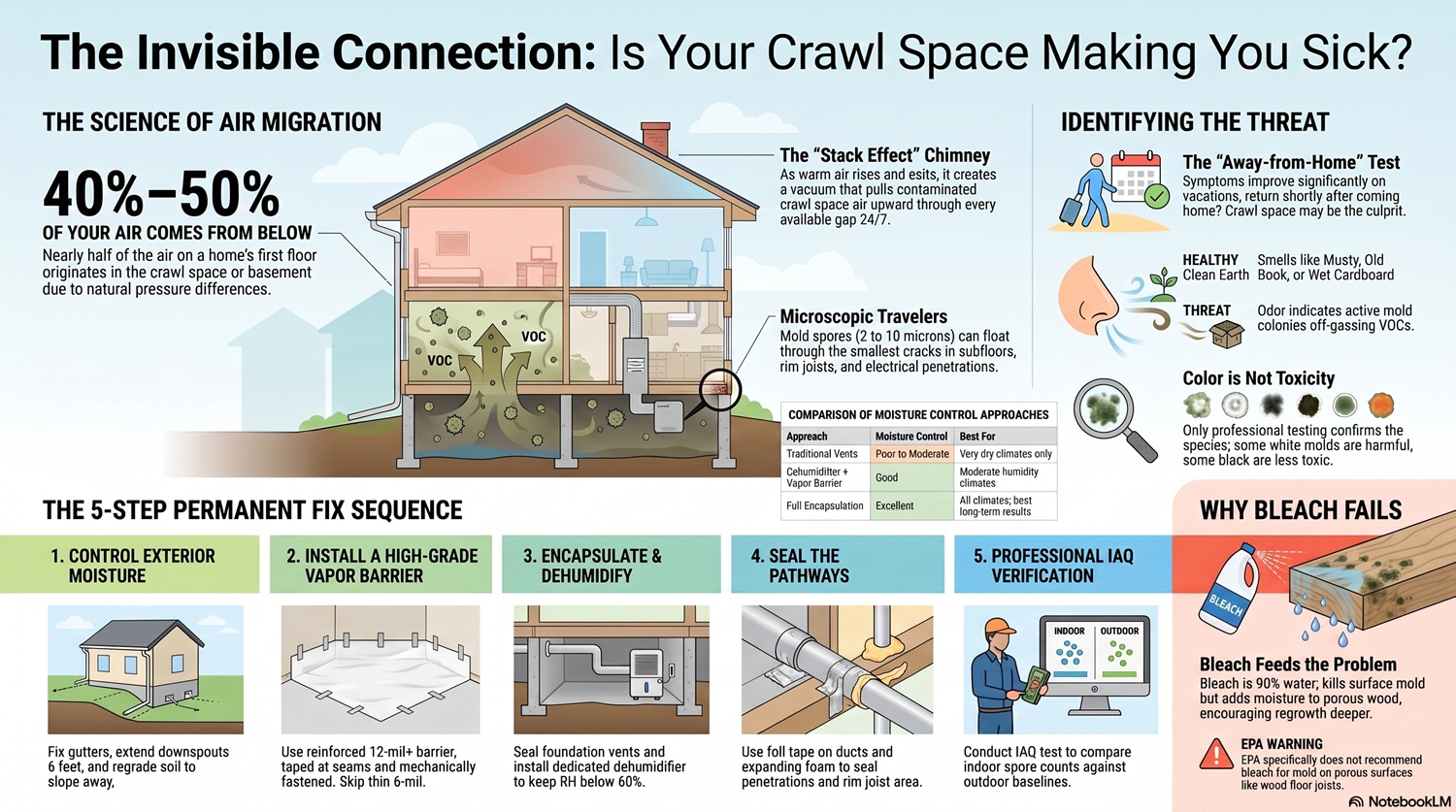
- 40–50% of the air on your first floor originally came from your crawl space — meaning mold growing beneath your home is almost certainly affecting what your family breathes every day.
- The stack effect continuously pulls crawl space air upward through gaps, ductwork, and floor penetrations into your living areas, whether you ever open the crawl space door or not.
- Bleach does not solve crawl space mold — it kills surface growth temporarily but leaves the moisture problem intact, guaranteeing regrowth within weeks.
- You don’t need to see or smell mold to be affected — an indoor air quality test is the only reliable way to confirm crawl space mold is reaching your living space.
- Keep reading to learn the exact fix sequence — from vapor barriers to encapsulation — that permanently stops mold from forming beneath your home.
If you have a crawl space, mold growing down there is not a below-the-floor problem — it’s a whole-home air quality problem.
Most homeowners never think about what’s happening underneath their house until a smell appears or a home inspector flags something alarming. But by that point, mold spores have likely been circulating through the living space for months, sometimes years. Understanding why this happens — and how to stop it — starts with understanding how air actually moves through your home. Resources like TampaBayMold.net have documented this connection extensively, making it easier for homeowners to understand the real scope of the problem.
Yes, Crawl Space Mold Is Affecting the Air You Breathe Right Now
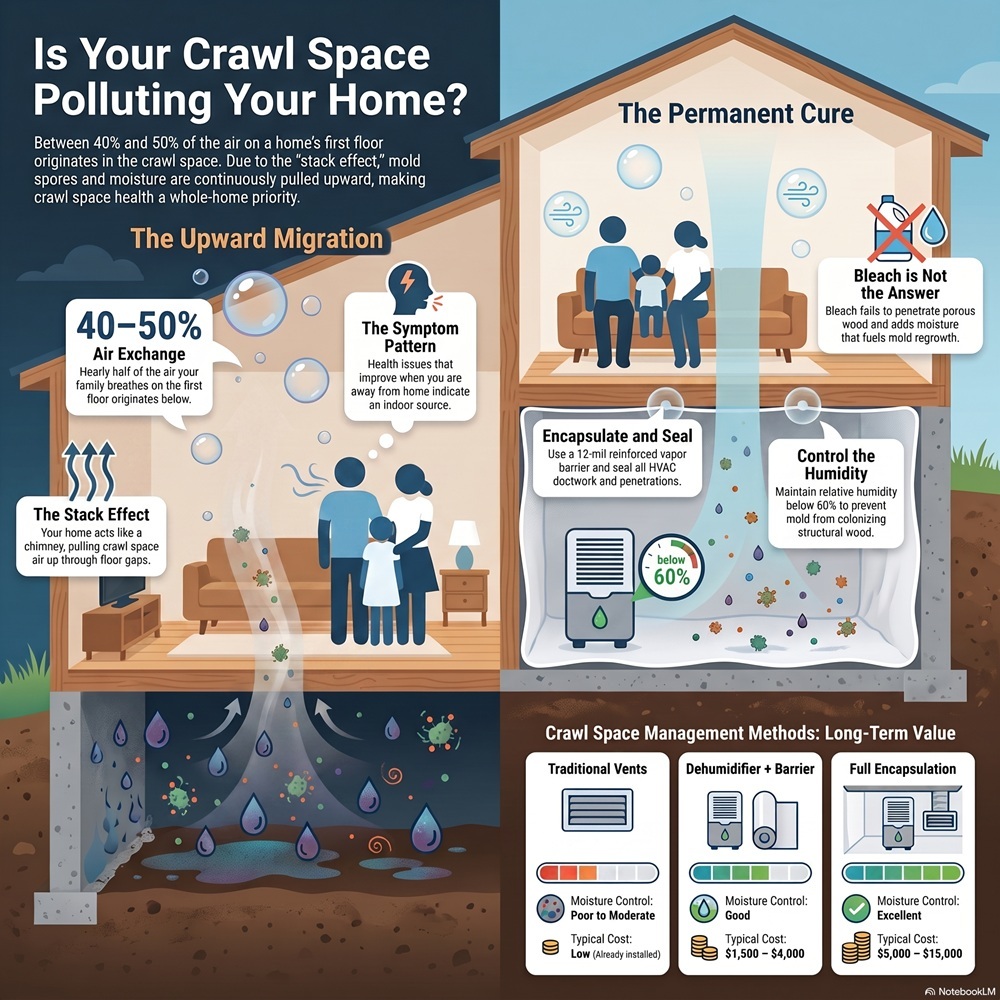
Research indicates that between 40 and 50 percent of the air on your home’s first floor originated in the crawl space or basement. That figure is not a worst-case estimate — it reflects how residential structures naturally move air due to pressure differences between lower and upper levels. Whatever is growing, decaying, or off-gassing beneath your floors is actively being introduced into the air your family breathes while sleeping, eating, and going about daily life.
Mold doesn’t need an open door to travel. It produces microscopic spores — typically between 2 and 10 microns in diameter — that float on air currents through the smallest gaps imaginable. A gap around a pipe, an unsealed rim joist, or a tiny crack in the subfloor is more than enough for continuous spore migration into living areas above.
How Mold Spores Travel From Your Crawl Space Into Your Home
There are two primary forces working against you when you have crawl space mold: the stack effect and your HVAC system. Together, they create a near-constant flow of contaminated air moving upward from below your home’s foundation into the rooms where your family lives. To understand more about the symptoms of crawl space mold, it’s important to recognize these effects.
The Stack Effect: Why Your Home Acts Like a Chimney
Warm air rises. It’s simple physics, and it has major consequences for crawl space air quality. As warm air exits through the upper portions of your home — through attic vents, windows, and ceiling gaps — it creates a zone of lower pressure at the bottom of the structure. Your home then compensates by drawing air in from the lowest available source: the crawl space. This continuous upward draft is called the stack effect, and it operates 24 hours a day regardless of season or weather.
In colder months, the temperature difference between inside and outside intensifies the stack effect significantly, pulling even more crawl space air — along with any mold spores, mycotoxins, or volatile organic compounds (VOCs) — directly into your living areas. Summer heat and air conditioning create similar pressure dynamics, so there is no truly “safe” season when crawl space air isn’t being drawn upward.
HVAC Ductwork as a Direct Delivery Route for Mold Spores
If your HVAC system runs ductwork through the crawl space — which is common in many home designs — you have a secondary and highly efficient delivery route for mold spores. Any leaks, loose connections, or unsealed joints in that ductwork allow crawl space air to be pulled directly into the supply air stream and distributed to every room in the house. Studies show that residential duct systems can lose 20 to 30 percent of conditioned air through leaks, which means that same volume of contaminated crawl space air is being drawn in as makeup.
Even sealed ductwork running through a mold-contaminated crawl space can accumulate spores on outer surfaces, which then shed into the surrounding crawl space air and continue the cycle. The duct system is both a contamination pathway and a distribution network — which is why sealing it is a non-negotiable step in any effective crawl space mold remediation plan.
Common Entry Points Mold Spores Use to Reach Living Areas
Beyond the stack effect and HVAC leaks, spores exploit dozens of smaller pathways throughout a home’s structure. The most common include:
- Gaps around plumbing supply and drain pipes penetrating the subfloor
- Unsealed rim joists where the floor framing meets the foundation wall
- Electrical wire penetrations through floor plates
- Poorly fitted crawl space access doors or hatches
- Open sump pump pits without airtight covers
- Cracks in wood subfloor panels that have warped due to moisture
Each of these gaps may seem trivial individually, but collectively they represent a significant and continuous pathway for contaminated air migration. Sealing them is an essential part of any long-term solution.
The Most Common Mold Species Found in Crawl Spaces
Not all crawl space mold is the same, and the species present determines both the health risk level and the remediation approach required. Crawl spaces create near-ideal conditions for several mold species because they combine the two things mold needs most: cellulose-based building materials and persistent moisture.
Wood floor joists, OSB sheathing, kraft paper insulation facing, and cardboard vapor barrier materials are all rich cellulose food sources. Add ground moisture vapor, condensation from temperature differentials, or any plumbing leak, and you have a self-sustaining mold growth environment that will expand indefinitely until the moisture source is removed.
Stachybotrys Chartarum (Black Mold): What You Need to Know
Stachybotrys chartarum — commonly called black mold — is one of the most talked-about crawl space mold species, and for good reason. It produces mycotoxins, which are toxic chemical byproducts that can cause serious respiratory and neurological symptoms with prolonged exposure. It thrives specifically on materials with very high cellulose content that have been continuously wet — not just damp — for extended periods, making chronically wet wood joists a primary target.
What makes Stachybotrys particularly problematic in crawl spaces is that it tends to colonize deeply into wood fiber rather than just on the surface, making surface-only treatments ineffective. Its spores are also heavier than many other mold species, meaning they don’t travel as freely through air — but when HVAC systems or air disturbance is involved, they absolutely reach living areas.
Why Color Alone Cannot Identify Dangerous Mold
One of the most dangerous misconceptions about crawl space mold is that you can assess risk by looking at the color. This is simply not accurate, and acting on that assumption can lead to serious health consequences.
- Cladosporium — appears olive-green to black; very common; triggers allergic reactions
- Penicillium — appears blue-green; spreads rapidly on damp wood; known allergen and potential mycotoxin producer
- Aspergillus — appears in many colors including yellow, green, and white; includes species capable of causing serious lung infections in vulnerable individuals
- Stachybotrys chartarum — appears dark greenish-black; requires prolonged wetness; produces mycotoxins
- Serpula lacrymans — appears yellowish-orange to brown; causes dry rot in structural wood; not typically a human health threat but indicates severe moisture damage
Some of the most harmful mold species appear white or green, while some relatively less harmful species appear black. Color tells you almost nothing useful about toxicity, allergenicity, or structural risk.
Air sampling or surface testing performed by a qualified Indoor Environmental Professional (IEP) is the only reliable method for identifying what species are present in your crawl space and determining what level of health risk actually exists. If you suspect mold, skip the visual guesswork and go straight to professional mold testing.
Health Effects of Crawl Space Mold Exposure
Health effects from crawl space mold vary based on the species involved, the concentration of spores in the air, how long exposure has been occurring, and the individual’s sensitivity. Children, elderly individuals, and those with asthma, allergies, or compromised immune systems are consistently the most vulnerable — but healthy adults are not immune to effects from prolonged, high-concentration exposure.
The insidious part of crawl space mold exposure is how gradually symptoms develop. Unlike a sudden, high-dose exposure event, crawl space mold delivers a low-level, continuous dose of spores and mycotoxins over months or years. This slow accumulation makes it genuinely difficult for families — and even their physicians — to connect recurring health issues to an environmental source beneath the home.
Symptoms that improve significantly when a family member travels or spends extended time away from home are a key indicator that indoor air quality — potentially from crawl space mold — may be the underlying cause. This pattern deserves serious investigation rather than repeated treatment of symptoms alone.
Respiratory Symptoms Linked to Crawl Space Mold
The respiratory system bears the most direct impact of airborne mold spore exposure. Chronic nasal congestion, persistent coughing, frequent throat irritation, and recurring sinus infections are among the most commonly reported symptoms in homes with crawl space mold issues. These symptoms often fluctuate with seasonal changes that affect crawl space moisture levels — worsening in humid summer months when mold growth accelerates, then slightly improving in dry winter conditions.
Allergic Reactions From Ongoing Mold Spore Exposure
Mold spores are recognized allergens, and continuous low-level exposure through crawl space air migration triggers immune responses that become more pronounced over time. Common allergic reactions include sneezing, runny nose, itchy or watery eyes, and skin irritation. What makes crawl space-related allergic reactions particularly difficult to manage is that the exposure source never stops — standard allergy treatments provide temporary relief but cannot address an ongoing environmental trigger that reactivates the immune response daily.
In individuals with asthma, crawl space mold exposure can trigger significantly more serious reactions. Mold spores inhaled into already-sensitive airways cause bronchial inflammation and constriction, increasing both the frequency and severity of asthma attacks. The American Academy of Allergy, Asthma and Immunology recognizes indoor mold exposure as a significant asthma trigger, particularly in homes with moisture control problems.
How Symptoms Change Based on Time Spent at Home
One of the clearest diagnostic signals that crawl space mold is affecting indoor air quality is a consistent pattern of symptoms that improve when occupants leave the home for extended periods. A family member whose chronic cough, congestion, or fatigue clears up after a week-long vacation — and then returns within days of coming home — is experiencing a pattern that points directly to an indoor environmental source.
Physicians treating patients for recurring respiratory or allergic conditions rarely ask about crawl space conditions, which means families can cycle through treatments for years without addressing the actual cause. If symptoms follow a home-versus-away pattern, environmental testing should be the next step, not another round of antihistamines or antibiotics.
Pattern to Watch For: If one or more family members consistently feel better after spending several days away from home — and symptoms return shortly after coming back — this is a strong indicator that your indoor air quality, potentially driven by crawl space mold, deserves professional evaluation. Track symptoms daily with location notes for two to four weeks before your appointment with an Indoor Environmental Professional.
Children are especially reliable indicators because they tend to spend more time at home than adults and are less likely to attribute symptoms to external stressors. A child with persistent nighttime coughing, frequent ear infections, or chronic congestion that clears up completely during a school trip or extended visit with relatives warrants serious investigation of the home environment.
How to Tell If Your Crawl Space Has Mold Without Going Inside
Most homeowners have no reason — or desire — to physically inspect their crawl space, and that’s completely understandable. The good news is that a significant mold problem beneath your home usually leaves detectable signals in the living space above it. You don’t need to put on knee pads and a respirator to gather enough evidence to know whether professional investigation is warranted.
These above-ground signals won’t tell you exactly what species is present or how extensive the growth is, but they are reliable enough to justify calling a professional for proper testing. Dismissing them because you can’t directly see the mold is one of the most common — and costly — mistakes homeowners make.
Warning Signs You Can Detect From Your Living Space
Several physical signs in your home’s living areas point directly to crawl space moisture and mold issues. Floors that feel soft, spongy, or that squeak more than usual indicate that subfloor materials have absorbed enough moisture to begin deteriorating — a condition that almost always accompanies active mold growth on the structural wood beneath. Peeling paint or bubbling on first-floor walls near floor level, gaps opening between hardwood floor boards, and doors or windows that no longer operate smoothly are also signs of elevated moisture levels that support mold growth below.
Beyond structural signs, watch for these specific indicators:
- A persistent musty or earthy odor in rooms on the first floor, especially in the morning before activity in the house increases air circulation
- Visible efflorescence (white mineral deposits) on foundation walls visible through vents or access points
- Condensation on first-floor windows during cold months, indicating high indoor humidity levels driven by crawl space moisture
- Increased allergy or respiratory symptoms in household members that worsen at home and improve elsewhere
- Visible rust on any metal components near floor level, including HVAC registers, door hinges, or pipe brackets
The Crawl Space Access Door Smell Test
If you want a quick preliminary indicator without fully entering the crawl space, the access door smell test is a simple and remarkably informative first step. Locate your crawl space access hatch or door — typically found in a closet floor, an exterior foundation wall, or a utility room — and open it just enough to get your face near the opening. Do not go inside. Simply breathe in and evaluate what you smell.
A healthy crawl space with proper moisture control should smell like cool, clean earth — similar to the smell of undisturbed soil after light rain. What you should not smell is a musty, damp, or distinctly earthy-organic odor that resembles old books, wet cardboard, or a basement that hasn’t been aired out in years. That smell is the volatile organic compounds (VOCs) produced by active mold colonies as part of their metabolic process.
If the smell is immediately noticeable when you open the access door — or if you can detect it even before fully opening it — consider that a clear signal that mold is actively growing below. The strength of the odor correlates roughly with the extent of growth, though some highly toxic species like Stachybotrys chartarum produce relatively little odor despite serious contamination. The smell test is a starting point, not a complete assessment.
When to Use an Indoor Air Quality Test
An indoor air quality (IAQ) test provides objective, quantifiable data about what is actually circulating in your home’s air. A qualified Indoor Environmental Professional collects air samples from multiple locations — typically one inside the living area, one directly from the crawl space, and one outdoor baseline sample — and sends them to a certified laboratory for spore count and species identification. The comparison between indoor and outdoor spore counts is what matters most: elevated indoor spore counts of species not dominant outdoors points directly to an internal source.
DIY air quality test kits are available at hardware stores, but their reliability is significantly lower than professional sampling due to inconsistent collection methods and the absence of a qualified professional interpreting comparative data. If your goal is actionable results — not just a general impression — spend the money on professional testing. It costs between $350 and $600 in most markets and provides the documentation you need to make informed remediation decisions, and in some cases, to support insurance claims.
Why Bleach Does Not Fix a Crawl Space Mold Problem
Bleach is the most common first response when homeowners discover crawl space mold, and it is almost entirely ineffective as a long-term solution. This is not an opinion — it’s a position supported by the EPA, which explicitly states that bleach is not recommended for porous surface mold remediation. Wood floor joists, OSB panels, and insulation are all porous materials, meaning bleach applied to their surface cannot penetrate deeply enough to reach mold hyphae growing within the material fibers.
What bleach actually does in a crawl space application is kill surface-level spores temporarily while the water component of the bleach solution adds additional moisture to already-damp wood — the exact opposite of what the situation requires. Within two to six weeks of a bleach treatment, mold colonies regrow from the surviving hyphae embedded in the wood, often appearing in the same locations as before. The homeowner then repeats the process, inadvertently cycling moisture into the crawl space repeatedly without making any progress on the underlying problem.
The only thing that permanently stops crawl space mold is eliminating the moisture conditions that allow it to grow. Mold requires three things to survive: a food source (which your wood framing provides indefinitely), oxygen (which your crawl space has in abundance), and moisture. Remove the moisture, and mold cannot grow — regardless of what species is present or how extensive previous growth has been. This is why every effective crawl space mold solution is fundamentally a moisture control solution.
- Bleach cannot penetrate porous wood — it only kills surface spores while leaving embedded hyphae intact and ready to regrow
- The water in bleach solutions adds moisture to already-damp structural wood, accelerating the underlying problem
- Mold regrows within weeks of bleach treatment because the moisture source driving growth was never addressed
- Antimicrobial encapsulants applied by professionals after proper drying are more effective than bleach, but still only work as part of a complete moisture management strategy
- The EPA does not recommend bleach for porous surface mold remediation — this guidance applies directly to crawl space wood framing and insulation
How to Stop Crawl Space Mold From Affecting Your Indoor Air
Fixing a crawl space mold problem requires working through a specific sequence — you cannot skip steps or reverse the order and expect lasting results. Remediation without moisture control leads to regrowth. Moisture control without sealing entry points still allows outdoor humidity in. Every step below builds on the one before it, and skipping any of them compromises the entire system.
1. Control Moisture at the Source
Before any mold treatment begins, identify and eliminate every source of moisture entering the crawl space. Ground moisture vapor is the most persistent source — water naturally evaporates from soil year-round and migrates upward into the crawl space through a process called vapor drive. In addition to ground vapor, check for plumbing leaks from supply lines or drain pipes running through the crawl space, condensation on cold water pipes during humid months, and surface water intrusion from improper grading or failed gutters directing water toward the foundation.
Exterior drainage corrections — regrading soil to slope away from the foundation, extending downspout discharge at least six feet from the foundation, and ensuring gutters are clean and functioning — can dramatically reduce the volume of moisture the crawl space must manage. These exterior steps cost relatively little compared to interior remediation and should always be completed before any work begins below the floor.
2. Install or Repair a Vapor Barrier
A ground vapor barrier is the single most impactful moisture control tool available for a crawl space, and an improperly installed or deteriorated barrier is one of the most common reasons crawl space mold problems persist even after other interventions. The barrier’s purpose is straightforward: physically block ground moisture vapor from evaporating upward into the crawl space air and condensing on structural wood surfaces.
Code-minimum vapor barriers — the thin 6-mil poly sheeting commonly used in older installations — are inadequate for long-term performance. They tear easily during any access to the crawl space, fail at seams, and do not seal against foundation walls. A proper installation uses a minimum 12-mil reinforced polyethylene barrier that covers 100% of the ground surface, overlaps at seams by at least 12 inches with seams taped using manufacturer-approved tape, and runs up and is mechanically fastened to foundation walls at least 6 inches above the ground level. Penetrations around piers and columns must also be carefully sealed. An improperly installed vapor barrier provides a false sense of security while allowing significant ground moisture to bypass its edges and seams.
3. Improve Crawl Space Ventilation or Encapsulation
Traditional crawl space ventilation — the foundation vents built into most homes constructed before the 2000s — was designed with good intentions but creates a moisture problem in many climates. The theory was that outside air flowing through foundation vents would dry out the crawl space. In practice, during humid summer months, warm outdoor air enters the vents, contacts cooler crawl space surfaces, and deposits moisture through condensation — the exact opposite of the intended effect. In humid climates, vented crawl spaces often have higher moisture levels than sealed ones.
Crawl space encapsulation is the modern solution that outperforms traditional venting in most climate zones. A fully encapsulated crawl space combines a heavy-duty sealed vapor barrier on the ground and walls, sealed foundation vents, conditioned air supply from the HVAC system or a dedicated dehumidifier, and an airtight access door. This converts the crawl space from an outside-connected, uncontrolled environment into a semi-conditioned space with managed temperature and humidity levels that mold cannot colonize.
A standalone crawl space dehumidifier — specifically a unit rated for crawl space use, such as the Santa Fe Advance2 or the AprilAire E080 — combined with a vapor barrier can achieve similar results where full encapsulation is not feasible. These units are designed to operate at low temperatures and high humidity levels that standard household dehumidifiers cannot handle reliably. The target relative humidity in any crawl space should be maintained below 60% year-round, with below 50% being ideal for mold prevention.
Ventilation vs. Encapsulation at a Glance:
Approach Best For Moisture Control Typical Cost Range Traditional Foundation Vents Dry climates only Poor to moderate Low (already installed) Dehumidifier + Vapor Barrier Moderate humidity climates Good $1,500 – $4,000 Full Encapsulation All climates, best long-term result Excellent $5,000 – $15,000
4. Seal Ductwork and Floor Penetrations
Once moisture is controlled and a vapor barrier is in place, sealing every air pathway between the crawl space and the living area above is the critical step that actually stops spore migration. Start with the ductwork — use UL 181-rated foil tape (not standard cloth duct tape, which fails within months) to seal every joint, connection point, and seam in any ductwork running through or near the crawl space. Where duct insulation has been damaged or compressed, replace it entirely rather than patching. Mastic sealant applied over taped joints provides an additional long-term seal on rigid duct systems.
For floor penetrations, use fire-rated expanding foam or pre-formed foam gaskets to seal around every pipe, wire bundle, and conduit passing through the subfloor. Pay particular attention to the rim joist area — the space between the top of the foundation wall and the bottom of the floor framing — which is typically the single largest air leakage zone in any crawl space and almost always goes completely unsealed in older construction. Rigid foam insulation cut to fit and sealed at the edges with spray foam is the most effective rim joist treatment available for existing homes.
5. Get a Professional Mold Assessment
After completing moisture control measures, have a qualified Indoor Environmental Professional conduct post-remediation verification testing before assuming the problem is resolved. This involves air sampling from the crawl space and living areas compared against outdoor baseline levels, confirming that spore counts have returned to acceptable ranges and that no active mold colonies remain. Without this verification step, you have no objective evidence that remediation was successful — and if health symptoms continue, you have no data to support further action. Professional assessment also provides documentation that can be valuable for real estate disclosure purposes and, in some cases, for insurance claims related to moisture damage.
Crawl Space Mold Left Untreated Will Only Get Worse
Mold does not stabilize on its own. Without intervention, a crawl space mold colony expands continuously as long as moisture remains available and food sources — your structural wood — are present. What begins as surface mold on a joist face progresses to deep hyphae penetration into the wood fiber, eventually causing structural degradation that goes far beyond an air quality concern. Wood that has been colonized by mold long-term loses structural integrity through a process that begins invisibly and only becomes detectable when floors start to feel soft or sag.
The financial cost of inaction compounds significantly over time. A crawl space mold problem addressed in its early stages — surface mold on joists with moisture levels just beginning to elevate — might cost $2,000 to $5,000 to fully remediate and seal. The same problem left for two to three additional years, with structural wood now showing early rot and subfloor panels requiring replacement, routinely runs $15,000 to $30,000 or more. Meanwhile, the air quality impact on your family continues every day remediation is delayed. There is no scenario in which waiting improves the outcome.
Frequently Asked Questions
Quick Reference: Crawl Space Mold Facts
Question Quick Answer Does crawl space mold affect indoor air? Yes — 40–50% of first-floor air originates in the crawl space Can bleach fix crawl space mold? No — it is ineffective on porous wood surfaces What humidity level prevents mold? Below 60% RH; ideally below 50% RH Is black mold the only dangerous type? No — multiple species pose health risks regardless of color How long does remediation take? Typically 1–5 days depending on severity and crawl space size
These are the questions homeowners most frequently ask once they realize their crawl space may be contributing to poor indoor air quality. The answers below go deeper than a quick summary can provide — because the details are what actually help you make the right decisions for your home and family.
Can crawl space mold affect my family even if we never go down there?
- The stack effect pulls crawl space air continuously upward into your living areas — no physical access required for spore migration
- HVAC ductwork running through the crawl space can draw contaminated air directly into the supply air stream distributed to every room
- Dozens of small gaps around pipes, wiring, and the rim joist provide constant pathways for spore travel into the space above
- Mycotoxins produced by mold colonies are chemical compounds that travel with air currents independently of spores themselves
- VOCs produced by active mold growth cause odors and potential health effects without requiring any physical spore inhalation
The short answer is an unambiguous yes — physical access to the crawl space is completely irrelevant to whether its air quality affects you. The only thing separating the crawl space environment from your living areas is a wood subfloor assembly that is neither airtight nor designed to be a contamination barrier.
Families who seal every visible gap in their floors and walls while leaving an active mold colony in the crawl space untreated are addressing symptoms rather than causes. The spore migration will continue through pathways too small to see or detect without specialized blower door testing equipment. The only effective approach is to eliminate the mold source and control the moisture conditions that allow it to persist.
What percentage of my indoor air comes from the crawl space?
Research indicates that 40 to 50 percent of the air on your home’s first floor originally came from the crawl space or basement. This figure reflects the natural air movement patterns created by the stack effect in residential construction — it is not a worst-case scenario or an extreme outlier estimate. It represents the typical condition in homes with crawl spaces that have not been specifically air-sealed and pressure-balanced to prevent this migration.
On the second floor, the percentage decreases as you move further from the source — but it does not drop to zero. Crawl space air that has mixed with first-floor air continues traveling upward, diluted but not eliminated, reaching every level of the home. Bedrooms on upper floors of a two-story home over a crawl space still receive measurable quantities of crawl space-origin air during a typical night of sleep.
How do I know if crawl space mold is making my family sick?
The clearest diagnostic pattern is symptoms that consistently improve when household members spend extended time away from the home and return when they come back. Chronic respiratory symptoms — persistent coughing, congestion, frequent sinus infections — combined with fatigue or headaches that follow a home-versus-away pattern are the most reliable indicators. The next step is a professional indoor air quality assessment with comparative spore counts from the crawl space, first floor, and outdoor baseline. If indoor spore counts are elevated above outdoor levels with species consistent with what grows on damp wood, you have your answer. Track symptoms by location daily for two to four weeks and bring that log to an Indoor Environmental Professional along with your home’s age, construction type, and any known history of moisture issues.
Is crawl space mold covered by homeowners insurance?
Standard homeowners insurance policies typically exclude mold remediation from coverage unless the mold resulted directly from a covered peril — most commonly a sudden and accidental water discharge, such as a burst pipe. Ground moisture vapor accumulation, condensation, flooding from external sources, and long-term moisture intrusion through the foundation are almost universally excluded from standard policy coverage. Insurance companies classify these as maintenance issues, arguing that proper moisture management is the homeowner’s responsibility.
There are exceptions worth investigating. Some insurers offer mold endorsements as add-on coverage that extends protection to a capped dollar amount — commonly $5,000 to $10,000 — for mold remediation regardless of cause. If your crawl space mold resulted from a plumbing failure that was itself a covered event, document everything meticulously and engage a public adjuster if your initial claim is denied. Policies vary significantly between carriers and states, so review your specific policy language carefully and call your agent with direct questions before assuming coverage doesn’t exist.
How much does it cost to remediate crawl space mold?
Crawl space mold remediation costs vary widely based on the square footage of the crawl space, the extent of mold growth, whether structural wood requires treatment or replacement, and what moisture control measures are included in the scope of work. For limited surface mold on joists in a small crawl space with a straightforward moisture source already corrected, professional remediation can run as low as $1,500 to $3,000. Moderate infestations covering significant portions of the joist system in an average-sized home typically range from $3,000 to $8,000 including post-remediation encapsulant application.
Severe cases — where mold has penetrated deeply into structural wood, subfloor panels require replacement, or the full joist system shows signs of early rot — can push total project costs to $15,000 to $30,000 or higher when structural repairs are included. These figures do not include the cost of the moisture control systems required to prevent recurrence, such as full crawl space encapsulation ($5,000 to $15,000) or a dedicated crawl space dehumidifier ($1,500 to $3,500 installed).
Getting three quotes from licensed mold remediation contractors — not general contractors or handymen — is essential, as pricing and scope of work vary significantly in this industry. Ensure each quote includes post-remediation verification testing, a written scope of work describing exactly what will be treated and how, and documentation of the disposal method for any removed materials. The lowest quote is rarely the best value when the alternative is paying for the same remediation twice because moisture control was not included in the original scope.
If you want to protect your home’s air quality from the ground up, TampaBayMold.net specializes in diagnosing and solving the moisture and mold problems beneath your home that directly impact the air your family breathes every day.
2 Replies to “Does Mold In My Crawl Space Affect The Air I Breathe Inside?”
Comments are closed.