
How Long Does A Mold Inspection Take In Tampa?
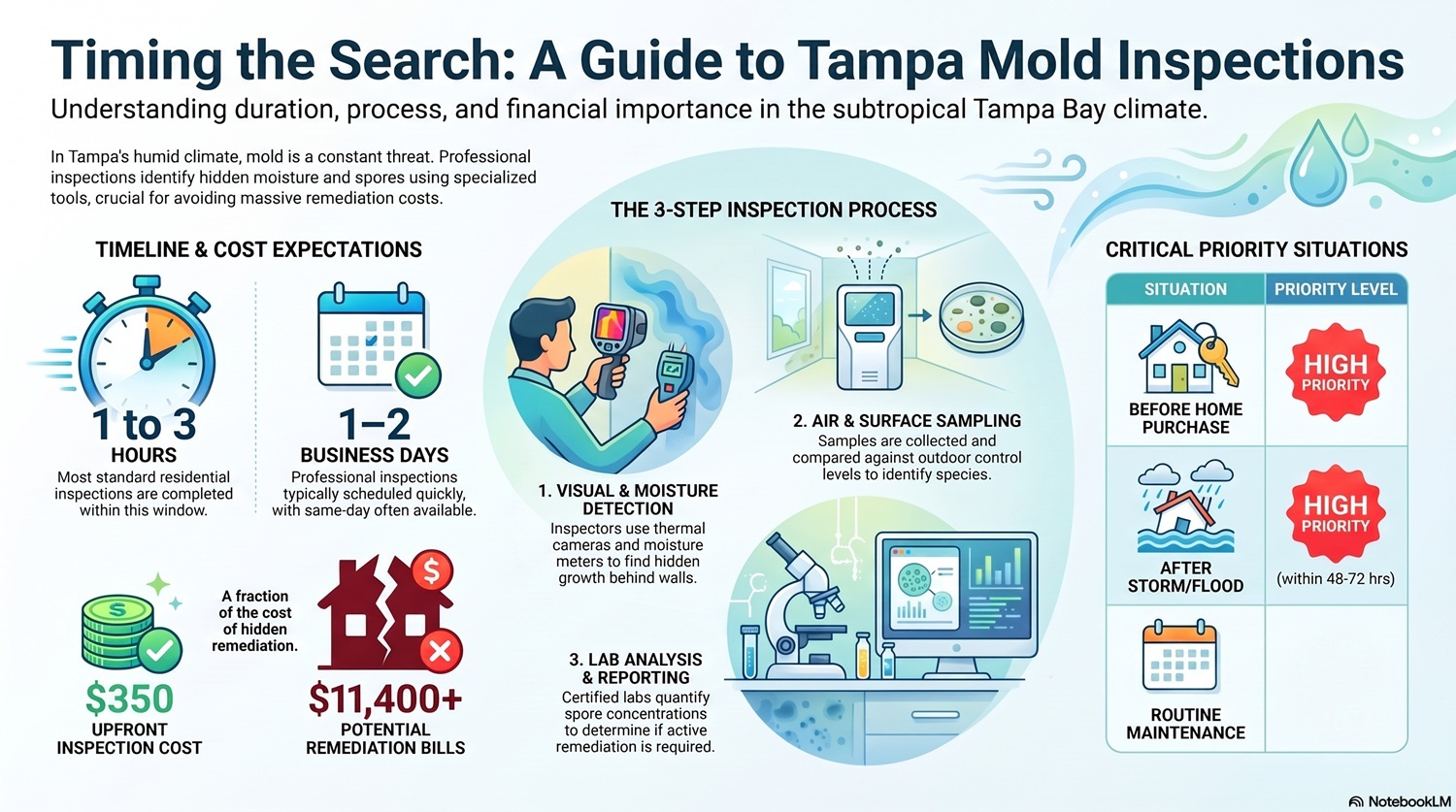
- Most Tampa mold inspections take between 1 and 3 hours for a standard residential property — though size, complexity, and suspected problem areas can push that timeline longer.
- Tampa’s subtropical climate makes mold a year-round threat, with humidity levels and frequent tropical storms creating near-perfect conditions for mold growth inside walls, attics, and HVAC systems.
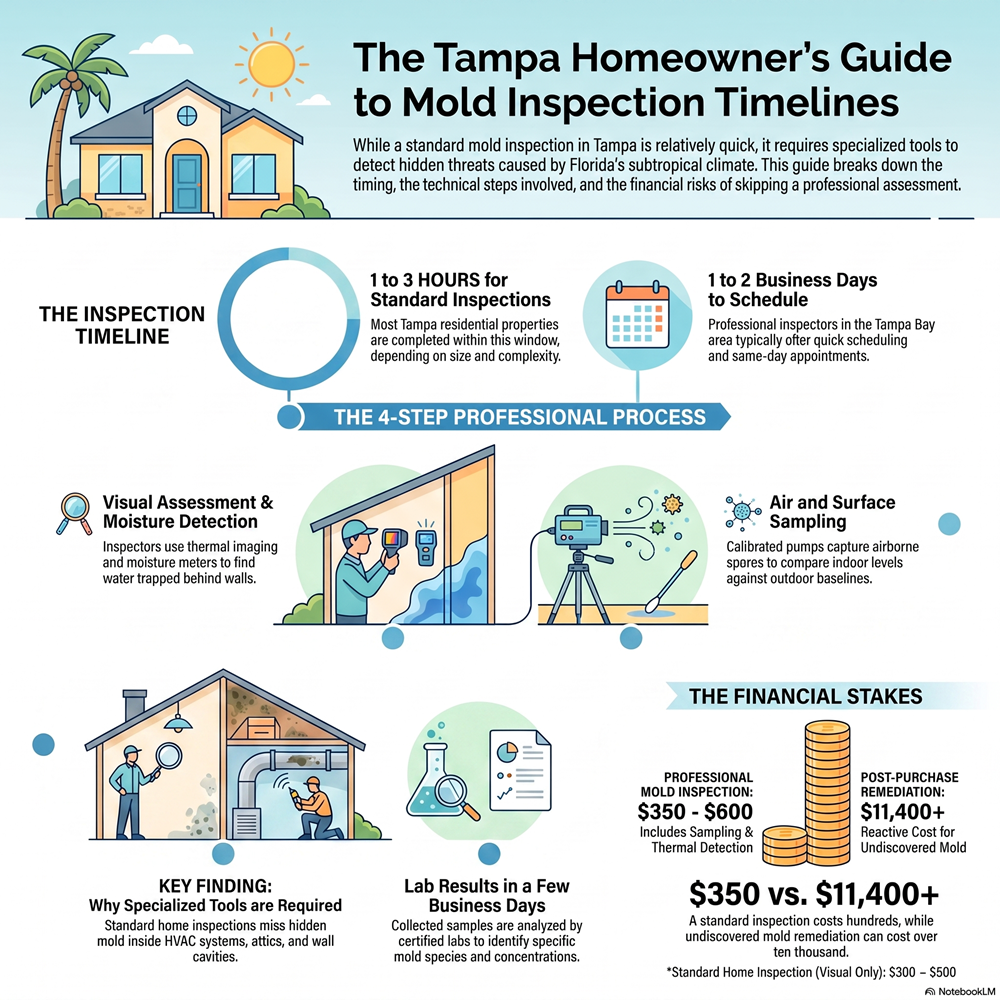
- A standard home inspection will not catch hidden mold — you need specialized moisture detection equipment and air sampling to know what’s really going on inside your home.
- Professional mold inspections in Tampa cost between $350 and $600, but skipping one before a home purchase can lead to remediation bills of $11,400 or more.
- TampaBayMold.net can typically schedule inspections within 1 to 2 business days, with same-day appointments often available — keep reading to understand exactly what happens during each step of the process.
Most Tampa Mold Inspections Take 1 to 3 Hours
A typical mold inspection in Tampa takes 1 to 3 hours for a standard single-family home. That window covers the full process: a visual walkthrough, moisture readings, air and surface sample collection, and documentation. Larger homes, complex layouts, or properties with multiple suspected problem areas will naturally take longer.
What you shouldn’t do is confuse inspection time with remediation time. The inspection itself is relatively quick. If mold is confirmed and remediation is needed, that’s a separate process — small bathroom mold might be resolved in a single day, while attic or multi-room contamination can take up to 5 days depending on the extent of the growth.
Why Tampa Homes Need Specialized Mold Inspections
Tampa is one of Florida’s most mold-prone regions, and that’s not an accident. The combination of year-round heat, high relative humidity, hurricane season moisture intrusion, and the construction styles common across Hillsborough, Pinellas, Pasco, Manatee, and Sarasota counties creates conditions where mold doesn’t just grow — it thrives. Understanding why Tampa homes are uniquely vulnerable changes how seriously you take inspection and prevention.
TampaBayMold.net, which has served the Tampa Bay area for over 14 years, draws on 17 years of mold experience to address exactly these regional conditions — including the specific building materials, HVAC configurations, and storm patterns that accelerate hidden mold growth in local homes.
Tampa’s Humidity Levels Create Year-Round Mold Risk
Mold needs moisture and organic material to grow. Tampa delivers the moisture part almost constantly. The city’s subtropical climate means humidity levels regularly exceed 70% — the threshold at which mold spores begin colonizing surfaces rapidly. Unlike northern states where mold risk peaks seasonally, Tampa homeowners face this threat every single month of the year.
After a tropical storm or even a heavy afternoon thunderstorm, moisture infiltrates roof joints, window seals, and foundation gaps in ways that aren’t immediately visible. That trapped moisture behind drywall or inside insulation creates the ideal hidden environment for mold to establish itself long before any visible signs appear on walls or ceilings.
Why Standard Home Inspections Miss Hidden Mold
Standard home inspections are designed to evaluate general property conditions — roofing, electrical, plumbing, structural integrity. They are not equipped to find mold. A general home inspector isn’t using thermal imaging cameras, calibrated moisture meters, or air sampling pumps. They’re doing a visual check, which means anything growing inside walls, under flooring, or in HVAC ductwork stays completely invisible during that process.
This gap is exactly why pre-purchase mold inspections are so critical in the Tampa Bay market. A home can pass a general inspection with flying colors while harboring significant mold contamination in areas a standard inspector simply cannot access or assess without specialized tools.
Where Mold Hides in Tampa Homes
Mold doesn’t announce itself. In Tampa homes, the most common hidden locations include:
- Behind drywall near exterior walls where condensation builds up
- Inside attic spaces, particularly after roof damage or poor ventilation
- Underneath flooring, especially in bathrooms and laundry rooms
- Inside HVAC ductwork and air handler units
- Around window frames and door seals with weathering or failed caulk
- In crawlspaces and under-slab areas with groundwater infiltration
Each of these areas requires specific inspection techniques to properly assess — a flashlight walkthrough won’t cut it.
What Happens During a Mold Inspection
A professional mold inspection isn’t just someone walking through your home looking for visible growth. It’s a structured, multi-step process using certified equipment and lab analysis. Here’s exactly what to expect at each stage.
Step 1: Visual Assessment of the Property
The inspection begins with a comprehensive visual walkthrough of the entire property. The inspector examines areas of known moisture risk first — bathrooms, kitchens, laundry rooms, utility spaces, and any areas the homeowner has flagged as concerns. They’re looking for visible mold growth, water staining, peeling paint, warped materials, and any signs of past or present moisture intrusion.
What inspectors look for during the visual stage:
Area Inspected What They’re Looking For Bathrooms & kitchens Grout discoloration, caulk failure, under-sink moisture Attic spaces Roof leak staining, insulation discoloration, poor ventilation signs HVAC units & vents Visible growth on coils, musty odor from vents, drain pan overflow Exterior walls (interior side) Efflorescence, bubbling drywall, cold spots indicating moisture Crawlspaces & utility rooms Standing water, organic debris, groundwater seepage
This visual stage sets the map for where moisture readings and sampling will be focused. It isn’t a standalone assessment — it’s the foundation for everything that follows in the inspection process.
Step 2: Moisture Detection With Specialized Equipment
After the visual walkthrough, the inspector moves into active moisture detection using calibrated tools that general home inspectors don’t carry. Thermal imaging cameras identify temperature differentials inside walls that indicate trapped moisture. Penetrating and non-penetrating moisture meters give precise readings on drywall, wood framing, and flooring materials without causing unnecessary damage. This equipment identifies exactly where mold conditions exist, even when there’s no visible surface growth yet.
Step 3: Air and Surface Sample Collection
Sampling is what separates a professional mold inspection from a general walkthrough. Air samples are collected using a calibrated pump that pulls a measured volume of air through a spore trap cassette. These cassettes capture airborne mold spores at concentrations too small to see or smell. Surface samples — typically tape lifts or swabs — are taken from any areas with visible suspected growth or high moisture readings.
Air vs. Surface Sampling: What Each Reveals
Sample Type Method What It Identifies Air Sample Spore trap cassette via pump Airborne spore count & mold species present in living areas Surface Sample (tape lift) Adhesive tape applied to surface Species identification on visible growth or staining Surface Sample (swab) Sterile swab of affected area Growth confirmation in textured or porous surfaces Outdoor Control Sample Air sample taken outside Baseline spore levels to compare against indoor readings
An outdoor control sample is always collected alongside indoor air samples. This comparison is essential — it tells the lab whether indoor spore levels are elevated relative to natural outdoor baseline counts, which is the actual indicator of a problem inside the home.
All collected samples are sent to a certified laboratory for analysis. The lab identifies the specific mold species present and quantifies spore concentration levels, giving the inspector — and ultimately the homeowner — a precise picture of what’s in the air they’re breathing every day.
Step 4: Lab Analysis and Results
Once samples reach the certified lab, analysis typically takes a few days. The lab report identifies every mold species detected, the spore concentration levels for each, and how indoor readings compare to the outdoor control baseline. Your inspector then translates those technical findings into plain language — telling you exactly what’s present, where it’s concentrated, and whether levels indicate an active problem requiring remediation.
Factors That Change How Long an Inspection Takes
Not every Tampa mold inspection takes the same amount of time. While the 1 to 3 hour window covers most standard residential properties, several factors push that timeline in either direction. Knowing what affects inspection duration helps you plan your day and sets realistic expectations before the inspector arrives.
Property Size and Layout
Square footage is the most straightforward factor. A 1,200 square foot condo takes considerably less time to inspect than a 3,500 square foot two-story home with a finished attic and detached garage. Multi-story layouts add time because every level needs individual moisture readings and visual assessment. Properties with complex floor plans — multiple additions, finished basements, or detached structures — require additional sampling points and extend the overall inspection window accordingly.
Severity and Location of Suspected Mold
When a homeowner reports a specific concern — a musty smell in one bedroom, visible discoloration near a window — the inspector can prioritize efficiently. But when mold signs are widespread, multiple sampling locations are needed across the property, and that adds meaningful time to the process.
Location matters just as much as severity. Mold suspected inside HVAC ductwork, in a crawlspace, or behind finished walls requires additional access steps and more careful documentation. An attic inspection alone can add 30 to 45 minutes if the space is large or poorly accessible. The inspector has to be thorough — rushing these areas is exactly how significant contamination gets missed.
HVAC System Complexity
Tampa’s climate means air conditioning runs nearly year-round, and HVAC systems are one of the most common vectors for mold spread throughout a home. A simple single-zone system is straightforward to inspect. Multi-zone systems, older ductwork, or units with known drainage issues require more time to properly evaluate — including checking the air handler, drain pan, coils, and accessible duct runs.
When mold colonizes an HVAC system, every time the system runs it distributes spores into living areas throughout the entire home. This makes HVAC inspection one of the most critical — and time-intensive — components of a thorough Tampa mold assessment.
How Much a Tampa Mold Inspection Costs
Cost is one of the first questions Tampa homeowners ask, and the honest answer is that professional mold inspection is far less expensive than the alternative of discovering a major mold problem after the fact.
Standard Residential Inspection Pricing
Professional mold inspections in the Tampa Bay area — covering Hillsborough, Pinellas, Pasco, Manatee, and Sarasota counties — typically range from $350 to $600 for standard residential properties. That price includes the on-site inspection, all sample collection, certified lab analysis, and a detailed report of findings. Larger properties or those requiring additional sample points may fall outside that range, but for most single-family Tampa homes, that window is accurate.
What Happens If Mold Is Found After Purchase
Skipping a pre-purchase mold inspection is a gamble that regularly costs Tampa homeowners far more than the inspection itself. When mold problems go undetected until after closing, remediation costs can reach $11,400 or more depending on how extensively the contamination has spread. At that point, the cost isn’t just financial — it’s the disruption of living through remediation in a home you just bought, and potentially dealing with health effects in the meantime.
When to Book a Mold Inspection in Tampa
Situation Recommended Action Priority Level Before purchasing any Tampa Bay home Schedule pre-purchase mold inspection 🔴 High After tropical storm or hurricane Inspect within 48–72 hours of moisture intrusion 🔴 High After roof leak or plumbing failure Inspect as soon as repairs are completed 🔴 High Musty smell with no visible source Schedule inspection promptly 🟡 Medium Routine maintenance — no known issues Inspect every 1–2 years 🟢 Routine Post-remediation clearance Clearance test after all remediation work 🔴 High
Timing your mold inspection correctly makes a significant difference in both what gets detected and what remediation ends up costing. Tampa’s climate doesn’t give homeowners much of a grace period — mold can begin establishing within 24 to 48 hours of moisture exposure, which means waiting weeks after a water event to schedule an inspection allows a manageable problem to grow into a major one.
There are clear trigger events that should prompt an immediate inspection call, and there are also routine windows every Tampa homeowner should build into their annual home maintenance schedule. Both matter, and neither should be skipped in a region with Tampa Bay’s mold pressure.
Routine inspections on a one to two year cycle are particularly important for older Tampa homes — properties built before modern moisture barriers and building code updates that have more vulnerability to hidden infiltration. Even homes that appear dry and well-maintained can accumulate moisture in areas that only specialized equipment will find.
After Tropical Storms, Roof Leaks, or Plumbing Failures
Water events are the single biggest driver of mold growth in Tampa homes. A roof leak after a storm, a burst pipe, an overflowing washing machine — any of these creates immediate mold risk if the moisture isn’t fully extracted and dried within a very short window. Even when visible water is cleaned up quickly, moisture trapped inside wall cavities, under flooring, or in insulation provides exactly the hidden environment mold needs to establish.
After any significant water event, an inspection isn’t just a precaution — it’s the only reliable way to confirm that hidden moisture has been fully addressed. Insurance documentation often requires this confirmation as well, making a professional inspection both a health decision and a practical financial one.
Before Buying Any Tampa Bay Property
Pre-Purchase Mold Inspection: What’s at Stake
Scenario Cost Estimate Pre-purchase mold inspection $350 – $600 Remediation discovered after purchase $11,400 or more Standard home inspection (mold not included) $300 – $500 (mold not covered) Potential negotiation savings when mold found pre-purchase Varies — often covers inspection cost many times over
Every Tampa Bay home buyer should schedule a dedicated mold inspection before closing — full stop. The general home inspection your real estate agent recommends is not a substitute. Standard home inspectors evaluate roofing, electrical, plumbing, and structure. They do not carry thermal imaging cameras, moisture meters, or air sampling equipment. A home can pass a general inspection while actively harboring mold contamination inside walls, in the attic, or throughout the ductwork.
The financial logic alone makes this a non-negotiable step. A professional mold inspection costs between $350 and $600. If mold is found before closing, you have real leverage — you can negotiate remediation costs into the purchase price, require the seller to remediate before closing, or walk away from a property that would have become a serious financial and health liability. If mold is discovered after closing, that leverage disappears entirely, and remediation bills can exceed $11,400 depending on the extent of the problem.
Beyond the numbers, buying a Tampa Bay home without a mold inspection means accepting an unknown risk in one of the most mold-prone regions in Florida. The subtropical climate, the history of tropical storm exposure, and the construction characteristics common across Hillsborough, Pinellas, Pasco, Manatee, and Sarasota counties all increase the probability that hidden moisture issues exist in any given property. A dedicated mold inspection removes that unknown before it becomes your problem.
Routine Inspections Every One to Two Years
Even without a triggering event — no storm damage, no plumbing failure, no musty smell — Tampa homeowners should schedule routine mold inspections every one to two years. This isn’t overcaution. It’s the appropriate maintenance response to living in a subtropical climate where mold pressure is constant and hidden moisture accumulation is common in even well-maintained homes. For more insights, you can refer to the Tampa Bay Mold Inspection guide.
Older Tampa properties are particularly vulnerable. Homes built before modern moisture barriers and updated building code requirements have structural characteristics that allow moisture infiltration in ways that newer construction partially mitigates. Crawlspaces, older window seals, aging HVAC systems, and decades-old ductwork all create ongoing risk that routine inspection catches before it compounds into a serious remediation project.
Tampa Homeowner Annual Mold Maintenance Schedule
Time of Year Recommended Action Pre-hurricane season (May) Inspect roof seals, window caulking, and HVAC drain lines Post-hurricane season (November) Schedule professional mold inspection if any storm events occurred Every 1–2 years (regardless of events) Full professional mold inspection with air sampling After any plumbing repair Moisture check in affected area; full inspection if significant leak HVAC service visits Request drain pan and coil inspection for mold signs
Think of routine mold inspection the same way you think about annual HVAC servicing or roof checks. It’s preventive maintenance that costs a fraction of what reactive repairs demand. In Tampa’s climate, the question isn’t whether mold risk exists — it always does. The question is whether you’re identifying it early or waiting until the problem forces your hand. For more information, check out this guide on mold inspection.
Schedule Your Tampa Mold Inspection Within 1 to 2 Business Days
TampaBayMold.net typically schedules inspections within 1 to 2 business days, with same-day appointments often available — call (813) 358-4766 to check current availability across all five counties: Hillsborough, Pinellas, Pasco, Manatee, and Sarasota.
Frequently Asked Questions
Tampa homeowners ask similar questions when they’re weighing a mold inspection for the first time. These answers cut straight to what you need to know before booking.
Does homeowners insurance cover mold inspection costs in Tampa?
Most standard homeowners insurance policies in Florida do not cover routine mold inspection costs. Coverage for mold-related expenses typically only applies when mold results directly from a covered peril — like sudden water damage from a burst pipe — and even then, many policies include mold-specific exclusions or sub-limits. Review your policy’s mold language carefully, and don’t assume coverage exists without confirming it with your insurer directly.
Can I stay in my home during a mold inspection?
Yes — in most cases, you can remain in your home throughout the inspection. The process involves a visual walkthrough, moisture readings, and sample collection, none of which require you to vacate the property. Being present during the inspection is actually beneficial, as it allows you to point out specific areas of concern and ask questions in real time as the inspector works through the property.
The exception would be if you or a household member has a known mold sensitivity or respiratory condition. In that case, it’s worth discussing with your inspector beforehand, as disturbing suspected mold growth during sample collection can briefly increase localized airborne spore counts in that specific area of the home.
How long does it take to get lab results after a mold inspection?
After samples are collected during your Tampa mold inspection, they are sent to a certified laboratory for analysis. Lab turnaround time typically runs a few business days from the point samples are received. Your inspector will then review the lab report and translate the technical findings — spore counts, species identification, comparison to outdoor baseline levels — into a clear summary of what was found and what it means for your home.
If you’re working against a real estate closing deadline, communicate that timeline to your inspector upfront. Expedited lab processing is sometimes available, which can compress the results window when time is a genuine constraint.
Is black mold more dangerous than other mold types found in Tampa homes?
Stachybotrys chartarum — commonly called black mold — does produce mycotoxins and is considered a serious concern, but the fixation on black mold specifically can be misleading. Multiple mold species found in Tampa homes, including Aspergillus and Cladosporium, can cause significant health effects depending on spore concentration and individual sensitivity. Color alone is not a reliable indicator of danger. Any mold growth identified at elevated levels in a home’s air sampling results warrants professional attention, regardless of species or appearance.
Do I need a mold inspection if I already had a general home inspection?
Yes. A general home inspection and a professional mold inspection are fundamentally different assessments using different tools and evaluating different things. A general inspector checks structural, electrical, plumbing, and roofing conditions. They are not equipped — and typically not trained — to assess mold or hidden moisture conditions.
In Tampa’s climate, this distinction matters more than it does in most parts of the country. The combination of year-round humidity, tropical storm exposure, and older housing stock across the region means hidden mold conditions are common in properties that look perfectly fine to a general inspector. Air sampling and moisture detection equipment are the only tools that reliably identify what’s happening inside walls, in attic spaces, and throughout HVAC systems.
3 Replies to “How Long Does A Mold Inspection Take In Tampa?”
Comments are closed.