
Will A Mold Inspection Detect All Types Of Mold?
Article At A Glance
- A mold inspection primarily relies on visual assessment and moisture detection — not air sampling — making thoroughness of the inspector critical to catching hidden mold.
- There are no federally established health-based standards for acceptable mold levels indoors, which limits how much air sampling results can actually tell you.
- Negative mold test results do not guarantee your home is mold-free
- Musty odors are one of the most reliable early indicators of mold presence, often more useful than lab testing alone.
- Knowing what a mold inspection can and cannot detect could be the difference between catching a serious problem early and missing it entirely — keep reading to find out what most inspectors overlook.
A mold inspection can detect a lot — but it won’t always catch everything, and that distinction matters more than most homeowners realize.
Understanding what a mold inspection actually covers helps you make smarter decisions about your home’s safety. TampaBayMold.net works with homeowners navigating exactly these situations, and one of the most common misconceptions they encounter is the belief that a single inspection gives you a complete picture. It rarely does.
Mold Inspections Have Real Limits — Here’s What You Need to Know
Mold is a fungal growth that spreads on damp or decaying organic matter. It exists both indoors and outdoors in virtually every climate, in every season. Indoors, it needs two things to thrive: moisture and a carbon source from building materials like drywall, wood framing, or insulation. The moment those two elements meet, mold can begin colonizing a surface — often invisibly.
The tricky part is that mold comes in many species and colors, and the color alone tells you nothing reliable about how dangerous it is. What actually matters is where it’s growing, how much of it exists, and what’s feeding it. A mold inspection is designed to answer those questions — but the methods used to find it have real limitations that every homeowner should understand before scheduling one.
What a Standard Mold Inspection Actually Covers
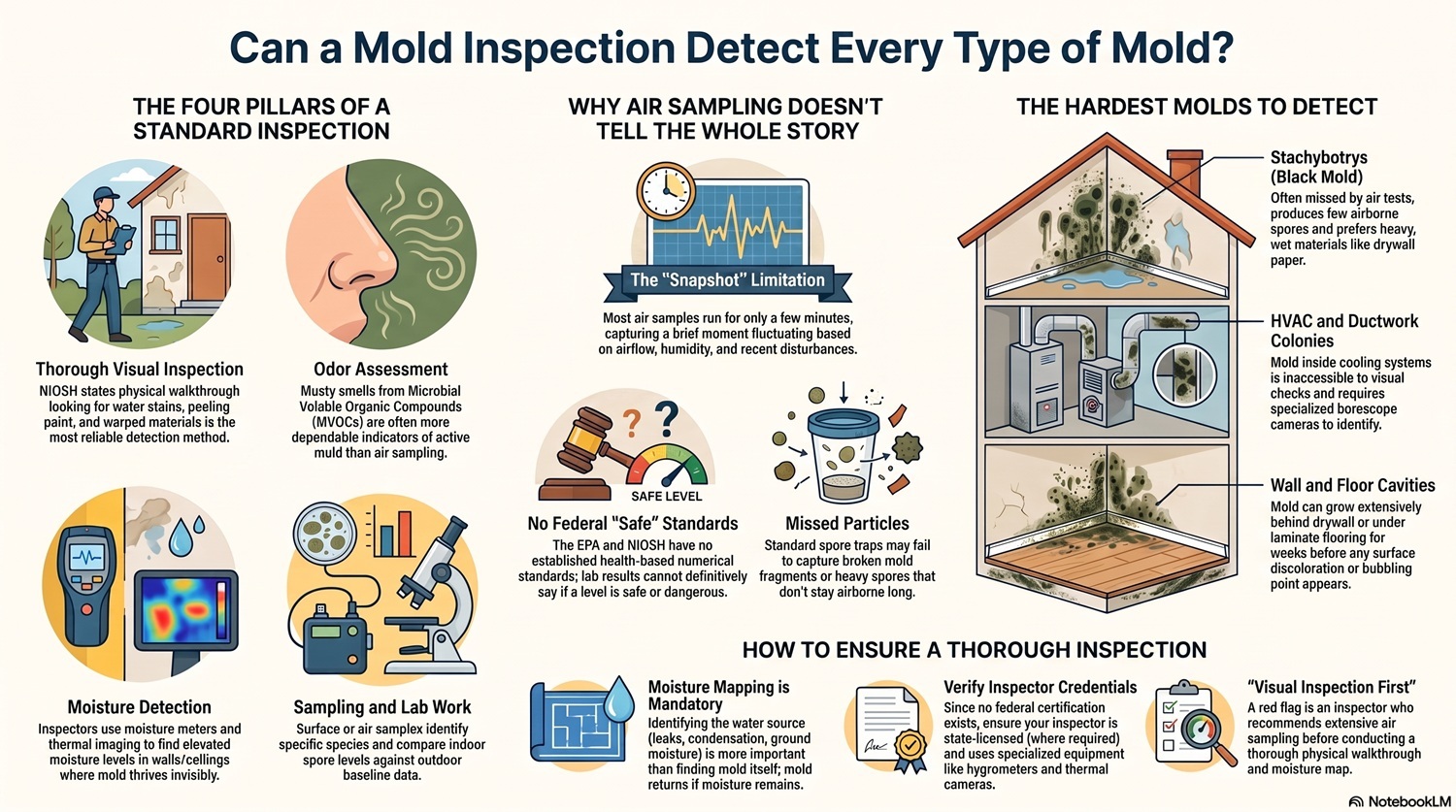
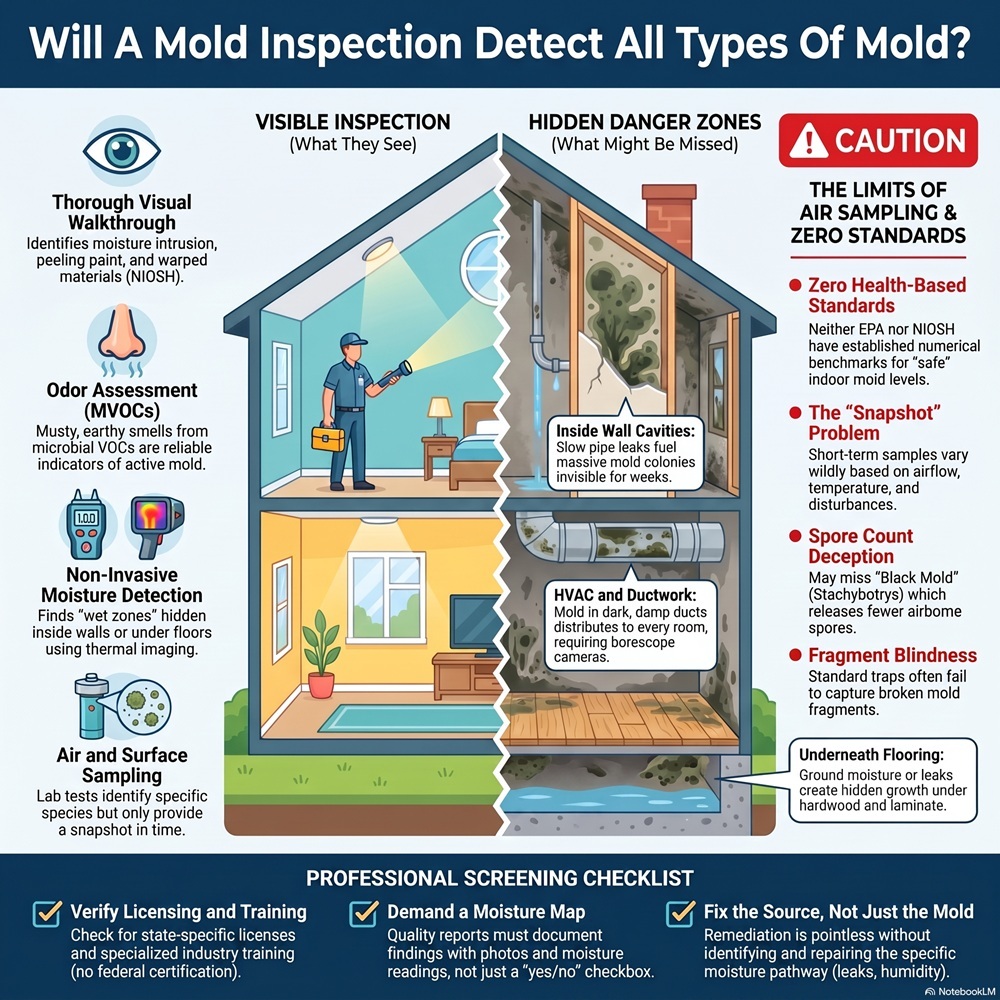
Most mold inspections are built around four core activities: a visual walkthrough, odor assessment, moisture detection, and sampling. Each plays a different role, and together they form the foundation of how inspectors identify whether a mold problem exists.
Visual Inspection: The Primary Detection Method
According to NIOSH, thorough visual inspection remains the most reliable method for detecting mold problems in a building. An inspector walks through the property looking for visible signs of mold growth, water staining, discoloration, peeling paint, warped materials, or any area that shows evidence of past or current moisture intrusion.
Common areas targeted during a visual inspection include:
- Bathrooms and kitchens where humidity levels are consistently elevated
- Basements and crawl spaces with limited ventilation
- Around windows and exterior walls where condensation builds
- Under sinks and around plumbing fixtures
- Attic spaces where roof leaks or poor insulation create moisture pockets
- Areas near HVAC systems and ductwork
A skilled inspector doesn’t just look — they interpret. Staining that looks like an old water mark could indicate an active slow leak. Bubbling paint on a basement wall might signal rising damp from the foundation. The visual inspection is only as good as the person performing it, which is why experience and training matter significantly.
Musty Odors as a Reliable Warning Sign
NIOSH specifically identifies musty odors as one of the more dependable indicators of a mold problem — sometimes more useful than air sampling. That distinctive earthy, damp smell comes from microbial volatile organic compounds (MVOCs) released during mold’s metabolic process. If an inspector or homeowner detects it, there’s almost always an active mold source nearby, even if it isn’t immediately visible.
The challenge is that odors can be faint in well-ventilated spaces, or masked by other household smells. An inspector who is methodical about checking enclosed spaces — closets, wall cavities, under-sink cabinets — is far more likely to catch odor-based clues that a rushed walkthrough would miss entirely.
Moisture Detection and Why It Matters
Since moisture is the single driving factor behind indoor mold growth, identifying where it exists is just as important as finding mold itself. Inspectors use moisture meters and thermal imaging cameras to detect elevated moisture levels inside walls, floors, and ceilings — areas where mold could already be growing without any visible surface signs.
Why Air Sampling Doesn’t Tell The Whole Story
Air sampling is one of the most commonly misunderstood parts of a mold inspection. Many homeowners assume it’s the gold standard for mold detection. There are no health-based standards for mold concentrations in indoor air. That means even if a lab returns a number — say, 800 spores per cubic meter — there is no established threshold to compare it against that definitively says whether that level is safe or dangerous. The EPA and NIOSH both note that without standardized benchmarks, measured mold concentrations from air samples cannot be meaningfully interpreted in relation to health risks. Generally, you want spore counts to less than the outside air and not at levels that indicate there is an ongoing humidity issue or water instrusion in a home or business.
Short-Term Sampling Sometimes Misses Hidden Mold
Most air sampling done during a mold inspection is short-term — typically running for just a few minutes in each location. That narrow window captures only a snapshot of what’s airborne at that exact moment, which can vary dramatically based on airflow, temperature, humidity, and whether the mold source was recently disturbed.
Mold inspection services can be a valuable complement here. Companies experienced in moisture intrusion know where hidden wet zones tend to develop and can help trace moisture pathways that standard air sampling simply cannot reveal.
Spore Counts Don’t Always Tell the Full Story
Even when air sampling does detect mold spores, the numbers alone don’t capture the full picture of exposure or risk. Here’s why spore counts are inherently limited:
- Not all mold species release spores at the same rate — some dangerous species like Stachybotrys chartarum produce relatively few airborne spores compared to common molds
- Fragment particles aren’t always counted — broken mold fragments can carry health risks but may not be captured in standard spore trap samples
- Results don’t reflect actual daily exposure — a single short-term sample doesn’t represent what a person living in the home breathes over days or weeks
- No baseline standard exists — without established safe levels, comparing results to a benchmark is impossible
Lab results from air sampling can provide useful supplementary data, but they should never be treated as a definitive verdict on whether a home is safe. The full picture requires combining visual inspection findings, moisture data, and — where appropriate — targeted surface sampling from suspected growth areas.
Types of Mold That Are Hardest to Detect
Not all mold hides in plain sight. Some of the most problematic mold colonies in a home grow in locations that a standard visual inspection simply cannot access without specialized equipment or invasive investigation. Knowing where these blind spots exist helps you ask better questions and push for a more thorough assessment.
Mold Hidden Inside Walls and Under Flooring
Wall cavities are one of the most common locations for hidden mold growth. When a pipe leaks slowly behind drywall, or when exterior moisture seeps through a compromised wall assembly, the interior framing and insulation can stay wet for weeks — long enough for mold to establish a substantial colony before any surface sign appears. By the time you see discoloration or bubbling paint on the outside of the wall, the growth behind it may already be extensive.
The same applies under flooring. A slow dishwasher leak, a poorly sealed bathroom, or a basement floor that wicks ground moisture can all create wet conditions beneath hardwood, laminate, or tile. Moisture meters and thermal imaging are the most effective non-invasive tools for detecting these hidden problem zones, but they aren’t always included in a basic inspection package. Always confirm what equipment your inspector is bringing before they arrive.
Stachybotrys Chartarum (Black Mold) and Why It Hides
Stachybotrys chartarum — commonly called black mold — is one of the harder species to detect through air sampling precisely because it produces relatively few airborne spores compared to other mold types. It prefers consistently wet cellulose materials like drywall paper, ceiling tiles, and wood that has stayed damp for an extended period. That means it typically grows in areas with chronic moisture problems rather than areas that dried out quickly after a single event.
Because Stachybotrys releases fewer spores into the air, a standard air sample taken in a room where it’s growing inside a wall may come back with low or unremarkable spore counts — creating a false sense of security. Surface sampling or direct inspection of suspected wet materials is far more effective for detecting this particular species. If your home has had any long-term water intrusion, targeted investigation of those areas is essential rather than optional.
Mold in HVAC Systems and Air Ducts
HVAC systems create ideal conditions for mold — cool, dark, and often damp from condensation. Mold growing inside ductwork is especially problematic because the system actively distributes spores throughout every room in the house every time it runs. Yet duct interiors are almost entirely inaccessible during a standard visual inspection without specialized cameras or scopes.
Signs that mold may be present in your HVAC system include musty odors that appear only when the system is running, visible dark spotting around supply or return vents, and occupants experiencing allergy-like symptoms that improve when they leave the building. If any of these are present, requesting a dedicated HVAC inspection using a borescope camera is the most direct way to confirm or rule out mold inside the ductwork.
There Are No Safe Mold Level Standards — Here’s Why That Matters
Neither the EPA nor NIOSH has established health-based numerical standards for acceptable mold levels in indoor air. This is not an oversight — it reflects the genuine scientific complexity of how different people respond to mold exposure. Sensitivity varies enormously between individuals based on age, immune status, existing respiratory conditions, and specific mold species involved. What causes no symptoms in one person may trigger a significant reaction in another living in the same house. This means that any report framing mold results as “within acceptable limits” should be viewed with skepticism, because no such universal limit officially exists.
What Triggers a Mold Reaction Is Not Always the Mold Itself
Most people think of mold exposure as a straightforward cause-and-effect — mold grows, person breathes spores, person gets sick. The reality is more layered than that. Mold produces several types of byproducts beyond spores, including mycotoxins (toxic chemical compounds), microbial volatile organic compounds (MVOCs), and cell wall fragments. Each of these can trigger different biological responses, and none of them are consistently captured in a standard spore count air sample.
MVOCs are what create the musty odor associated with mold. They’re present even when spore counts are low, which is part of why NIOSH considers odor detection a meaningful and reliable indicator of a mold problem. The presence of that smell means active biological activity is occurring — regardless of what any air sample says about spore concentrations in that room.
Mycotoxins add another layer of complexity. Certain mold species produce these compounds under specific environmental stress conditions, and their presence or absence isn’t predictable from spore counts alone. Standard mold inspections do not test for mycotoxins — that requires specialized, separate laboratory analysis. For most homeowners, the practical takeaway is this: even a “low mold” environment can be biologically active in ways that affect health, especially for sensitive individuals.
How to Choose a Qualified Mold Inspector
The quality of a mold inspection depends almost entirely on the person performing it. Since the tools available have significant limitations, an experienced, methodical inspector who knows where to look and what questions to ask will consistently outperform a less experienced one using the same equipment. Before hiring anyone, it’s worth understanding the qualification landscape — because it’s less regulated than most homeowners expect.
No Federal Certification Exists — Know What to Look For
There is no federal certification requirement for mold inspectors in the United States. Some states have introduced their own licensing requirements like Florida, and some professional organizations offer training and examinations for practitioners in the indoor air quality industry — but none of these are universally mandated. This means the barrier to entry for someone calling themselves a mold inspector is low, and credentials vary widely.
Questions to Ask Before Hiring an Inspector
Before committing to any mold inspection service, treat the initial conversation as a screening interview. The right inspector will welcome specific questions and answer them with clarity — not vague reassurances.
Here are the most important questions to ask upfront:
- What methods will you use? — Confirm they plan to do a thorough visual inspection, use moisture detection equipment, and explain when and why air or surface sampling would or wouldn’t be recommended
- What equipment do you bring? — Hygrometers and moisture meters should be standard; ask whether HVAC scoping is available
- What licensing, certifications or training do you hold? — Look for specifics, not general contractor licenses
- What will the report include? — A quality report should document findings with photos, moisture readings, and specific location data — not just a checkbox summary
One red flag worth noting: any inspector who immediately recommends extensive air sampling as the first and primary step — before a thorough visual walkthrough — may not be approaching the process with the right priorities. Visual inspection and moisture mapping come first. Everything else is supplementary.
The Most Reliable Way to Catch All Mold Types in Your Home
No single method catches every type of mold in every location. The most thorough approach combines multiple detection strategies in a logical sequence, starting with what the evidence consistently shows to be most reliable and building from there based on what the initial findings reveal.
1. Start With a Thorough Visual Inspection
A thorough visual walkthrough is the single most important step in detecting mold, and it should always come before any testing or sampling. An experienced inspector systematically checks every moisture-prone area — bathrooms, basements, crawl spaces, attic spaces, around plumbing, near HVAC components, and along exterior walls. The goal isn’t just to spot visible mold colonies but to identify conditions that make mold growth likely, including water staining, condensation damage, and deteriorating building materials.
2. Address Moisture Problems First
Finding mold and removing it without fixing the moisture source is pointless. The mold will return. Every effective mold detection strategy treats moisture control as the foundational priority — because without excess moisture, indoor mold cannot establish or sustain growth. Before spending money on remediation, confirm that every identified moisture source has been located, documented, and has a clear plan for repair.
This means looking beyond the visible mold to trace where the water is actually coming from. Is it a roof leak migrating down through the attic? A slow pipe fitting dripping inside a wall? Ground moisture wicking through a concrete slab? Each source requires a different fix, and missing even one means the mold problem is only temporarily addressed. Moisture mapping using thermal cameras and moisture meters is the most effective non-invasive method for tracing these pathways before remediation begins.
3. Consider Mold Inspection Services
Companies that specialize in mold inspection bring a different perspective to mold detection than standard home inspectors. Their core expertise is understanding how water moves through a building — where it enters, where it travels, and where it accumulates. That structural knowledge often allows them to locate hidden wet zones that a general mold inspector might not immediately recognize. If your home has experienced any flooding, roof damage, plumbing failures, or persistent humidity issues, combining a water damage assessment with your mold inspection gives you a significantly more complete picture of the actual risk inside your home.
A Mold Inspection Is a Starting Point, Not a Final Answer
A mold inspection — even a thorough one — tells you what was detectable on the day it was performed, using the tools and methods available to that inspector. It is not a guarantee that every mold colony in the building has been found, and it is not a substitute for ongoing moisture management and vigilance. Use the inspection findings as a roadmap: identify the problem areas, fix the moisture sources, remediate confirmed growth, and follow up. For any home with a history of water intrusion or persistent humidity, periodic reassessment is far more protective than treating a single inspection as a permanent clean bill of health.
Frequently Asked Questions
Homeowners researching mold inspections often have similar questions — and the answers are sometimes more nuanced than a quick online search reveals. Here are the most common ones, answered directly.
Can a mold inspection miss mold that is behind walls?
Yes — and this is one of the most important limitations to understand. A standard visual inspection cannot see through walls, floors, or ceilings. Mold growing inside wall cavities, under flooring, or behind tile is invisible to a surface inspection unless it has migrated far enough to cause visible damage on the exterior surface of the material. For more information on testing and remediation, you can visit the CDC’s guide on mold testing.
Thermal imaging cameras and moisture meters improve detection significantly by identifying temperature differentials and elevated moisture levels that suggest hidden wet zones. However, even these tools have limits. Definitive confirmation of mold inside a wall often requires either removing a section of drywall for direct inspection or using a borescope camera to view interior cavities without full demolition. If you have reason to suspect hidden mold — persistent odors, unexplained health symptoms, or a known history of water intrusion — push for invasive investigation rather than accepting a surface-level assessment as complete.
Is air sampling an accurate way to detect all types of mold?
Air sampling is not an accurate or comprehensive detection method on its own. Short-term air samples capture only what is airborne at a single moment in a single location, and mold spore concentrations fluctuate constantly based on airflow, disturbance, temperature, and humidity. A mold colony sitting undisturbed inside a wall cavity may release very few spores into the general room air during a calm sampling period.
Additionally, there are no federally established health-based standards for mold concentrations in indoor air. Without a benchmark to compare results against, the numbers generated by air sampling have limited interpretive value. Air sampling can provide useful supplementary data alongside a thorough visual inspection and moisture assessment, but it should never be the primary or sole detection method.
What types of mold are most commonly missed during an inspection?
Mold growing in enclosed, inaccessible spaces is consistently the most likely to be missed. This includes mold inside HVAC ductwork, within wall cavities adjacent to plumbing, under bathroom flooring, and in crawl spaces with limited access. These areas combine the conditions mold needs most — consistent moisture, darkness, and an organic food source — while remaining almost entirely hidden from a surface visual inspection.
Stachybotrys chartarum, commonly called black mold, is also frequently missed because it releases relatively few airborne spores compared to other species, making it harder to detect through air sampling. It prefers materials that have been wet for an extended, continuous period — like drywall paper or ceiling tiles with chronic moisture exposure — and tends to grow deep within material surfaces rather than on top where it’s easily visible. Any area of a home with a history of prolonged water exposure warrants targeted investigation specifically for this species.
How is black mold different from other mold types found indoors?
Black mold — Stachybotrys chartarum — differs from many common indoor molds primarily in its growth requirements and detection behavior. While many mold species can colonize surfaces after relatively brief moisture exposure, Stachybotrys requires materials that have been consistently wet for an extended period, typically one to two weeks or longer. This means it’s more likely to appear after chronic leaks, flooding events, or prolonged humidity problems rather than after a quick spill that dried out within a day or two.
It’s also important to understand that the color of mold — including black — does not reliably indicate species or danger level. Many molds appear dark or black, and not all of them are Stachybotrys. Conversely, Stachybotrys can sometimes appear dark greenish-black rather than pure black. Visual identification alone is not sufficient to confirm species — laboratory analysis of a surface sample is required for definitive identification.
From a detection standpoint, Stachybotrys is particularly hard to catch through air sampling because it produces fewer airborne spores relative to its colony size. It tends to release spores in clusters rather than continuously, and those clusters often settle quickly rather than remaining suspended in the air where a sampler would capture them. This makes direct surface investigation of suspected wet materials far more reliable than air sampling when Stachybotrys is specifically suspected.
3 Replies to “Will A Mold Inspection Detect All Types Of Mold?”
Comments are closed.