
11 Most Common Questions People Always Ask About A Mold Inspection In Tampa Bay
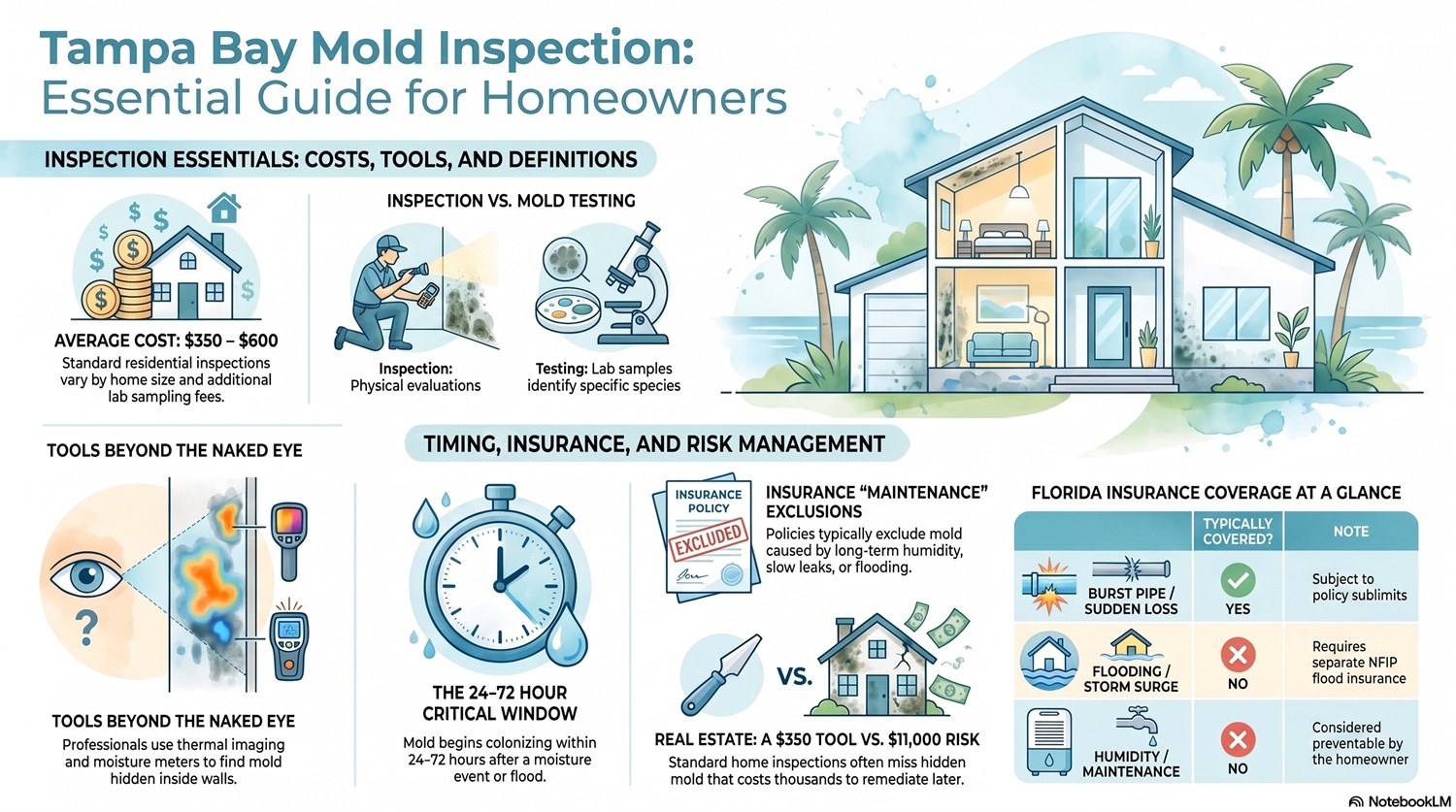
- Tampa Bay’s subtropical humidity creates near-perfect mold conditions year-round — most homes in the area will encounter mold at some point, making routine inspections a smart investment, not a luxury.
- A mold inspection and a mold test are two different things — knowing which one you actually need can save you hundreds of dollars and prevent unnecessary remediation work.
- Professional mold inspectors use tools like thermal imaging cameras and moisture meters to find hidden mold behind walls and under floors that you’d never spot with a visual check alone.
- TampaBayMold.net has been helping homeowners across five counties since 2013 — owner-operated with 14+ years of local expertise in one of Florida’s most mold-prone regions.
- There’s a specific window after water damage or flooding where mold can be stopped before it spreads — and most homeowners miss it entirely. Keep reading to find out what that window is.
Key Takeaways: What Tampa Bay Homeowners Need to Know About Mold Inspections
Tampa Bay’s climate doesn’t just make summers miserable — it turns your home into a mold incubator if you’re not paying attention.
With average humidity levels regularly exceeding 70% and a rain season that stretches nearly half the year, the conditions that mold needs to thrive are practically built into the environment here. That’s not an exaggeration. It’s just the reality of living in one of the most humid metro areas in the continental United States. For homeowners across Hillsborough, Pinellas, Pasco, Polk, and Hernando counties, understanding mold inspection isn’t just useful knowledge — it’s a home safety essential.
If you’ve ever wondered what a mold inspection actually involves, how much it costs in the Tampa Bay area, or whether you even need one, TampaBayMold.net has been answering those exact questions for local families for over 14 years. This guide pulls together the 11 questions Tampa Bay homeowners ask most, with direct, no-nonsense answers to each one.
Mold Inspections in Tampa Bay Are Not Optional — Here’s Why
Mold is not a minor inconvenience. Left unaddressed, it damages structural materials like drywall, wood framing, and insulation — often silently, inside walls where no one can see it. It also releases spores that affect indoor air quality and can trigger respiratory issues, allergic reactions, and chronic health problems, particularly in children, the elderly, and anyone with asthma or immune system conditions.
- Tampa Bay receives an average of 46 to 50 inches of rain per year
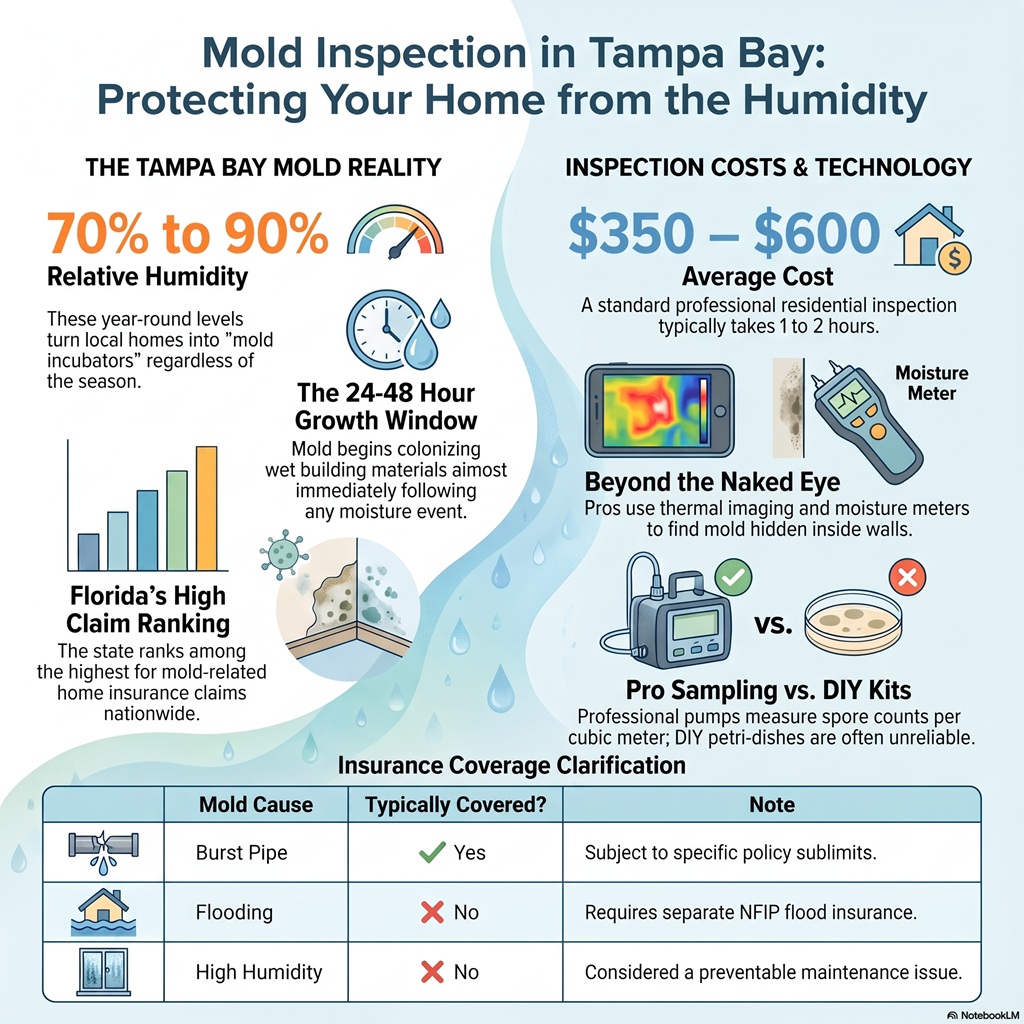
- Relative humidity in the region regularly sits between 70% and 90%
- Mold can begin growing within 24 to 48 hours of a moisture event
- Florida ranks among the top states for mold-related home insurance claims
- Many Tampa Bay homes use construction methods that are particularly vulnerable to moisture intrusion
What makes Tampa Bay uniquely challenging is that mold doesn’t need a flood or a burst pipe to take hold. Condensation from an overworked air conditioning system, a slow roof leak, or even just poor ventilation in a bathroom is enough to create the moisture levels mold needs to grow. This is a year-round problem — not a seasonal one.
Why Tampa Bay’s Climate Makes Mold a Year-Round Threat
Most parts of the country get a break from mold pressure during cooler, drier months. Tampa Bay doesn’t. Even in January, average humidity levels rarely drop to a range that discourages mold growth. The subtropical climate means that moisture is almost always present, and when you combine that with the indoor temperature differentials created by air conditioning running constantly, you get a perfect environment for mold to colonize — especially in less-ventilated spaces like attics, crawl spaces, and inside wall cavities.
The Difference Between a Mold Inspection and a Mold Test
A mold inspection is a physical evaluation of your home — a trained inspector walks through the property looking for visible mold growth, moisture sources, water damage, and conditions that are likely to produce mold. A mold test, on the other hand, involves collecting air or surface samples that get sent to a lab to identify the specific types and concentrations of mold spores present. You can have an inspection without testing, and sometimes that’s all you need. Testing is typically added when there’s a need to confirm the species of mold present, measure spore counts, or provide documentation for legal or real estate purposes.
When You Actually Need a Professional Mold Inspection
You need a professional mold inspection any time you notice a musty odor you can’t source, visible discoloration on walls or ceilings, or after any water intrusion event — including flooding, roof leaks, pipe bursts, or even prolonged high humidity. It’s also strongly recommended before purchasing a home, after hurricane season, or if occupants are experiencing unexplained respiratory symptoms. Don’t wait for mold to become visible — by the time you see it, it’s usually been growing for a while. For more information, you can check out questions to ask a mold inspector to ensure you are well-prepared.
1. How Much Does a Mold Inspection Cost in Tampa Bay?
Mold inspection costs in the Tampa Bay area typically range from $350 to $600 for a standard residential inspection, though the price varies based on the size of the home, the complexity of the inspection, and whether lab testing is included. Larger homes or properties with multiple suspected problem areas will naturally sit at the higher end of that range. If air or surface sampling is added for lab analysis, expect to add another $75 to $150 per sample depending on the lab and turnaround time.
It’s worth noting that some companies advertise very low inspection fees — sometimes under $100 — but these are often loss-leader pricing models where the inspector is incentivized to recommend remediation services they also sell. A truly independent inspection, where the inspector has no financial stake in the remediation outcome, gives you unbiased results you can actually trust.
What Factors Drive the Price Up or Down
The main cost variables are square footage, accessibility of suspected areas (attics, crawl spaces, and inside walls cost more to inspect thoroughly), the number of samples collected for lab testing, and whether you need a post-remediation clearance inspection after work has been completed. Geographic location within the Tampa Bay metro also plays a minor role, with some inspectors charging travel fees for properties in more remote areas of Pasco or Polk County.
Why Cheap Inspections Can Cost You More Later
A $75 inspection that misses hidden mold behind a bathroom wall can lead to thousands of dollars in structural remediation six months later. The goal of a mold inspection is accurate information — and that requires time, proper equipment, and an inspector who isn’t rushing through the job. Spending $350 to $600 on a thorough, independent inspection is almost always the more economical choice in the long run.
2. How Long Does a Mold Inspection Take In Tampa?
For a typical single-family home in the Tampa Bay area, a thorough mold inspection takes 1 to 3 hours. Smaller condos or apartments may be completed in less time, while larger homes with multiple bathrooms, attic access, crawl spaces, or complex HVAC systems can take closer to 2 to 4 hours. If the inspector is also collecting multiple air and surface samples for lab analysis, add time for that process as well.
3. What Does a Mold Inspector Actually Look For In A Tampa Bay Home?
A professional mold inspector is doing far more than just looking for green or black spots on walls. The inspection is a systematic evaluation of every area of the home where moisture can accumulate, where water has historically intruded, or where ventilation is insufficient to keep humidity in check. This includes the obvious places — bathrooms, kitchens, laundry rooms — and the less obvious ones, like inside HVAC air handlers, beneath flooring near exterior walls, and in attic spaces where roof ventilation may be inadequate.
Visible Mold vs. Hidden Mold: What Inspectors Check
Visible mold is actually the easier part of the job. The real skill in a mold inspection is finding hidden mold — growth that exists inside wall cavities, beneath flooring, above drop ceilings, or inside ductwork where it can distribute spores throughout the entire home every time the AC runs. Inspectors look for secondary indicators like water staining, peeling paint, warped baseboards, and elevated moisture readings that suggest active moisture problems even when no mold is visually present yet.
Moisture Meters, Thermal Imaging, and Other Tools Used
High-quality mold inspectors in Tampa Bay use a combination of tools to find what the naked eye can’t. Moisture meters measure the water content inside building materials like drywall and wood — readings above 17% to 18% moisture content in wood, for example, indicate conditions where mold is likely already growing or will soon. Thermal imaging cameras detect temperature differentials inside walls that often indicate moisture intrusion — wet materials cool differently than dry ones, creating thermal signatures visible on an infrared camera. Some inspectors also use borescopes — small cameras on flexible cables — to look inside wall cavities without requiring demolition. These tools together give an experienced inspector a comprehensive picture of what’s happening inside your home’s structure, not just on its surface.
4. Can I Stay Home During a Mold Inspection?
Yes — and in most cases, it’s actually helpful if you’re present. Being home during the inspection allows you to point out areas of concern, share the history of any past water damage or leaks, and ask questions in real time as the inspector works through the property. You’ll also get to hear preliminary observations directly from the inspector before the formal written report is prepared. The inspection process itself poses no health risk to occupants — the inspector is evaluating conditions, not disturbing mold growth in a way that would release significant additional spores into the air.
5. Will A Mold Inspection Detect All Types of Mold?
A visual inspection can identify mold growth and flag areas where conditions are right for mold to thrive, but it cannot definitively identify the specific species of mold without lab testing. Different mold species look similar to the naked eye, and some of the most problematic types — like Stachybotrys chartarum (commonly called black mold) — can look similar to other less harmful species. If species identification matters for your situation — particularly for health concerns, real estate transactions, or insurance claims — air or surface sampling sent to an accredited lab is the reliable way to get that answer.
The Most Common Mold Species Found in Tampa Bay Homes
Tampa Bay homes most frequently test positive for Cladosporium, Penicillium, Aspergillus, and Chaetomium — all of which thrive in humid, warm environments and can colonize drywall, wood, fabric, and HVAC components. Cladosporium is particularly common in Florida because it grows well in both warm and cool conditions, making it a persistent presence inside air conditioning systems. Aspergillus species are especially concerning in homes where occupants have compromised immune systems, as certain strains can cause serious respiratory infections.
Chaetomium is a strong indicator of long-term water damage — it produces a musty, distinctive odor and is frequently found in Tampa Bay homes that have experienced roof leaks or plumbing failures that weren’t fully dried out. Finding Chaetomium in a lab result is often a sign that moisture has been present for weeks or months, not days. Penicillium spreads rapidly and is commonly found behind wallpaper, under carpeting, and inside insulation — all materials that are common in Florida homes and that tend to trap moisture.
Why Black Mold Gets the Most Attention
Stachybotrys chartarum — what most people call black mold — earns its reputation because it produces mycotoxins, which are toxic compounds that can cause severe health reactions including chronic fatigue, neurological symptoms, and serious respiratory problems with prolonged exposure. It requires consistently wet conditions to grow, typically appearing after sustained water damage that wasn’t properly remediated. While it’s not the most common mold found in Tampa Bay homes, the high rate of flood and storm damage in the region means Stachybotrys shows up more frequently here than in drier parts of the country — and it should always be treated as a serious finding requiring immediate professional remediation.
6. Do I Need a Mold Inspection Before Buying a Home in Tampa?
Buying a home in Tampa Bay without a dedicated mold inspection is a significant financial risk. The standard home inspection required by most mortgage lenders covers the general condition of the property — roof, electrical, plumbing, HVAC — but home inspectors are not trained or equipped to identify mold growth or evaluate moisture conditions the way a mold specialist is. In a region where nearly every older home has experienced at least some form of water intrusion, skipping a mold inspection before closing is the kind of decision that can cost tens of thousands of dollars to correct after the purchase is done.
The Tampa Bay real estate market moves quickly, and buyers are often pressured to keep inspections minimal to stay competitive. But a mold inspection is a relatively small investment — typically $350 to $600 — compared to the cost of discovering a significant mold problem after you’ve already signed the deed. Schedule the mold inspection to run concurrently with your standard home inspection to keep the timeline tight without cutting corners on due diligence.
Real Scenario: A buyer purchases a 1,980 sq ft home in Seminole, FL. The standard home inspection passes. Three months after closing, a musty smell prompts a mold inspection — results show Chaetomium and Penicillium growing inside two bathroom walls and beneath the master bedroom flooring, the result of a slow shower pan leak that had been ongoing for over a year. Total remediation cost: $11,400. A pre-purchase mold inspection costing $350 would have revealed elevated moisture readings in exactly those areas — giving the buyer negotiating leverage or the option to walk away.
Florida does have some seller disclosure requirements, but mold is not always explicitly listed as a mandatory disclosure item, and sellers may not even be aware of hidden mold inside wall cavities. Don’t rely on disclosure forms to protect you — rely on an independent inspection.
Why a Standard Home Inspection Is Not Enough
A licensed home inspector in Florida is trained to evaluate the visible, accessible components of a home. Their job is broad by design — they’re evaluating dozens of systems in a single visit. Mold detection requires a completely different focus: understanding airflow patterns, moisture migration, building envelope vulnerabilities, and the specific conditions that allow mold to colonize materials inside walls and beneath floors.
The most dangerous mold in a home purchase scenario is hidden mold — growth that exists behind perfectly normal-looking walls, under flooring, or inside air handlers. A standard home inspection will not find it. A professional mold inspection, using hygrometers, thermal imaging and moisture meters throughout the property in addition to taking air samples to evaluate air quality, has a significantly higher probability of flagging the problem before you close.
How to Use Mold Findings in Purchase Negotiations
If a mold inspection reveals active growth or high-risk moisture conditions, you have several options as a buyer. You can request that the seller fund professional remediation before closing, negotiate a price reduction that covers the projected remediation cost, ask for a credit at closing to handle the work yourself, or walk away entirely if the findings are severe enough — assuming your contract includes an inspection contingency, which it should.
The written mold inspection report and any lab results become your documentation for these negotiations. A report showing confirmed mold growth with lab-verified species identification is far more compelling in a negotiation than a verbal concern — it’s specific, professional, and hard for a seller or their agent to dismiss. In competitive markets, buyers sometimes hesitate to use inspection findings as leverage, but with mold, the health and financial stakes are too significant to let that pressure override good judgment.
7. What Happens After a Mold Inspection?
Once the inspection is complete, you’ll receive a written report that documents everything the inspector found — areas of visible mold growth, locations with elevated moisture readings, suspected hidden mold areas, lab results if samples were taken, and recommended next steps. This report is your roadmap. It tells you whether you have an active mold problem that needs immediate remediation, moisture conditions that need to be corrected before mold develops, or a clean bill of health with recommendations for ongoing prevention. For more details, you can explore questions to ask a mold inspector to ensure thorough understanding.
Not every mold inspection ends with a remediation recommendation. Sometimes the inspector finds minor surface mold in a single bathroom that can be addressed with targeted cleaning and improved ventilation — no professional remediation required. Other times, the findings are more serious and remediation is strongly advised. The report should make the distinction clearly, and a trustworthy inspector will explain the findings honestly rather than defaulting to the most expensive recommendation.
How to Read Your Mold Inspection Report
A well-structured mold inspection report will include the date and scope of the inspection, a property overview, specific findings organized by location within the home, moisture meter readings with flagged areas above normal thresholds, photographs documenting problem areas, lab results with spore counts and species identification if testing was performed, and a recommendations section that prioritizes next steps. Pay particular attention to any area where moisture readings are elevated even without visible mold — that’s where the next growth is most likely to appear. If the report is vague, lacks photographs, or doesn’t include specific moisture readings, ask the inspector for clarification before proceeding with any remediation work.
When Remediation Is Recommended vs. Required
Remediation is recommended when mold is present but contained to a small area — generally under 10 square feet — and the moisture source has already been corrected. It’s effectively required when mold covers a larger area, has penetrated structural materials, is present inside HVAC systems distributing spores throughout the home, or when lab results confirm the presence of toxigenic species like Stachybotrys. In Florida, the EPA’s guidelines and the IICRC S520 standard are the primary frameworks that professional remediators use to determine the appropriate scope of work based on the extent of contamination.
8. Can I Do My Own Mold Inspection In Tampa Bay?
You can walk through your own home and look for obvious signs of mold — visible growth, water staining, musty odors — and that kind of regular self-monitoring is genuinely useful. But a self-inspection has serious limitations: you don’t have the tools to measure moisture inside walls, you can’t safely access areas like attic spaces and air handlers with the same systematic approach a professional uses, and confirmation bias is a real factor — homeowners often check the places they expect to find a problem and miss the ones they haven’t considered. For a thorough evaluation that gives you reliable, actionable information, professional inspection is the appropriate choice.
DIY Mold Test Kits vs. Professional Inspections
DIY mold test kits — the kind sold at home improvement stores for $10 to $50 — are petri dish-based settle plate tests that you leave open in a room for a set period, then mail to a lab. The fundamental problem with these kits is that mold spores exist in virtually every indoor environment at some level. A positive result tells you that mold spores are present in your air, which is true of almost every home on the planet. It doesn’t tell you whether spore levels are elevated above normal outdoor background levels, where the mold source is, what species are present in meaningful concentrations, or whether there’s an active growth colony anywhere in the structure.
Professional air sampling, by contrast, uses calibrated air pumps that pull a specific volume of air through collection media at a controlled rate, with simultaneous outdoor control samples taken for comparison. The results give you spore counts per cubic meter of air, species identification, and a direct comparison between indoor and outdoor levels — which is the actual data you need to assess whether you have an indoor mold problem. The difference in information quality between a $15 DIY kit and a professional air sample isn’t subtle. It’s the difference between guessing and knowing.
Where Homeowners Typically Miss Hidden Mold
The locations Tampa Bay homeowners most consistently overlook are the interior of air handler units and drain pans inside HVAC systems, the wall cavities behind shower surrounds (particularly in older homes with fiberglass surrounds over drywall), beneath refrigerators and dishwashers where slow drips go unnoticed for months, inside attic spaces near roof penetrations, and the underside of subfloor materials in bathrooms directly above crawl spaces. These are exactly the areas a professional mold inspector prioritizes — because they’ve seen the same patterns repeat across thousands of Tampa Bay homes.
9. Does Homeowners Insurance Cover Mold Inspection in Florida?
Florida homeowners insurance coverage for mold is one of the most misunderstood aspects of home ownership in the state. The short answer is: it depends entirely on the cause of the mold and the specific language in your policy.
Most standard homeowners insurance policies in Florida will cover mold damage only when it results directly from a covered peril — typically a sudden and accidental water loss like a burst pipe or an appliance failure. If a pipe bursts and water damages your drywall, and mold subsequently grows as a result of that water event, your policy will likely cover remediation as part of the water damage claim — up to whatever mold coverage limit is specified in your policy, which is often capped at $10,000 to $25,000.
What policies almost universally exclude is mold resulting from long-term moisture problems, flooding (which requires separate flood insurance through the National Flood Insurance Program), or what insurers classify as “maintenance issues” — meaning mold that developed because of a slow leak, poor ventilation, or humidity conditions that the homeowner should have been managing. This exclusion catches a lot of Tampa Bay homeowners by surprise, particularly after hurricane season when flood-driven mold growth is common but flood damage is excluded from standard policies.
It’s also worth noting that Florida insurers have been tightening mold coverage significantly over the past decade. Many policies now include explicit mold sublimits and exclusion riders that weren’t common in policies written 10 to 15 years ago. Review your current policy’s mold coverage section carefully — don’t assume you’re covered because you were covered under a previous policy.
Florida Mold Coverage at a Glance:
Mold Cause Typically Covered? Notes Burst pipe / sudden water loss ✓ Usually covered Subject to mold sublimit Roof leak (storm-related) ⚠ Sometimes covered Depends on cause and policy language Flooding / storm surge ✗ Not covered Requires separate flood insurance (NFIP) Long-term slow leak ✗ Typically excluded Classified as maintenance issue High humidity / condensation ✗ Excluded Considered preventable by homeowner
What Florida Policies Typically Include and Exclude
Beyond the cause-based distinctions above, most Florida homeowners policies that include any mold coverage will cap it at a sublimit — commonly between $5,000 and $25,000 — which sounds substantial until you’re facing a whole-house remediation estimate of $30,000 to $60,000 after a major water event. Some insurers offer mold coverage endorsements that raise these limits for an additional premium, which can be worth considering given Tampa Bay’s climate profile. Read your Declarations Page and the mold section of your policy specifically — the coverage details are almost never in the summary.
The mold inspection itself — the cost of the assessment — is rarely covered separately by insurance. Most policies cover remediation costs when applicable, not the cost of identifying the problem. However, having a professional inspection report is often required by insurers before they will approve a remediation claim, so the inspection cost is effectively a necessary step in the claims process.
How to Document Mold Damage for an Insurance Claim
If you’re planning to file an insurance claim involving mold, documentation quality directly affects your outcome. Start photographing every affected area immediately — wide shots for context and close-ups showing the extent of visible growth. Note dates carefully: when you first noticed the problem, when any related water event occurred, and when you contacted a professional. Insurers look for evidence that you reported the damage promptly and didn’t allow conditions to worsen through inaction.
Get a professional mold inspection report before your insurance adjuster visits the property. An independent report from a certified mold inspector — documenting species, extent, moisture readings, and probable cause — gives you a factual baseline that is much harder for an adjuster to dispute than your own description of the problem. If the insurer sends their own inspector, you are entitled to be present and to have your own report as a reference document.
Keep all receipts and contractor estimates related to the water damage event, as insurers often evaluate mold claims in the context of the original water loss. A clear paper trail connecting the water event, the resulting conditions, and the mold growth is your strongest position for a successful claim.
10. How Often Should Tampa Bay Homes Be Inspected for Mold?
For most Tampa Bay homeowners, a professional mold inspection every one to two years is a reasonable baseline — but that schedule should accelerate significantly any time a moisture event occurs. The humid subtropical climate here means that mold pressure is constant, and the cumulative effect of minor moisture events that seem insignificant in the moment can build into serious contamination over time.
The one-to-two year recommendation isn’t arbitrary. It accounts for the typical rate at which slow leaks, HVAC condensation issues, and gradual building envelope degradation create conditions for mold growth — problems that develop quietly and are most cost-effective to address early. Waiting until you smell something or see visible growth means the mold has already been colonizing for weeks or months.
Older homes in the Tampa Bay area — particularly those built before 1990 using paper-faced drywall throughout, which is highly susceptible to mold colonization — should lean toward annual inspections rather than every two years. The same applies to homes that have had any history of water intrusion, even if it was professionally remediated.
- Homes built before 1990: annual inspection recommended
- Homes with prior water damage history: annual inspection minimum
- Homes with older HVAC systems (10+ years): annual inspection of air handler and ductwork
- Vacation or seasonal properties left unoccupied: inspect before and after each extended absence
- Recently purchased homes with unknown history: inspect immediately, then annually
- Homes in low-lying or flood-prone areas of Tampa Bay: annual inspection, more frequently after storm events
For newer homes in good condition with no prior moisture issues and well-maintained HVAC systems, every two years is adequate — provided you’re doing regular self-monitoring between professional visits. That means checking under sinks monthly, inspecting caulk and grout in bathrooms quarterly, and paying attention to any new musty odors that develop, particularly after extended periods of rain.
High-Risk Situations That Require an Immediate Inspection
Certain situations should trigger an immediate professional mold inspection regardless of when your last one was. Any flooding event — including storm surge, heavy rain intrusion, or plumbing failure — warrants an inspection within 24 to 72 hours of the water being removed. This is the critical window: mold begins colonizing in as little as 24 hours under the right conditions, and Tampa Bay’s heat and humidity create those conditions almost year-round. Other immediate-inspection triggers include discovering a roof leak that has been active for an unknown period of time, noticing a sudden increase in allergy or asthma symptoms among household members with no other explanation, purchasing a home with any visible signs of past water damage, or finding that a previous mold remediation area has developed a recurring musty odor — which can signal incomplete remediation or a moisture source that was never fully corrected.
Routine Inspection Schedule for Florida Homeowners
The most practical approach for Tampa Bay homeowners is to align routine mold inspections with the end of hurricane season — November is an ideal month, after the peak storm period has passed and before the winter months when homes are often closed up with reduced ventilation. This timing allows any storm-season moisture intrusion to be identified and addressed before it has months of mild winter weather to develop into a larger problem. Pairing your mold inspection with your annual HVAC service visit is another efficient approach — an HVAC technician can flag visible moisture issues inside air handlers while your mold inspector evaluates the broader property, giving you a comprehensive picture of your home’s moisture management in a single coordinated visit.
11. How Do I Choose a Trustworthy Mold Inspector in Tampa Bay?
The Tampa Bay area has no shortage of companies offering mold inspection services, and the quality varies enormously. The most important distinction to make upfront is whether the inspector is independent — meaning they do not also sell remediation services. When a company both inspects and remediates, there is an inherent financial incentive to find problems that require their remediation services. An independent inspector who only performs assessments has no financial stake in the outcome, which means you can trust the findings.
Certifications and Licenses to Look For in Florida
Florida does currently require a specific state license for mold inspectors and mold remediators through the Florida Department of Business and Professional Regulation (DBPR). There are certification credentials in the industry such as the ACAC (American Council for Accredited Certification) and NORMI (National Organization of Remediators And Microbial Inspectors)
Questions to Ask Before You Hire Anyone
Before scheduling any mold inspector in Tampa Bay, ask these specific questions and evaluate the answers carefully:
- Do you also provide remediation services as well? — Florida regulations require that a separate company from the mold inspection company must provide mold remediation if visible mold is greater than 10 sq ft. If visible mold is less than 10 sq ft the mold issue is considered non-regulated and the same company may provide both services in such a situation.
- What licenses do you hold, and can you provide documentation? — Any licensed inspector will have no hesitation providing this.
- What tools do you use during the inspection? — The answer should include moisture meters and hygrometers at a minimum.
- Will the report include photographs and specific moisture and humidity readings?
- Do you use an accredited lab for sample analysis? — Third-party accredited labs (look for AIHA-LAP accreditation) provide reliable, defensible results.
- How long have you been inspecting homes specifically in the Tampa Bay area? — Local experience matters because regional construction methods and climate patterns require specific knowledge.
- Can you provide references or verified reviews from past clients? — Established inspectors with a legitimate track record will have these readily available.
Get a Mold Inspection Before Tampa Bay’s Humidity Does More Damage
In Tampa Bay, mold isn’t a matter of if — it’s a matter of when and how much. The humidity, the rain, the hurricane seasons, and the way homes are built and air-conditioned here all contribute to an environment where mold can establish itself faster than most homeowners realize. The difference between a minor remediation job and a major structural overhaul often comes down to how quickly the problem was identified — and identification starts with a professional inspection by someone who knows what they’re looking for and has the tools to find it.
Whether you’re a new buyer, a long-term homeowner who hasn’t had an inspection in years, or someone dealing with the aftermath of storm damage, the most protective step you can take right now is scheduling a professional mold inspection from a certified, independent inspector with verifiable Tampa Bay experience. The cost of the inspection is always less than the cost of discovering what you missed.
Frequently Asked Questions
The questions below are among the most common ones Tampa Bay homeowners ask when they’re trying to understand whether they have a mold problem and what to do about it. Each answer is direct — because when it comes to mold, clarity matters more than comfort.
If your specific situation isn’t covered here, the most reliable next step is a consultation with a certified local mold inspector who can evaluate your home’s actual conditions rather than giving you a generalized answer based on incomplete information.
Is mold common in Tampa Bay homes?
Yes — mold is extremely common in Tampa Bay homes. The region’s combination of high year-round humidity, frequent rainfall, warm temperatures, and hurricane exposure creates near-ideal conditions for mold growth. Studies and industry data consistently show Florida among the highest-risk states for residential mold, and Tampa Bay’s specific climate profile places it among the most mold-prone metro areas in the state. Most homes in the area will experience some form of mold growth at some point — the question is whether it’s caught early or discovered after it has become a serious structural and health issue. For more information on mold in Florida, you can visit the Florida Department of Health website.
What is the difference between mold inspection and mold remediation?
A mold inspection is an assessment — a trained professional evaluates your home to identify whether mold is present, where it is located, what conditions are causing or supporting its growth, and what level of intervention is needed. Mold remediation is the physical process of removing mold contamination, treating affected materials, correcting moisture sources, and restoring the area to a condition where mold is no longer present at problematic levels. Inspection comes first and informs the remediation scope. They are separate services, and for unbiased results, they should ideally be performed by separate companies with no financial connection to each other.
How soon after water damage should I get a mold inspection?
As soon as possible — ideally within 24 to 72 hours of the water being removed or the source being stopped. Mold can begin colonizing wet building materials in as little as 24 hours under Tampa Bay’s temperature and humidity conditions. If professional water extraction and drying is performed promptly and thoroughly, the mold risk is significantly reduced — but an inspection following the drying process confirms whether the materials were dried to acceptable moisture levels before mold had a chance to establish. If more than 72 hours passed between the water event and the start of professional drying, treat a mold inspection as urgent rather than precautionary.
Does Tampa Bay’s hurricane season increase the risk of mold?
Significantly. Hurricane season — which runs from June through November and peaks between August and October — brings storm surge, wind-driven rain, roof damage, and flooding events that introduce large volumes of water into homes very quickly. The warm temperatures that persist through most of Florida’s hurricane season accelerate mold growth dramatically compared to water events that occur in cooler climates. After Hurricanes Irma, Ian, Helene, and Milton mold remediation demand across the Tampa Bay area spiked sharply — not just in directly flooded homes, but in properties that experienced roof damage, broken windows, or compromised weatherproofing that allowed sustained moisture intrusion.
The particularly dangerous scenario post-hurricane is losing power for an extended period while the home is closed. Without air conditioning running to dehumidify the indoor air, indoor humidity can reach levels where mold begins growing on virtually any organic surface within days. If your home was closed and without power for more than 48 to 72 hours during or after a hurricane, a professional mold inspection is strongly warranted even if you don’t see any visible damage — because the conditions for rapid mold growth were almost certainly present.
Can mold grow inside air conditioning systems in Florida homes?
Yes — and this is one of the most serious mold scenarios for Tampa Bay homeowners specifically, because Florida homes run their air conditioning systems almost continuously for eight to ten months of the year. The interior of an air handler unit — including the evaporator coil, drain pan, and air plenum — operates in conditions of near-constant moisture from condensation, making it an ideal mold growth environment. When mold establishes inside an air handler or in the ductwork connected to it, every time the system runs it distributes spores throughout the entire home, contaminating living spaces that would otherwise show no mold indicators at all.
Signs that your HVAC system may have a mold problem include a musty odor that appears when the AC first turns on, visible dark discoloration around supply air vents, an unexplained increase in allergy or sinus symptoms that improve when you spend time outside, or standing water in the air handler drain pan during inspection. Cladosporium and Aspergillus/Penicillium species are the most common HVAC mold findings in Tampa Bay homes — both capable of causing respiratory issues with ongoing exposure through a contaminated air distribution system.
A professional mold inspection should always include a specific evaluation of the HVAC system — not just the air handler itself, but the return air plenum, visible ductwork, and supply registers. If HVAC mold is identified, remediation requires specialized cleaning of the system components, not just treatment of visible mold in living spaces. Treating the surface mold while leaving a contaminated air handler in place will result in rapid re-contamination of the remediated areas — a frustrating and expensive outcome that a thorough initial inspection helps prevent.
2 Replies to “11 Most Common Questions People Always Ask About A Mold Inspection In Tampa Bay”
Comments are closed.