
Can I Do My Own Mold Inspection In Tampa Bay?
Article-At-A-Glance
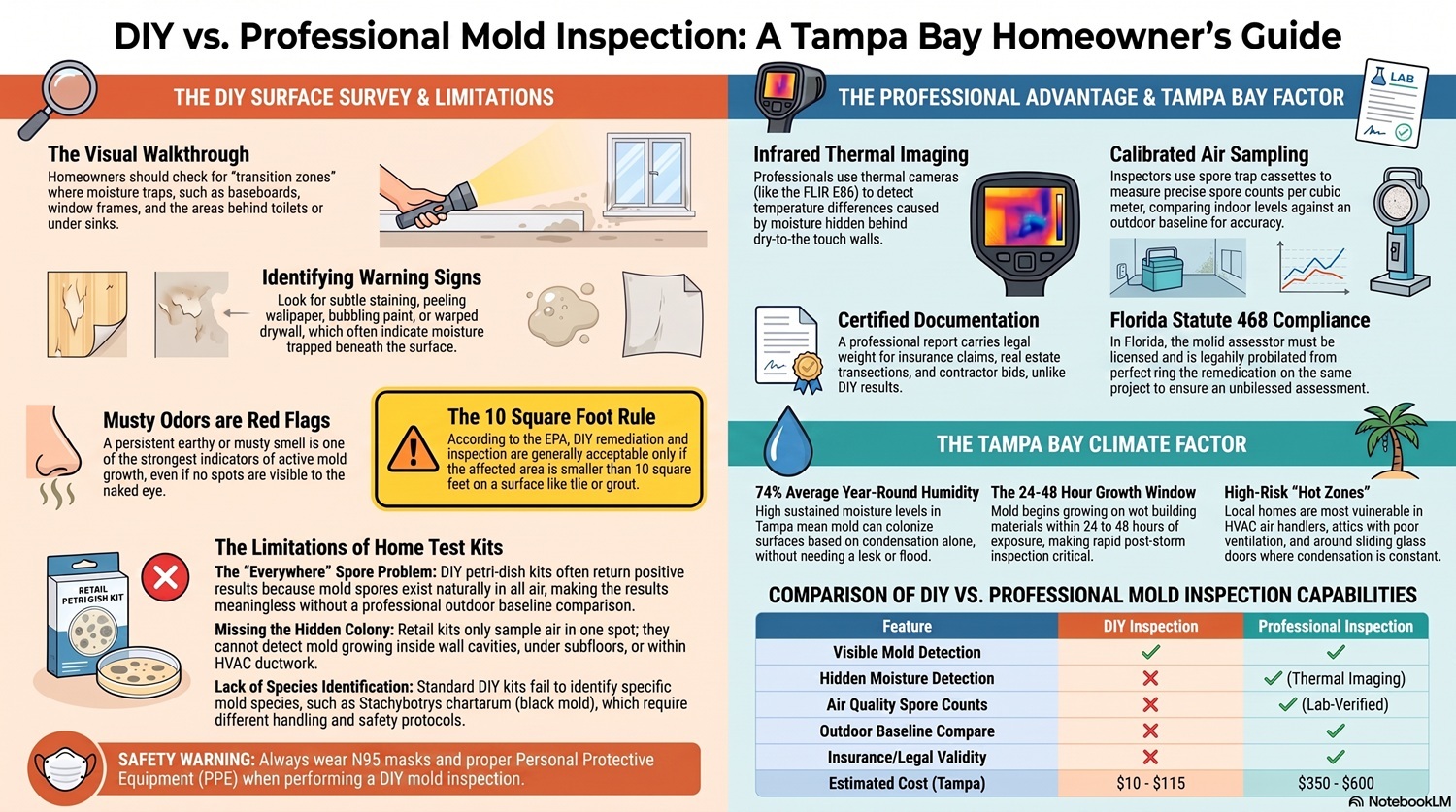
- You can do a basic mold inspection yourself, but DIY methods miss hidden mold behind walls, under floors, and in HVAC systems — where Tampa’s biggest mold problems actually live.
- Tampa Bay’s average humidity sits above 74% year-round, making it one of the highest-risk regions in the U.S. for residential mold growth.
- DIY mold test kits are widely available but have a critical flaw most homeowners don’t find out until it’s too late — more on that below.
- Professional inspectors use thermal imaging and air quality testing to find mold that no visual check or petri dish kit will ever detect.
- Tampa Bay Mold provides certified mold inspections that give homeowners the documentation and clarity needed to take real action.
Yes, you can do your own mold inspection in Tampa Bay — but whether you should is a completely different question.
Tampa’s heat and humidity create one of the most aggressive mold environments in the country. What looks like a small patch of discoloration near a window could be the surface sign of a colony spreading behind your drywall. Before you grab a flashlight and a $15 kit from Home Depot, it’s worth understanding exactly what a DIY inspection can and cannot tell you. TampaBayMold.net has been helping homeowners navigate exactly this decision, and the difference between catching mold early and missing it entirely often comes down to knowing the right places to look.
Yes, You Can — But Here’s What That Really Means
Doing your own mold inspection means conducting a visual walkthrough of your home, checking moisture-prone areas, and possibly using an over-the-counter mold test kit. It’s a legitimate starting point, especially if you’ve noticed a musty smell or visible discoloration and want to confirm your suspicions before spending money on a professional. However, the word “inspection” can be misleading here. What most homeowners actually perform is a surface-level survey, not a true inspection.
A real mold inspection involves identifying not just visible growth, but also the moisture sources feeding it, the types of mold present, and the air quality impact throughout the home. DIY methods address only the first part — and even then, only partially.
What a DIY Mold Inspection Actually Involves
When done correctly, a DIY mold inspection is more than just a quick look around. It’s a systematic walkthrough of your home using your senses and a few basic tools. Done right, it can absolutely help you catch early warning signs.
Visual Checks: What to Look For
Start with your eyes and your nose. Mold doesn’t always announce itself with a giant green patch — it often shows up as subtle staining, discoloration, or peeling paint. A persistent musty odor in a room, even without visible growth, is one of the strongest indicators that mold is actively growing somewhere nearby.
During your walkthrough, you’re looking for:
- Black, green, gray, or white spots on walls, ceilings, or grout lines
- Water stains or discoloration around windows, vents, and pipe access points
- Peeling wallpaper or bubbling paint, which signals moisture trapped underneath
- Warped baseboards or swollen drywall at floor level
- A persistent earthy or musty smell that doesn’t go away with ventilation
Pay close attention to areas where two materials meet — like where drywall meets the floor, or where caulk seals a bathtub. These transition zones are where moisture gets trapped and mold takes hold first.
Common Areas in Tampa Homes Where Mold Hides
In Tampa Bay, the areas that generate the most mold problems are predictable once you understand how humidity behaves inside a home. Warm, moist air constantly pushes into cooler spaces — and wherever that air condenses, mold follows.
Focus your inspection on these high-risk zones:
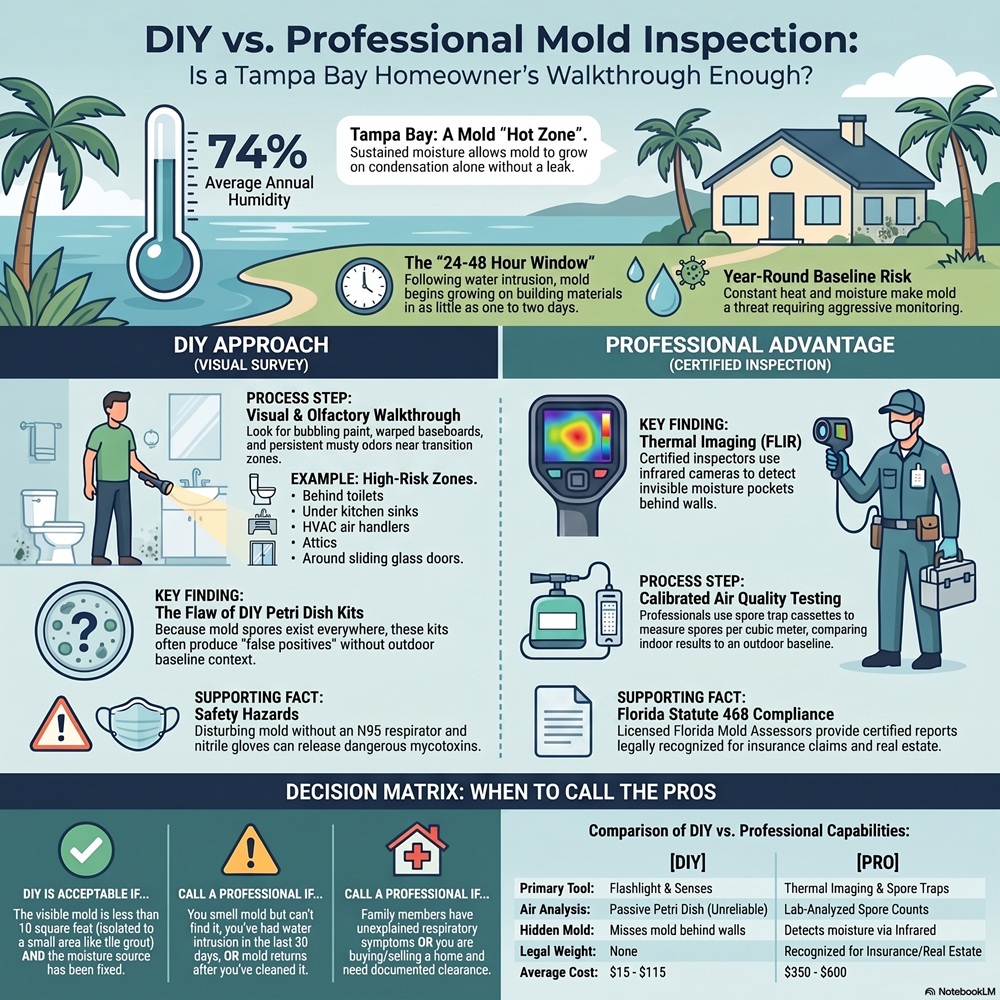
- Bathrooms — behind toilets, under sink cabinets, around the base of the shower
- Kitchens — under the sink, behind the refrigerator, around dishwasher connections
- HVAC air handlers — a common but frequently overlooked mold source in Florida homes
- Attics — poor ventilation combined with roof heat creates ideal mold conditions
- Garage walls and laundry areas — especially where exterior walls meet interior spaces
- Around windows and sliding glass doors — condensation buildup is nearly constant in summer
How DIY Mold Test Kits Work
The most common DIY mold test kit uses a petri dish pre-coated with a growth medium. You leave the dish open in the suspected area for 48 hours, seal it, and either observe the results yourself or mail it to a lab. Brands like the Pro-Lab Mold Test Kit (MO109) and Healthful Home 5-Minute Mold Test are common examples you’ll find at hardware stores or online.
The lab-based versions typically cost between $10 and $40 for the kit, with an additional $30 to $75 lab fee if you want professional analysis. Results come back identifying whether mold spores are present and, in some cases, the general mold category detected.
The Real Limitations of DIY Mold Inspection
Here’s where things get important. The tools available to homeowners are genuinely useful for raising a flag — but they were never designed to give you the full picture.
Why Test Kits Often Miss the Bigger Problem
The fundamental flaw with petri dish kits is that mold spores are everywhere — including in normal, healthy air. A positive result from a kit sitting open in your living room doesn’t tell you whether you have an active mold colony or simply a home with normal ambient spore levels. According to the Centers for Disease Control and Prevention (CDC), there are no established federal standards for acceptable indoor mold spore counts, which means a positive kit result has no reference point to be evaluated against without professional context.
Beyond that, these kits only sample the air in one location at one moment in time. They cannot:
- Identify the specific mold species present (some are far more dangerous than others)
- Determine the source or extent of the mold colony
- Test multiple rooms or compare indoor vs. outdoor spore levels
- Detect mold growing inside walls, under subfloors, or in ductwork
A negative result from a DIY kit can be dangerously misleading. If the mold is growing inside your wall cavity, those spores may not be reaching the dish at concentrations high enough to register — but they’re still circulating through your HVAC system every time the air runs.
Hidden Mold Is the Biggest Risk
The mold you can see is rarely the mold doing the most damage. In Tampa Bay homes, the most serious infestations tend to start in places no visual inspection ever reaches — inside air handler units, between floor joists, behind shower surrounds, and within wall cavities adjacent to plumbing. For more information on identifying these hidden threats, learn how to check for mold in your Tampa home.
By the time mold becomes visible on a wall surface, it has typically been growing on the interior side of that same wall for weeks or months. The EPA notes that mold can begin growing on wet building materials within 24 to 48 hours of water exposure. After a single plumbing leak or hurricane rain intrusion — both extremely common in Tampa — that clock starts immediately, whether you see it or not.
This is the core problem with relying entirely on a DIY inspection: you’re evaluating only the evidence mold has chosen to show you. For more details on how to check for mold in your home, visit this comprehensive guide.
Health Risks of Inspecting Without Proper Protection
Disturbing mold during a DIY inspection without proper protective gear is a real health risk — not a minor one. When you move insulation, pull back carpet, or poke around a damp wall cavity, you’re releasing mold spores directly into the air you’re breathing. For most mold species this causes irritation, but species like Stachybotrys chartarum (black mold) produce mycotoxins that can trigger serious respiratory responses, particularly in children, the elderly, and anyone with asthma or a compromised immune system.
At minimum, wear an N95 respirator mask, nitrile gloves, and eye protection before entering any area with suspected mold growth. Never inspect a heavily affected area without proper PPE, and avoid running your HVAC system while inspecting — it will pull disturbed spores throughout every room in the house.
Why Tampa Bay’s Climate Makes Mold Harder to Find
Tampa Bay isn’t just humid — it’s consistently, relentlessly humid in a way that changes how mold behaves inside homes. Average relative humidity in the Tampa Bay area sits above 74% year-round, with summer months regularly pushing 90% or higher during the afternoon. That sustained moisture level means mold doesn’t need a leak or a flood to get started. It can grow on condensation alone.
Most mold guides are written for climates where mold is a seasonal or event-driven problem — a flood, a roof leak, a burst pipe. In Tampa Bay, mold is a year-round baseline risk. The strategies and inspection frequency that work in drier states simply aren’t aggressive enough here. What counts as “normal” humidity in Minnesota would trigger active mold growth in a Tampa home.
This is the context that makes DIY mold inspection in Tampa Bay genuinely harder than it might be elsewhere. You’re not just looking for the aftermath of a single event — you’re monitoring a home that is under constant moisture pressure from every direction.
How Humidity Drives Mold Growth Year-Round
Mold requires four things to grow: a food source (which includes drywall, wood, and insulation), oxygen, the right temperature range, and moisture. In Tampa Bay, three of those four conditions are permanently present in virtually every home. The only variable homeowners can meaningfully control is moisture — and that requires more than cracking a window.
When indoor relative humidity rises above 60%, mold can begin colonizing surfaces even without any visible water source. ASHRAE Standard 55 recommends keeping indoor humidity below 60%, but many Tampa homes — particularly older ones without properly sized air conditioning systems — regularly exceed this threshold. An HVAC system that’s oversized will cool the air quickly without running long enough to dehumidify it, creating perfectly cool, damp conditions that feel comfortable but are actively feeding mold growth behind your walls.
Post-Hurricane and Storm Season Mold Risks
Tampa Bay sits in one of the most active hurricane corridors in the United States. Even storms that don’t make direct landfall as major hurricanes bring days of sustained rain, flooding, and wind-driven moisture intrusion that can saturate building materials in hours. After Hurricane Ian and Hurricane Idalia, mold remediation calls across the Tampa Bay region surged — many from homeowners who thought they had escaped serious damage.
The problem is timing. After a storm, most homeowners focus on visible structural damage — roof damage, broken windows, flooded floors. Mold remediation takes a back seat. But the EPA’s 24 to 48-hour window for mold growth on wet materials means that by the time a homeowner gets around to a DIY inspection a week after a storm, active colonies may already be well-established inside wall cavities and under subfloors.
Post-storm inspections require checking not just the obvious flood zones, but also areas where wind-driven rain may have entered through small gaps — around window frames, roof vents, soffit intersections, and exterior wall penetrations. These are subtle entry points that a surface-level DIY inspection frequently overlooks entirely.
What a Professional Mold Inspection Includes That DIY Doesn’t
A certified mold inspector brings tools, training, and methodology that simply aren’t available in a hardware store kit. The difference isn’t just precision — it’s the ability to find mold where it actually lives, not just where it’s visible. For more information on how to check for mold in your Tampa home, visit this detailed guide.
Air Quality Testing and Mold Spore Counts
Professional air quality testing uses spore trap cassettes and calibrated air pumps to pull a precise volume of air through a collection medium. The samples are then analyzed by an accredited laboratory under microscopy, producing a spore count measured in spores per cubic meter of air. Critically, professionals also collect an outdoor baseline sample at the same time, allowing them to compare indoor spore levels to the natural outdoor environment. This comparison is what transforms raw data into actionable information — a finding that indoor Cladosporium levels are three times higher than outdoor levels tells you something definitive. A petri dish sitting on your counter tells you almost nothing by comparison.
Thermal Imaging to Detect Moisture Behind Walls
Infrared thermal imaging cameras detect temperature differentials on wall and ceiling surfaces. Moisture causes evaporative cooling, which shows up as a distinctly cooler zone on a thermal image — even when the wall surface looks and feels completely dry to the touch. Professional inspectors use cameras like the FLIR E86 or similar-grade equipment to scan walls, ceilings, and floors in minutes, identifying hidden moisture pockets that would otherwise require destructive investigation to locate. In a Tampa Bay home after a storm or plumbing event, this tool alone can identify the true scope of a problem that a visual inspection would completely miss.
A Certified Report You Can Actually Use
One of the most practical advantages of a professional mold inspection is the documentation it produces. A certified inspection report from a licensed Florida mold assessor includes laboratory results, photo documentation, moisture readings, and specific remediation recommendations. This report carries legal and financial weight — it can be used in real estate transactions, insurance claims, and contractor bids in ways that a DIY kit result simply cannot.
Florida is one of the few states with specific licensing requirements for mold assessors and remediators under Florida Statute 468, Part XVI. Hiring a licensed assessor means you’re working with someone who is legally accountable for their findings — and whose report is recognized by insurance companies, real estate attorneys, and remediation contractors across the state.
When DIY Is Acceptable vs. When to Call a Professional
There are situations where a DIY inspection is a perfectly reasonable first step. If you’ve noticed a small area of visible mold — say, a patch smaller than 10 square feet on a bathroom tile or grout line — a visual inspection and surface cleaning may be all you need. The EPA’s mold remediation guidelines actually support homeowner self-remediation for isolated surface mold in this size range, provided the underlying moisture source has been fixed. A DIY approach also makes sense as a routine walkthrough habit — doing a seasonal check of your high-risk zones every few months is smart preventive maintenance for any Tampa Bay homeowner.
However, there are clear situations where calling a professional isn’t optional — it’s the only responsible move:
- You can smell mold but cannot find the source after a thorough visual search
- You’ve had a water intrusion event — flood, storm, roof leak, or burst pipe — in the last 30 days
- A family member is experiencing unexplained respiratory symptoms, headaches, or allergy flare-ups at home
- You’re buying or selling a home in Tampa Bay and need documented mold clearance
- Visible mold covers more than 10 square feet or appears in multiple rooms
- Mold keeps returning in the same area after you’ve cleaned it
- Your HVAC system has visible dust buildup, musty output air, or hasn’t been inspected in over a year
The honest answer is that for most Tampa Bay homeowners dealing with anything beyond a minor surface situation, a professional mold inspection will save money in the long run. Missing an active hidden colony for six months costs far more to remediate than catching it early with a $350 to $600 professional assessment.
A Professional Inspection Is Worth It for Tampa Homeowners
In a climate like Tampa Bay’s, mold isn’t a rare event — it’s a standing threat that every homeowner needs a real strategy for. A DIY inspection can help you stay alert and catch obvious warning signs, but it was never built to do the job that Tampa’s humidity demands. A certified professional inspection gives you verified data, thermal imaging coverage, laboratory-backed spore counts, and a report that actually means something when it matters most. For a home in one of the most mold-prone regions in the country, that’s not an upgrade — it’s the baseline.
Frequently Asked Questions
Here are answers to the most common questions Tampa Bay homeowners ask about DIY mold inspections and when professional help is the right call.
Are DIY Mold Test Kits Accurate Enough to Rely On?
DIY mold test kits can confirm the presence of mold spores in your air, but they cannot tell you what type of mold is present, where it’s coming from, or how serious the problem is. Without an outdoor baseline comparison, a positive result has no meaningful reference point.
The American Industrial Hygiene Association (AIHA) has raised concerns about the reliability of consumer petri dish kits, noting that because mold spores are naturally present in virtually all air, a positive result is essentially guaranteed in almost any home. That makes the result nearly impossible to interpret without professional context. They’re useful for raising a flag — not for closing the case.
How Much Does a Professional Mold Inspection Cost in Tampa Bay?
In the Tampa Bay area, a professional mold inspection from a licensed Florida mold assessor typically ranges from $350 to $600, depending on the size of the home, the number of air samples collected, and whether thermal imaging is included. Larger homes or inspections requiring multiple laboratory samples will fall toward the higher end of that range.
It’s worth noting that under Florida Statute 468, Part XVI, the company that performs your mold assessment cannot legally be the same company that performs the remediation unless the amount of visible mold is less than 10 sq ft or the remediation is performed 12 months after the assessment. This consumer protection law exists specifically to prevent inflated findings and ensures your assessment results are unbiased. Always verify that your inspector holds a current Florida Mold Assessor License (MRSA) before hiring.
Can I Get Sick From Inspecting Mold Myself?
Yes — especially if you disturb mold during your inspection without proper protective equipment. Physically moving materials in a mold-affected area releases a concentrated burst of spores into the air. At minimum, wear an N95 respirator, nitrile gloves, and safety glasses before entering any area with suspected or confirmed mold growth. People with asthma, allergies, or immune system conditions should not conduct mold inspections in affected areas under any circumstances.
How Long Does a Professional Mold Inspection Take?
For an average-sized Tampa Bay home — roughly 1,500 to 2,500 square feet — a thorough professional mold inspection typically takes between 1 to 3 hours on-site. This includes the visual walkthrough, moisture meter readings, thermal imaging scan, and air sample collection. Laboratory results from the collected air samples usually come back within 3 to 5 business days, after which your inspector will provide a written report with findings and remediation recommendations.
Larger homes, properties with multiple suspected problem areas, or post-storm inspections involving structural complexity can extend the process to a full day. Rush laboratory processing is available from most accredited labs for an additional fee if timing is critical — such as during a real estate transaction with a tight closing window.
Does Homeowners Insurance Cover Mold Inspections in Florida?
Florida homeowners insurance coverage for mold is notoriously limited. Most standard policies will cover mold damage only if it is a direct result of a covered peril — such as a burst pipe or sudden roof damage — and even then, coverage caps for mold remediation are common, often limited to $10,000 or less under standard policy terms.
Mold that results from long-term humidity, poor ventilation, or deferred maintenance is almost universally excluded. This is a critical distinction in Tampa Bay, where ambient humidity alone can drive mold growth without any single triggering event. If you believe your mold problem stems from a covered event like storm damage, document everything immediately — photos, dates, and professional inspection reports — before filing a claim.
Some insurers in Florida offer mold endorsements that expand coverage limits, but these are add-on policies and must be purchased proactively. Review your current policy’s mold language carefully, and if you’re uncertain, contact your insurer directly to ask specifically about mold assessment and remediation coverage limits under your plan.
If you’re ready to move beyond guesswork and get a clear picture of your home’s mold risk, TampaBayMold.net provides licensed mold inspections backed by licensed assessors and laboratory-grade air quality testing — exactly what Tampa Bay homes actually need. For more information on how to check for mold in your home, you can read this article on how to check for mold in your Tampa home.
2 Replies to “Can I Do My Own Mold Inspection In Tampa Bay?”
Comments are closed.